The realization of what culture is

So I readily admit that I was one of those people who originally signed up for GLI because it was easy to click ‘yes’ and because I got to travel from it. I know, I know, but really, what did I know at the time? I was 18, a little bit younger and more naive than I am now. It sounded cool and I got to learn about more cultures.

The thing about that was that I really didn’t understand the word ‘culture’. I went the first 18 years of my life without really understanding what culture is, at least from the perspective that this experience has taught me to (Disclaimer: this is my personal definition of culture and identity, not to be applied to culture as a whole. I’m an Anthropologist, I realize the nebulous-ness of this debate).

The problem stems from the fact that I was raised in the same house, with the same people, in the same neighborhood for my entire childhood. I thought that everyone ate dinner at the same time, everyone ate the same food, everyone had the same general values. At least in America. Eventually I learned this was not the case but it did not sink in. I did not have the opportunity to fully comprehend the differences between cultures until I was physically thrown out of my culture and into someone else’s.

Which was possibly the best experience I’ve ever had. Mark Twain said, “Travel is fatal to prejudice, bigotry, and narrow-mindedness, and many of our people need it sorely on these accounts. Broad, wholesome, charitable views of men and things cannot be acquired by vegetating in one little corner of the earth all one’s lifetime.” Truer words have never been written down. Admittedly political correctness acknowledges the rudeness of the quote, but the unbiased truth still stands. Learning and living in places where people’s world views are different, sometimes entirely so, from my own has forced me to see that culture is not just American – it is French, Italian, Japanese, Egyptian, and all the other nations of the world. Culture is distinct and wonderful wherever you go. People are different. Culture is a facet and a way to sum up those societal, political, and economic differences.

It was an important lesson to learn. It is also impossible to adequately describe another’s culture. I can’t even adequately describe my own and I’ve been living in it for twenty one years. Culture is internal as much as it is external. I hope to eventually be able to share my experiences in other cultures, but first I feel like I need to meditate and mentally dissect everything that I’ve experienced. I’m even mentally dissecting things right now. I’m still figuring things out as I go along, which is good because you never stop learning.

-Megan Nishida
We are now in the mountains and they are in us – John Muir

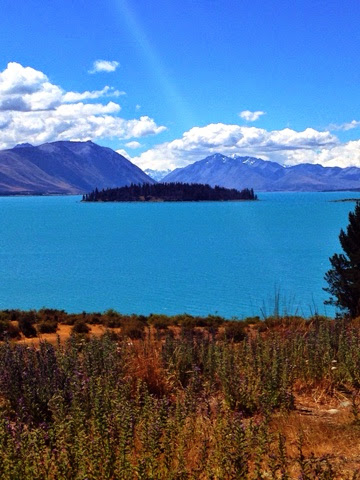
I don’t know how it’s possible but the days seem to get better and better as I make my way further down south. I scrambled through the city of Christchurch looking for my bus and finally a nice man on a walk took me the right way. The next stop was Tekapo where I was hoping see some mountains, that I already miss so much. When I arrived in Tekapo I was instantly overwhelmed by the bright blue lake and the glacier topped mountain in the far distance. It was absolutely stunning and the bluest lake I’d ever seen. I hung out in a coffee shop charging my phone for while and taking advantage of the free wifi, which is harder to come by.  My plan for Tekapo was to hike up to Macaulay Hut and stay there for a couple nights. After talking to the information desk I found out that it was another 40Km up to the trial head but I thought why not! 


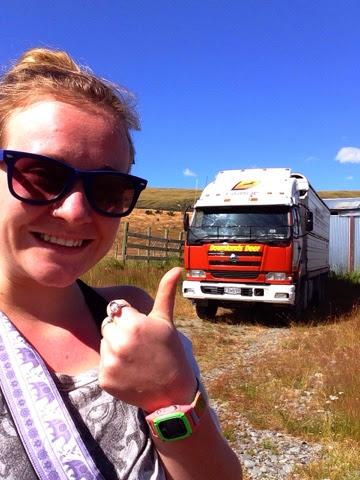
I started walking up the Lilybank road and soon found out that catching a ride wasn’t going to be so easy. The paved road soon turned into a dirt road and there were few cars that wouldn’t pay me any attention. After walking for an hour and a half while doubting my decision a semi truck turned the corner. I was a tad skeptical but at the last minute put my thumb up.  It’s actually been on my bucket list to ride in a semi and now I can cross that one off (sorry mom!). Alan was the driver and he was taking two crates of deer back to the farm at the end of the road which was right where I was headed. He was such a nice man and told me all about New Zealand animals which are all most all introduced like deer, tahr, cow, sheep and much more. You can hunt New Zealand without a permit because they thought of as a nuisance or a pest. However, it’s one of there biggest exports so it’s quite a mix up of how to manage it all. All this I learned in a quick ride with in a semi full of deer, I’d say what an experience! We dropped off the deer at a farm with a guy named Jonny.  I got to see the whole process and even see his two smart dogs herd the cow and deer into the right fenced off areas.


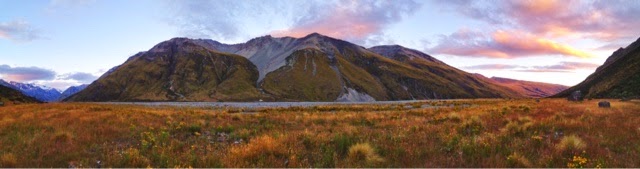
Jonny and his two adorable dogs took me part way to the Macaulay Hut. It was a lovely ride in to the valley that had towering mountains on either side.  Jonny showed me all the places he skies right in his backyard and told me all the places he’s skied around the world. I was quite jealous and long to ski around the world someday. He dropped me off in what’s called Boulder field as there are huge boulders laying everywhere. Apparently the boulders  didn’t roll down the mountains but were catapulted from an earthquake 50 some years ago. While in the valley I feared of getting smushed by a flying Boulder in earthquake but I surely lucked out. 

As I sat alone cooking dinner I was absolutely memorized by the unique beauty of the valley, as the mountains so vast and jagged towered over the river bed on each side.  You could see for miles where there used to lay a enormous glacier that now in the distance was so small. Across the river in the middle of a scree field there was a cascade of water coming from the middle of the mountain. The sound of the rushing water echoed up the valley along with the variety of birds singing into the everlasting sunset. 

The night sky was one of the prettiest I’ve ever seen with the silhouette of the tower mountains laying against the mist of the twinkling starts. Not a cloud dare disrupt the beauty along with the absence of city lights. More stars appeared as the night grew older and galaxies above became so clear. It was a whole new side of the universe I had never seen and I enjoyed every second of it. 

After sleeping in and being awakened by the hot sun I finished my hike to the hut. The hut could have been a house it was so big. It had 14 bunks and a huge kitchen area with a stove and running water. There was even a tub down from the hut that you could warm water with a fire and enjoy the nice view of the glacier mountains in the distance.

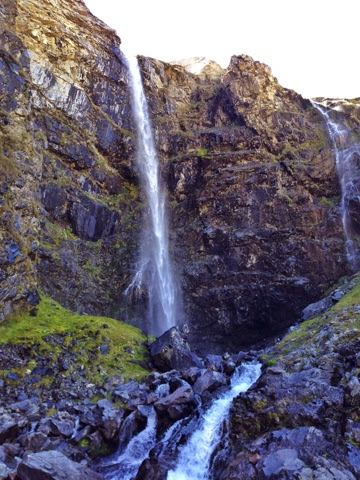
 After settling in I figured I go exploring while I had the chance.  There was a creek running right by the river and a waterfall I could see in the far distance.  I grabbed my bag and was off up the valley jumping from rock to rock following the river. I was surprised with not only one water fall but probably upwards ten. Each one unique and absolutely beautiful. I kept climbing up and soon found myself at an alpine glacier lake. Like Lake Tekapo it was bright blue and so clear that the floor seemed so much closer then it actually was. I decided I would take a swim to cool off and reward myself. I walked out further and further all the way up to my stomach. I stood there for a minute then counted to three out loud multiple times trying to motivate myself to dunk my whole body. I couldn’t bring myself to emerge in the freezing water and chickened out.

When I started hiking down the mountain I saw some tahr in the distance. The only other place in world you can tahr is the Himalayas. They are some what like mountain goats but a grey cooler and not as broad.  I continued walking and two kea landed on a rock ten feet in front of me. I instantly grabbed my camera and got closer to snap some pictures. They are the only alpine patriots in the world, and boy are they stunning and smart too.  They have a beautiful green outside coat but when they fly there wings are a mixture of orange, yellow, red, blue and green. After watching them for a while I carried on but one liked my presence and followed me down the mountain for quite some time. From meeting amazing locals, to hiking the river bed, to wondering the vast mountains and hanging out with kea birds. I gotta say this short trip up the Macaulay River was really a trip of a life time.

To live is to change.

“To live is to change, to acquire the words of a story, and that is the only celebration we mortals really know.”
– Barbara Kingsolver, The Poisonwood Bible

Why did I come here? How have I changed? What Is the story I will tell when I finally come home?

I came to Morocco because I had stopped growing. I was content in Missoula but I wasn’t becoming the person I knew I wanted to be. I had come to a standstill. When I told my mom I wanted to go to Africa she said “Michael why could’t it be France? Britain? New Zealand?” “Because this is what I need to do ma”. I wont say that I chose Morocco simply because it would be a challenge but it was a factor.

After 5 months I think I got exactly what I wanted. I lived, I changed, I gained an unlikely story. I know that I have changed. How I don’t know, I wont know until I see myself reflected in the perplexed eyes of the people I left behind. I know that my life has been altered. I have rediscovered my love for making music, I have learned to unleash courage and that I didn’t even know I had. I have found resilience in my darkest hours, I understand myself better and I cant go back. I am marked by this place, I am still investigating how.

When I return to Montana what will I tell them? That I was Lawrence of Arabia galloping through the desert on on a camel? That shopping malls look exactly the same everywhere you go? No, I will tell them “There were good days and bad, Morocco isn’t better, its not worse, its just like Montana, full of kind generous and welcoming people, breathtaking scenery and experiences that will change your life.”

At the close of my time in Morocco I want to send out some thanks…

To Paola: Thank you for the adventures, for the laughter and tears, you understood me from the start and saw who I was supposed to be, because of you I am closer to becoming him. For that and so much more thank you.

To Noah: Thank you for uncovering my love for music I abandoned it years ago. I will always treasure your spirt and our friendship.

To Nabil: Thank for your generosity, the translations, your laughter and smile. I couldn’t ask for a better example of hospitality, kindness, and understanding. To my moroccan sherpa and dear friend thank you.

To my new friends: Thank you for welcoming me into your lives it has been a great honor to get to know you. All of you have such bright futures I cannot wait to see what where you go next.

To my friends back home: Thank you for answering Facetime calls at 3am. “My love for you burns with the white hot intensity of a thousand suns.”

To my dear brother and sister: This is more an apology. I am sorry that I could not be there for you these last few months I have not been present as I should have I will see you both soon. Thank you both for supporting and encouraging me.

To Nathan: If I’ve learned something here its that it doesn’t matter if I’m watching the sunrise in the Sahara or going on a 3 am Walmart quest, what matters are the people you share it with. I am lucky to be your friend. I treasure our adventures. Thank you for being my friend.

To my mother and father: Thank you for teaching me to be strong for being an example and for letting me go (like you had a choice). Thank you for letting me make mistakes and then helping me up after. I am blessed to have you.

The adventure isn’t important its those you share it with even if its just yourself.

Safe travels thank you for hearing my story,
Michael Nelson

“Hope fades
Into the world of night
Through shadows falling
Out of memory and time
Don’t say: «We have come now to the end»
White shores are calling
You and I will meet again”
– Annie Lennox, Into the west

Harnessing the Chilean Wilderness

Aldridge Patagonia

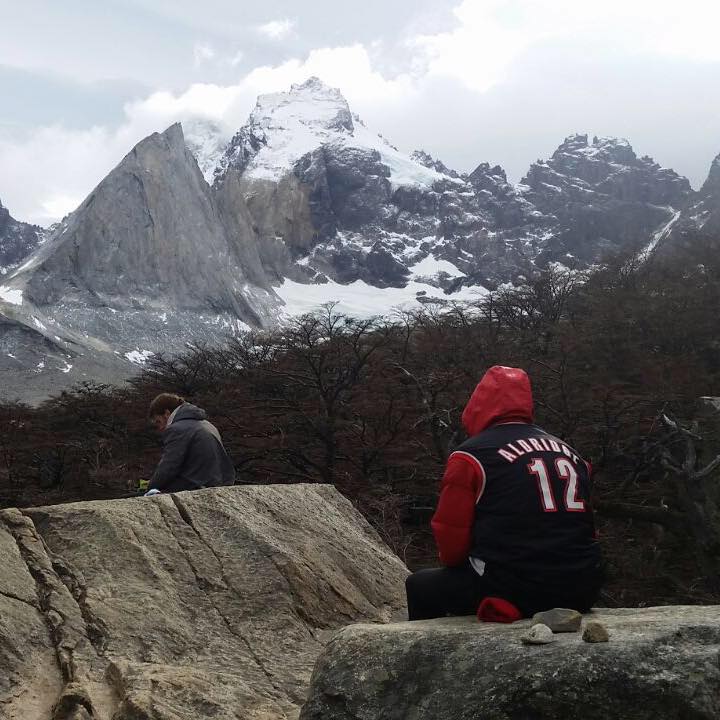
Few times in my life had I been more excited than when my peer from Germany asked me if I wanted to go backpacking for five days in Torres del Paine National Park. Going to school in Montana, the outdoors are part of the culture of the university. While during the semester it isn’t uncommon to have friends go away on a day hike or weekend camping trip, people who go to school in Missoula generally love the outdoors. Choosing to study abroad in Santiago, I was scared that nothing about my exchange would be outdoorsy. After two months of living in the hustle of a metropolis consumed by smog and volcanic ash, I was itching to escape to somewhere peaceful. Torres del Paine is located on the southern tip of Chile, commonly referred to as the “end of the world” because of the way the sky slopes downward and seemingly touches the ground. When I first arrived at the park, I was struck by how naturally beautiful it was. Never in my life had I seen such massive mountains covered in pristine glaciers surrounded by ancient old growth forest. Even though a few years back two Israeli’s accidentally started a forest fire that severely burned large portions of the park (and caused numerous warning signs in Hebrew to be put up everywhere we looked) it was as if the fire added to the mystery of the park. Walking along the trail felt like it was straight out of a classic horror movie, with the burned trees, the howling wind, and icy temperatures making the forest an astoundingly beautiful, yet “wicked” forest.

When we arrived to the park, there were just four of us. Stefan from Germany, Colomban from France, Nick from the USA, and myself. With all of us except for Colomban having prior backpacking experience, I felt that since the park was such a national staple, it couldn’t be too terribly hard of a trek. Boy was I mistaken. After the second day, we had walked a shade under 45 kilometers (28 miles). I woke up with horrible pain in both my legs that radiated all the way down to my feet. With no other option than to walk another 12 miles to the next campsite, I wasn’t sure I knew what I had gotten myself into. As I walked straight up hill to the first view point, I knew it was all worth it. Never before had I been struck by such natural beauty. At every view point I went to, I became more and more impressed with what Chile had to offer. By the end of the trip I had seen lakes, rivers, mountains, glaciers, and some of the most impressive wildlife I had ever come across. At every view point there were massive condors flying above us with 7 foot wing spans. At one point in the trail, we came across a wild puma lounging in a tree just off to the side. The nature in Torres del Paine was mesmerizing and lived up the the hype 100%.

The people we encountered on the trail were just as interesting. I’m not sure how it is in other countries, but there are so so so many french people in Chile. Having Colomban proved to be our ticket to figuring out every shortcut and trick on the trail due to the amount of french people that we crossed. We spent a lot of time on the trail with two frenchmen, Willy and Gerrard. Both in their thirties, they didn’t speak hardly any Spanish so I tried my best to pick up French, without much success. We also met three college friends from Poland, who were reuniting twenty years after graduation to spend some time together before they all went back to their respective careers. Finally, we spent time with a Chilean couple, one of which appeared to be completely European. Born and raised in Chile after her parents moved from Europe, she didn’t speak any English, much to the surprise of everyone who didn’t expect a small European woman to speak perfect Spanish with Chilean accent. All in all, the people we met were friendly, and it’s sad to think that we’ll never see each other ever again. It just goes to show how the outdoors can unite people from all walks of life, and how even though we don’t speak the same language, the love of nature can help us communicate in ways that we don’t see coming.

The things I lost

While traveling in Morocco I have lost 2 debit cards, $90, a wallet, a drivers license, an iPhone 4, a student ID, a passport and all but a shred of dignity. Wether these things were stolen or lost they are gone. At first glance this list is substantial, and when compiled I felt like I should have just been sent home and put out of my misery.

I spent a while feeling this way. Each time I lost something I would promise myself It was the last time. And when it eventually occurred again I would only affirm this great fear that I didn’t deserve to be here. It was in a bus station in Agadir when I lost my wallet, student ID and $90 that I truly wanted to go home. I was embarrassed and tired. Ashamed that I could be so stupid to continue to lose my valuables, I was not just penniless for the rest of spring break I was blue too.

Of course I was fine. My friends were champions and all helped me get through the rest of the week. And most astonishingly my wallet was found and posted to a lost and found board online and was returned to me (without the cash (gotta pay that $90 idiot tax sometime)). But something had changed in me. A month later when I lost my phone in the back of a taxi I spent 1 hour distraught and angry at myself. I then calmly accepted the fact that I no longer had a phone and made a list of reasons why I needed it, and the answer was I didn’t really.

These are things, some of them are important others are not. Some things you can afford to lose others you cannot. But trust me as an expert on the subject when I say there is always a solution (unless you break the law and become the next episode of locked up abroad). I lost all my Identification including my passport in the Charles De Gaulle Airport and look at this incredible journey I’ve been on.

If you really want to hold on to your belongings get a body wallet that can be hung around your neck or strapped to your body underneath your clothes. Keep your passport and documents in there. Only keep a small amount of money in your wallet (I only keep $20 or so). Travel light! Only take what is absolutely necessary the less you take the less you have to lose. Have a routine, this can be hard when you are on the road but even just doing a check every time you are about to leave a location and every time you arrive is good. Have a designated place for your items. If you loose everything (like I did) take a moment and think what are your assets and what has to be done. Don’t stress, don’t beat yourself up you aren’t solving any problems that way. There is a solution, you are smart, you are here for a reason and you will get through it.

What was most comforting to me when I had lost everything was the list of things that I had gained while I was in Morocco. In this beautiful place I have gained a tan, and a beard, I am in the best shape of my life, I have improved my french and arabic, I have learned to dance salsa, I have learned to play the ukulele, I have gained incredible friendships, tasted delicious food, I have watched the stars in the sahara, and I’ve found myself.

I have paid a fair price. I am stronger for my trials. I have learned how to hold to the things that are important (the hard way) and to let go of the things that are not.

Safe travels
Michael Nelson

Lessons from Ruins and Silences

IMG_1562

Our second day in the backcountry was our first day hiking in the bottom of Horseshoe Canyon. Within the first hour of our trek, Ben stopped in his tracks and stooped to grab something half buried in the sand. Amid a mosaic of stones and pebbles, the shiny red glint of a small specimen had caught his eye. It was a flat triangular thing, maybe an inch from base to tip, and it had clearly not achieved this form through the forces of nature. All eight of us crowded around for a show and tell that would spark a whole new topic of intrigue in canyon country. “It’s the tip of an arrowhead! Ancient people made them out of chert,” Ben informed us. He pointed to the once razor sharp edges and drew our attention to scalloped ridges indicative of human handiwork. We passed the artifact around and each took a turn imagining the prehistoric person who had created it. At this point, we realized that frequently scanning the ground was just as important as gaping at the immense beauty of the canyon surrounding us.
During this first section of our course, we read Singing Stone by Tom Flieschner. At the end of this book, he asks, “How do we live here? How should we live here?” in reference to the high deserts of the Colorado Plateau. Initially, I thought that maybe we shouldn’t live here. Maybe the delicate soils of the desert can’t tolerate our impacts. Perhaps the water sources in this region are too scant to support any sort of human population. But people lived here before. They lived here for thousands of years! The Colorado Plateau harbors a great deal of evidence supporting the notion that the Ancient Puebloans and the Freemont people utilized an intimate knowledge of the land to support their civilizations.
Our next encounter with the area’s past inhabitants occurred on the fifth day of our journey down Horseshoe Canyon. We entered an area that has been incorporated as a satellite unit of Canyonlands National Park. Not long after passing into this new territory, we came across a large alcove. The walls of this sandstone overhang were covered with dark red paintings of long-bodied humanoid shapes with short little limbs. Some had horns, some held spear-like objects, but my favorites were those that had intricate patterns of zig-zags and animal figures covering the interior of their bodies. One that caught my attention in particular had two goats on either side of its chest.
There is no way of knowing what message, if any, the artists of these pictographs were trying to convey, but it is always fun to speculate. Perhaps the goat-covered man was symbolic of the connection people had to goats as a source of food. There was another image that was a horizontal oval with small vertical hash marks attached to its bottom side. They then continued down the wall for about a foot. I supposed that it was a rain cloud , and that this panel praised the rainwater necessary for the crops these people grew. Maybe the intention of these painting was to tell the tales of how to live within the means supplied by this landscape.
On the fourth morning of our trip along the Dirty Devil River, we had class in No Man’s Canyon. As we wrapped up our session for the day, Katie pointed out a rather large alcove in the canyon wall. The eight of us wandered over to check out a pile of strategically placed flat rocks held together by some sort of cement, the remnants of an ancient structure.
The alcove was high above us and we were unable to scramble up to it, so we were unable confirm its purpose, but it was likely a dwelling or a place for storing food. At the foot of this aged structure, we spent some time thinking about what life was like for these people. I reflected on how they might have interacted within their families and within their communities. I imagined a father taking his son for a walk to find perfect pieces of chert for making tools. He would spend hours teaching his child the tedious process of chipping away tiny pieces of the red stones in just the right way. During one instructional session, a neighbor may have come over to ask the father for help with building a new grainery, as the corn he had planted was doing very well that year. I imagined that these people were close to the land, their livelihood depended on it, so they taught each other to be very intentional, to take great care in the things they did.
A couple days later, we were hiking up Larry Canyon. We followed a creek bed, the sides of which were eight-foot high vertical walls of dirt. Horizontal lines of sand, decomposed organic matter, and pebbles told us the history of the movement of sediment and water through the canyon. Amid the layers of strata, we saw a bubble of charcoal and ash. We were lucky enough to have stumbled upon a prehistoric fire ring! I approached the dark oval, which was set about a foot below eye level. The top of the terrace it was embedded in was several feet above my head. It takes a very long time for an inch of new soil to form in this dry climate, so the layers of sand and pebbles I looked up at served as a perfect visual for the 800 years that have passed since this fire ring was used.
The desert is a place where I have experienced profound silence, unlike that I have known anywhere else. There are times when no breeze rustles through the trees, no flowing water babbels, and no creatures chitter. Have these moments always existed here? Has this landscape changed in the last 800 years? How will the things we leave behind affect the landscape 800 years in the future? I like to think that the ancient people of this region did have these silences, and used them as a reminder that life-giving resources are not in abundance, but rather, can be carefully reaped to support civilization. I like to think that we can contemplate the lessons of the past and interpret these silences in the same way.

Rain Forest Shenanigans

I had the incredible opportunity to travel with the university to Bosawás, a national reserve that takes up a large part of northern Nicaragua. The reserve mostly consists of rainforest. It is home to tons of plants and trees. While we trekked, our guides pointed out bamboo (that grows at a rate of 1 meter every day!), pine trees (in a tropical rainforest?!), maple trees, and trees from prehistoric times (we’re talking dinosaurs). And those were just a few of the hundreds, thousands, maybe millions of varieties that grow in the reserve. Suffice it to say that it was green everywhere and always interesting. Bosawás also has crazy cool animal life – jaguars, sloths, birds, snakes, frogs, bugs (large ones), and plenty more. Unfortunately, we didn’t spot any jaguars or sloths. I’d imagine it would be an incredible site for wildlife biology research.

While we were in this world of LIFE in so many forms, we stayed at an educational center that had a few small houses and rooms for guests. It was so tranquil and lovely! There was a short path that led to a waterfall. We learned about some of the environmental problems in Nicaragua, such as the water shortage in some cities. We also learned about the bees that they raise at the center and tried some of the pure nectar which has a crazy flavor – it’s bitter, tangy, sweet, sour, kind of everything!

Each morning, I woke up to the sound of rain. It felt great to stay under a blanket and listen 🙂 Then we ate an incredible breakfast – beans with lime and chili flavor, fresh fruit, coffee from the nearby farms, freshly baked bread (I think I ate 5 pieces), pancakes with their own honey, and granola. What a way to start the day! Then we went on hikes. On the first day we took a fairly short hike to a waterfall. Along the way we stopped often to learn about the plants and such. The waterfall was gorgeous. It fell quite a distance onto a rocky area and formed a pool that trickled into the rainforest. We adventured along the rocks underneath the falls, swam across the small pool, and got to a high rock where there was a great view of the rainforest and the hills in the distance. We were all wearing our hiking clothes and rainboots that the center had provided, so we got completely soaked. We stayed cool on the hike back! We were welcomed back by a lunch that did not disappoint. I stuffed my belly with fresh juices, the best gallo pinto I’ve had yet, handmade tortillas, juicy chicken, and tons of flavorful veggies. Naturally, we all napped after lunch, explored a bit more around the center, then had an equally impressive dinner. That night, we took a quick hike to a clear spot and stargazed. The skies were clear and absolutely sparkling.

On the second day, we took a more intense hike. This time, we summited the mountain and arrived at the top of the waterfall! The path got pretty steep and they’d constructed ladders for us to scurry up at points. Between the intensity of the hike and the humidity, I was literally dripping with sweat by the time we got to the top. Fortunately, there was a natural swimming hole which cooled us right off 🙂

Bosawás was amazing. I got to see a type of environment I’ve never seen before and be blown away by the diversity of creation. God is quite the artist. 🙂 Swimming under the waterfall and hiking through the rainforest will definitely be some of my fondest memories of Nicaragua.

Living in Germany for a year, or taking a vacation for a year… where’s the line?

This week marks the first week of the Summer semester in Braunschweig (Brunswick, Germany). This means I’m actually more than half way done with my study abroad. I have learned so much, and hope to learn more in the coming months.

Because this past week was the first of the semester, I now reflect on my semester break. While quite a few of my friends and acquaintances traveled home for extended periods of time, I have mostly stayed in Braunschweig during this period. Sure, I took the train and explored for a weekend, and have taken a few day trips, but I still could have travelled more— After all, I had 6 weeks off. So, besides financial reasons, why did I not travel more in this free-time?

Well, I came to Germany to live in Braunschweig. I did not come to Germany to live on the rails. I firmly believe its better to go “a mile deep and an inch wide,” rather than “a mile wide and an inch deep.”

In our current age of Wikipedia, I can simply look up things about cities and buildings. Pictures are everywhere. Naturally, looking online is not as breathtaking as actually going and seeing these things. In all truth, though- I’m tired of looking at old buildings.

The things you can’t get on Wikipedia, is the culture. You can’t talk with Wikipedia. You can’t eat the food pictured on Wikipedia. You can’t experience the other persons point of view, as explained on Wikipedia. You can’t make cross-cultural friendships on Wikipedia.

Each of these things you don’t get on a vacation (Well, maybe the food, but even then, as food is seasonal).

I came to Braunschweig to live here. To make friendships, drink great beer (it is Germany, after all), to live as a German. To be in their shoes.

Once one lives in a city, one starts to understand the deeper intentions, the deeper history. Not just facts about old buildings, but rather why. Why were the buildings built, and why are they still maintained? Why is our castle also a shopping mall? These “Whys” are not simply the physical utilitarian purpose of the buildings at one certain time, but the cultural attitude toward them and their existence. One starts to look less at the building, and the culture defining it, and the people behind the culture.

People. That’s what’s missing on Wikipedia.

So vacation? Well, it’s nice for a week. But me? I would rather live somewhere. Not watch the people, but be apart of the crowd.

This is my “Goal” in Braunschweig. And everyday I think “I can’t believe this is actually happening”

When In Africa (Get your Anthropological Hat On!)

As the only anthropology major on the trip it seemed like I may have been dealt a great hand with going on an anthropological trip to Tanzania. We were allotted many experiences that normally would only be designated to professional anthropologist. I am forever grateful for these experiences. Granted some aspects that were ‘anthropological’ were more touristy, such as our meeting with the Massai compared to our meeting with the Hazabe.

The Massai seem to have this sort of meet and greet with tourist groups often. They were all very respectful and nice, answered as many questions as I could come up with, but the entire experience felt rushed and like we were being siphoned for money. Before we showed up the Massai already had the entire visit structured from one activity to another.  The head of the village partnered each student up with a ‘guide’ that didn’t seem concerned with making personal relations, but rather to get you through their set up, and help us shop for trinkets their mothers and other women in their village made. I learned some things while being there, like what the inside of one of their huts looks like, and the type of food they eat but still some experiences were more educational and anthropological than others.

One of my favorite experiences was meeting the Hadzabe people which are one of the last nomadic hunter/gatherer groups on Earth. When we showed up to the location that our one day guide brought us to, bright and early in the morning, two other groups were in the midst of their visit with them. Eventually, they left, and the people that entertained the last group was resting and getting ready to ‘welcome’ us. Welcoming us basically involved them acknowledging our guide. Walking among their grass huts that they only make for part of the year, I got the sense from the people’s lack of caring that we were there that they may get visited by many different groups during all times of the year. Heck one of these hunter/gatherers may of meet more people from different places in the world than I have. I take pictures of these people and where they live, and they seem to look right through me. One woman speaks to another, and their language, a Khoisan language that has distinct clicking sounds, is one of the strangest but most familiar sounding language I think I have ever heard. It seems to be a language that would come more naturally than our English disaster. Our group went on a ‘small’ hunting trip with three of their men, which is kind of like speed walking as quietly as you can and as fast as you can. The village’s dogs stuck at the heels of the hunters, hoping to pick up one of the birds that the hunters manage to get. It was astonishing seeing them pull back their hand-made bows with hand-made arrows, shoot it 20-30 feet through the air and hitting a target smaller than a BlueJay or Robin back home. All in all the hunters of the hour got four small birds; a nice little snack. While we were there our professor gifted them with tobacco, which the entire village smokes daily along with marijuana. They were highly appreciative of this gift, but in the end said that it will probably only last them a day or two for their entire village of 60 people. We also got a more rare of experience of seeing the Hadzabe sing and dance one of their traditional songs, the lyrics pertaining to going out for a hunt to see what they can get. Of the people that we met my favorite, or the one I seemed to develop the best relationship with at the time, was the most excitable gentleman there, who was was probably in his mid twenties to early thirties. He enthusiastically showed me his grass hut which was very large compared to the others. He also helped me navigate to the rovers and back to the little village center, where the rest of my group was purchasing jewelry and other products the Hadzabe make to sell to their frequent visitors. He also posed with me for pictures, and led the group during the song and dance we witnessed. Though we didn’t spend more than five hours with them, I feel like my understanding of humanity was definitely deepened after that meeting.

Overall I met many different people while in Tanzania, many will be in my memory forever, some I hope to visit again sometime in the future, and forever will I crave more Anthropological experiences that Tanzania has to offer.

When In Africa (Go on Safari or Adventure!)

On our anthropological trip in Tanzania its kind of hard to miss the millions of wild animals that inhabit the country. So you go on Safari to see all those animals, Safari also means to go on a journey or adventure. Especially when you go through multiple National Parks, including the Serengeti, Tarangire, Ngorongoro Crater, and Lake Manyara.

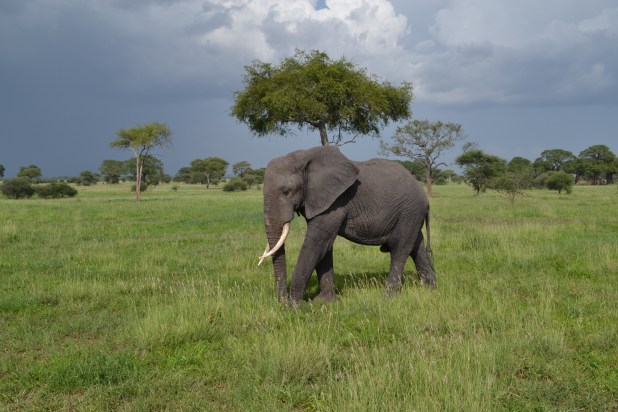
Seeing your first elephant in the wild is absolutely ..well.. wild! Seeing this massive and brilliant creature exist in its natural habitat before you own very eyes is awe inspiring, it blows you away farther than than I would of ever dreamt possible. But then you see a giraffe not even 30 yards away and the same feeling washes over you again! Can you be any more awe struck? Then you see a lion, then a lion nursing two baby cubs, and then two lions mating! What?!? Ok maybe it didn’t happen that fast, but depending on which park you visit the animals are all together and are everywhere. And we were told that our seeing all of the animals and the activities they were engaged in was highly unusual.  Going there I had no expectations on which animals I was going to see and I was not expecting to see all that we did. We did end up seeing the extremely endangered Rhino while at Ngorongoro Crater, where we also witnessed the lions mating and the mommy lion nursing her couple cubs. But this Crater has a plethora of wild animals, with millions of zebra, wildebeest, antelope, cape buffalo, birds, hippos, and much, much more.

Our group also somehow ended up in the midst of the great migration, with even more wildebeest, zebra, and antelope, which was amazing! Seeing millions of bodies all moving in the same direction with a common purpose was extraordinary. Nature really does know how to throw you curve balls in life that makes you to take a step back and reevaluate your purpose and experience in life. And I think thats one of the biggest things I took away from this experience was finally understanding where my priorities lay in life, and what I actually want to pursue in my daily existence.

Going on safari and seeing the way of the world in a way that I never experienced in my many trips to Yellowstone National Park is a very special experience for me. It really is the circle of life that they sing about on The Lion King. I hope everyone will get this sense of where they stand in this world like I did, with my mutual appreciation of being an animal damned to existence on the planet Earth and just making the best of it. Living life and going on safari.