Arusha at First Glance

My first week in Arusha, Tanzania was a blur. Zooming cars, screaming citizens, a foreign language, completely losing myself within the city and the culture. It was chaos, crazy but thrilling and absolutely wonderful. The city of Arusha is far larger than I expected and is relatively diverse, filled with people of all classes, religion and color. There are some individuals that are welcoming and eager to question and there are some that prefer to observe you from afar. Overall it is a bustling city that is full of life.

I arrived in Tanzania on a Sunday morning after approximately fifty hours of traveling; it was warm, humid and beautiful. I was exhausted but this didn’t cease me from taking in the beautiful green wilderness around me, trees, flowers, grasses and blue skies. After making it through customs, attaining a visa and my baggage and reporting the missing baggage that had somehow lost its way among the several airports I walked outside to find Christopher, my guide and driver that would take me to the volunteer house.

From the airport, heading into Arusha, there was an evident change. The site from the window started as vast brown and green farmland with children roaming along the side of the roads herding goats and cattle, houses were few and far between, mostly constructed of dirt and sticks, others with concrete. Getting closer to the city houses became more frequent and the number of people increased. The roads were incredibly bumpy and the traffic was horrific at first. Eventually I grew used to the constant swerving and honking, the passing of other cars regardless of oncoming traffic and the occasional pedestrian standing in the middle of the street among the traffic.

Arriving at the house, I met fellow volunteers that were from Denmark, Georgia, Greece, France and Spain, all of which were volunteering within some program throughout the city; some were volunteering with the farming community, some orphanages, schools and some were fellow medical volunteers. They told me of their own studies and experiences.

The next day I participated in an orientation and was shown around to a lot of necessary locations throughout the city such as a bank, a grocery store, the market and the hospitals. After the first day, our group walked to the hospitals together. We met the doctors and nurses that we would be working with and began following them. Throughout the next few days we learned the procedures and protocol of the hospitals.

Our mode of transportation in Arusha was our feet. Walking several miles a day allowed us to see more and more of the city we were in. It also allowed us to experience more of the culture. The streets were always crowded with both people and vehicles. It was loud and chaotic. Crossing the street was nearly impossible. Cars were always driving quickly, ignoring the few traffic signs and passing other vehicles at any time. The sidewalks were filled with children walking to school, the homeless with their belongings, women selling corn and peanuts and others walking to and from stores or the hospitals at which we volunteered.

The hospitals we volunteered at were far different from those of the states. Sanitation was extremely lacking compared to the US standards and there was less supplies to work with. Considering the conditions, the nurses and physicians did do a great job with what they were given. Sanitation was something that we tried to address within our group, showing the faculty the few things that we saw they could improve with the supplies that they had. The faculty were very accepting and taught anything that related to the patients and conditions that we observed and aided with. There were many conditions and situations that were difficult to comprehend and accept but I will dive into those in my next blog.

Upon my return…

Returning home to Michigan after spending my first time abroad in a place like Argentina was definitely bittersweet.  Argentina has taught me so much about myself, education, and life itself.  It is hard to explain what specifically changes you when you travel and it can be hard to pinpoint that moment as well.  Studying abroad and learning a language and culture by being immersed is the best way to fully understand everything you attempt to understand in a classroom setting.

I was lucky enough to work on my minor in Spanish as well as complete my study abroad as a part of GLI.  Argentina has not only given my insight on Latin American culture, but it has also shown me the significance of where I’m from and what it truly means to be American.  I’m forever more appreciative of the opportunity that America gives students my age and how our freedom is truly a gift.

Even though I was in Argentina, I spent some time in Uruguay and did some traveling as well.  I made a friend from Scotland, Holland, France, and made some friends in Uruguay as well.  As never having traveled to Europe either, learning about other countries thousands of miles away by meeting up with new friends across the world was a whole other experience.  We were able to talk about politics, education, laws, rights, and of course, what we all consider the basic normalities between countries.  It was amazing to me to feel as though I know so much about this large world of ours by meeting a few people in just a miniscule part of it.

As my global theme and topic is discrimination of indigenous cultures, it was also a topic I had brought up within the meetings of new friends.  We would have dinner conversations or rooftop discussions about differences within culture of their countries in comparison with the United States or Argentina.  They all helped me really put into perspective how native people, no matter the country, influence the culture and lifestyle of that country.  I’m grateful for the opportunity Argentina has given me and I’m beyond blessed to have made friends all over the world.

Being back in the United States, I’ve had plenty of time to think about the next steps in my theme as part of the GLI Program.  My topic has led me to many different areas of thinking and processing the questions of social inequality and the issue of discrimination of indigenous cultures.  I have raised some questions for myself of where to take me next steps and in what direction:

  • Is the discrimination of other countries influence in a culture considered indigenous if the inhabitants have moved by immigration?
  • What defines an indigenous group?
  • Does gender have an influence in this issue? (If so, how large of an influence?)
  • What conclusions have I made on the issue based on my time spent in Argentina? Is there a resolution I propose that could help dissolve the idea of discrimination within Argentine or within the United States?

el subjuntivo

Among the most important knowledge I have built during my studies in Chile is that of Spanish grammar. As a native English speaker hoping to teach Spanish, my understanding of grammar is of utmost importance. That’s where the real work of teaching or learning a second language is—vocabulary can be memorized, but grammar has to be understood.

One aspect of Spanish grammar that has challenged me as long as I’ve studied the language is the subjunctive mood. It’s not something often discussed outside of language classrooms, because it’s difficult to express exactly what it is or why it’s a necessary part of some sentences. Even Spanish speakers who use it regularly are often at a loss if asked to explain it; they rely on their implicit (unconscious) knowledge of their native language.

English also has a subjunctive mood, but it’s not common. We see it in this sentence: “The company requires that you be first-aid certified.” Notice how the second verb (the one in the subordinate clause) has changed its form. It would be ungrammatical in many other contexts to say “you be first-aid certified,” at least in most English dialects.

So in certain sentences with subordinate clauses, the verb in the subordinate clause takes a different form. This is the subjunctive. Contrary to what some students and teachers of Spanish may tell you, the subjunctive is not a verbal tense, but a verbal mood. It’s a different property independent of tense. The mood used in the majority of Spanish sentences, and virtually all those in English, is the indicative mood. In English the subjunctive form is just the verb’s infinitive. Spanish, in contrast, has a whole different set of subjunctive conjugations to be learned.

For my fellow students/potential teachers of Spanish, I assure you there is hope. My understanding of this challenging aspect of Spanish grammar really clicked after we discussed it in my grammar class. I began to notice it more in spoken Spanish, and now I actually feel fairly confident using it (and much more aware of which sentences require it). In addition to this encouragement, I offer these resources, which I have helped me in my study of the subjunctive and Spanish in general:

  • WordReference is my favorite online Spanish-English dictionary. Among its many useful features is a verb conjugator that gives all the forms of a verb, including the subjunctive of every tense. It’s available on the website, as a free app (for iOS or Android), and as a browser extension (for Chrome or Firefox).
  • Verbix is another useful conjugation tool. It can conjugate English verbs, one of the few things WordReference won’t do.
  • Linguee is a different dictionary website. It doesn’t conjugate verbs, but it lets you see words in context, giving examples in official documents that have been translated into both languages.
  • This song, which my professor played for our class, has many examples of the subjunctive in Spanish being used with the expression “Ojalá.” (Listen in better quality on Spotify.)

¡Espero que puedas entender el subjuntivo!

Umeshiba?

“Umeshiba?” I ask little George, in Swahili. (“Are you full?”)

He looks up at me lazily. He is mentally disabled, and he cannot feed himself. His bib has some food on it, but not too much. Some of the children I fed smiled. Others stare blankly. But  after each feeding session, the bowl is demolished, the spoon licked clean.

“Umeshiba?” I ask again, tickling his protruding bellies.

Sometimes that’s the best question you can ask a child in Kenya.

Earlier we went to Mother Theresa’s Home in Huruma (a slum in Nairobi). My director told us to “look for Jesus” in the people we interact with. I saw Jesus in the eyes of Marine and Christine and Moses and little Georgiana. I saw Jesus in the workers and the Sister nuns who devote their lives to this ministry of taking care of the “least of these.” I saw Jesus in Hailey, who made the children balloon hats; and Kelsey, who cuddled the smallest child, who could barely sit up in her crib. I saw Jesus in Jennifer, who began dancing and singing, doing her best to cheer up even the most non-responsive child sitting drowsily in her chair. I saw Jesus in their tiny fingers and smiles and in each kiss on the head. My director said that the human spirit transcends the cerebral cortex, and I couldn’t have put in a better way. Even the simplest reaction communicates that there is someone there, a human spirit, inside. These kids, although limited in many ways, still can experience love, compassion and provision, even if they do not respond in the cosignatory way we expect.

I don’t mean to sound romantic about it. After all, they are orphans. They are helpless. Some have literally been thrown away in trash sacks, are found by police, and handed over to the Sisters. These are what the Bible calls the “least of these.” But it’s not God’s fault. We must realize that we humans do this to one another. As Mother Theresa said, “God does not create poverty. It was created by you and I because we don’t share.”

And just a personal note, orphanages are close to my heart, because I was abandoned as a newborn. I lived in an orphanage, tied to a high chair, until my adoptive family welcomed me into their new family and into a new life. I don’t pretend to understand what these kids have gone through, but I see the redemptive element to their story.

Even though there is brokenness and sorrow in their stories, there is sacrificial light that shines brighter. From my perspective, these children see the best of humanity. They have been shown great injustice in this world. But they also have been shown great mercy and grace by the individuals who take care of them, the individuals who do “small things with great love for God.”

Behind the walls of Mother Theresa, they experience a good quality of life, one that their senses can enjoy. They enjoy tickles. They enjoy their names being called. They love bubbles. They have simple books and learning materials. The children at the Mother Theresa’s home in Haruma are able to achieve their fullest potential, which is more than many of the children running around the slum of Haruma can ask for.

This work of feeding disabled children, laundering piles of sheets, providing 24-hr medical treatment for mentally disabled children and women is not glamorous work, but it is beautiful work. The love they experience isn’t fuzzy. Most are tied to chairs so they can’t hurt themselves. Some have to be force fed so they have enough nutrition in their little bodies. The workers don’t have the time to be constantly swatting the flies away from their tiny eyes and mouths. The love isn’t fuzzy, but it’s raw, and it’s real, and that’s what makes it beautiful to me.

Lessons that I’ve learned at Mother Theresa’s? Do a thankless job, out of love, not for affirmation. Devote time and energy consistently, and commit to those that you vow to help. I’m not sure yet in which capacity that I will help the “least of these,” but I long to find my “Calcutta”–the place of ministry that is dear to my heart and that I am passionate about; a place that even if it’s hard, it feels like it’s home–like Mother Theresa did long ago. The Mother Theresa children’s home is a little piece of heaven among all the chaos of the slum suffering; it extends compassion to those who are hurting. Maybe this sounds romantic. It’s better– it’s rubbing dirty fingers and kissing tiny heads and rubbing swollen bellies.

(The Mother Theresa quotes are taken from a book called Finding Calcutta by Mary Poplin.)


Feminism in Kenya?

During my 7-weeks, I began asking Kenyan women this question: “What does it mean to be a woman?”

Women replied boldly: “Women are the soul of the family.”

“Women hold things together when everything is breaking.”

“Women are a pillar, men don’t do anything.”

One man even said, “Women are everything.”

With these bold statements, however, they also described the innumerable responsibilities they had in their homes. As traditional roles of homemakers, Kenyan women were responsible for all the cooking, cleaning, laundry, raising children, managing shops/small businesses, harvesting food, shopping, church activities, etc. Implications for these responsibilities? Some younger, unmarried women told me they are taught to believe that if there’s a problem in the home, it’s the wives’ fault, never the husbands’. If the kids have bad values, it reflects poorly on the mother. If the kids are spoiled, it’s the woman to blame. When I asked what the man’s role was in the home, one Kenyan said, “to live on the women.”

The Kenyan women I met have immense pressure placed on them by these gender roles, but something that struck me was that they would describe their responsibilities, never their rights. They never complained, but assumed their gender roles with dignity. They unashamedly make bold feminist claims like “Women are strong! Women can do anything!” because they can back up those claims as married/single/divorced women who play major and vital roles in their homes and communities and churches. The Kenyan women I spoke to found their identity primarily in their families, as many in collectivist societies tend to do. Many people in Western culture find their identity in their jobs or careers. I think it’s easy for Americans to do that because ideally your career celebrates you as an individual–your interest, your passion, your skill set–and therefore, a fulfilling career is an extension of yourself. 

I personally find such rigid gender roles distasteful, but I respect the Kenyan women I met who performed those roles faithfully. They were strong, amazing women. They did everything, and they knew it. Even the single moms didn’t blame the men who failed them; they were still faithful to their families, put their kids first, and lived sacrificially. They demonstrated that to be a woman, from a Kenyan perspective, means to be sacrificial, community-minded, responsible, and serving.


Imago Dei in the Slums of Mathare

What does it mean to be made in the image of God?

Genesis 1:27 says “So God created man in his own image, in the image of God he created them; male and female he created them.”

It’s a powerful idea. One interpretation that I appreciate is that to be made in the image of God means to be creative; essentially, we reflect his image by being creative. We make things. We think of new uses and new ways. We redefine and reinterpret.

My team went to Mathare Valley today, one of the oldest and biggest slums in Nairobi. We are told that 70% of Nairobi’s population lives on 5% of it’s land area. There, we saw people picking through trash, looking for things to sell or things to eat. It’s not that they can’t create, or are not creative people, but they have no means to create. They are focused on merely surviving. Four-year-old children are sent from their little metal homes to search for a meal for the day–they were made in the image of God, yet scavenge around in trash for food. Some mothers give their children beer, because it makes them feel full and sleepy, and it stops them from crying for food. The crime of the slums, as one staff put it, is that in the fight for survival, people in the slum cannot create, make or dream. They were made in the image of God, yet they scavenge around in piles of trash. Even 4-year olds are sent to the street to find something to eat for the day. Some children sleep on a chair. Some children believe that it’s okay to hit girls. Some 13-, 14-, 15-year old boys will be dead in the next month because of gang run-ins with the police.

Our director said, “Children grow up believing that the world looks this way, that the world smells this way (garbage), that the world feels this way (abuse, beating). They cannot climb the ladder because they cannot even get on the ladder.” As victims of violence, abuse, neglect, or abandonment, they cannot even touch the ladder.

In Meru Country, the place I spent 3 weeks with a host family, many people pick tea leaves everyday. It’s hard work, but it puts food on the table. Most people in Weru (the town I was in) don’t have running water or electricity, but they have a mosquito nets and their gardens and some have a cow for fresh milk. They’re working, they have some means. Many people would say that they are in poverty, but it’s enough.There is a drastic difference between Weru folk who have work, and those in the slum picking through trash. My standards of poverty have definitely shifted.

(I’m actually back from my experience in Kenya, but I kept a daily journal and I also posted email updates for my friends, family and donors. I wasn’t able to access this media website in Kenya, so here are my blog posts.)

estadounidense

I’ve heard that studying abroad changes one’s relationship to their native culture and home country. But I didn’t expect for that to be such a prominent part of my experience in Chile. My relationships to the United States and to my own identity as being from that country have shifted significantly during my first experience living in another country.

For instance, I’ve been irritated for years by the fact that the English language doesn’t have an adjective signifying “from the United States of America” that could not also be interpreted to mean “from any part of North or South America.” Over time, the usage of the word “American” for that purpose seemed more and more acceptable to me (as in American values, American cinema, American military, American imperialism, etc.) Over time, I accepted that the alternatives I thought more appropriate (the most promising among them the noun “United Stater”) were extremely unlikely to be accepted into common use, and all but forgot about the matter.

In Spanish 201, I learned a Spanish word that distinguishes between U.S. American and the more general meaning of American: “estadounidense,” which comes from the name of the USA in Spanish: “Estados Unidos de América.” The cognate “americano” is understood as referencing the United States in most contexts, but I made the deliberate choice to use “estadounidense” to refer to my national identity while in Chile. Especially after talking to some Chileans about the subject, it seems inaccurate and disrespectful to speak in such a way that claims the only Americans (o americanos, si se habla español) are those that come from the US.

This is one of many ways I’ve become more aware of the United States as a global influence—in many cases, a negative one. I’ve become uncomfortably aware of the aggressive exportation of US culture abroad: many fast food restaurants that originated in the US can now be found in the majority of nations in the world, along with the health problems their food tends to exacerbate. Holidays are another type of cultural icon US companies push on other parts of the world. My Chilean family doesn’t celebrate Halloween, but by their own account, they are among few that do not partake. When I listen to Chilean radio stations, I hear chart-toppers from the US just as often (if not slightly more) as music in Spanish.

The general trend seems to be that culture from the United States takes root elsewhere in the world because it can be bought and sold and someone (most likely a corporation from the US) makes a profit. For the first time, I can see firsthand how my home country affects the rest of the world, culturally and economically, and there are many negative aspects that can’t easily be seen from within our United States.

At the same time, I’ve become aware of positive aspects of my own culture and nation in ways I wasn’t before I traveled internationally. From the Chileans’ admiration for artists from the United States, especially those associated with the ’60s counterculture; or inventors from the US, like the Wright Brothers or Steve Jobs, I’ve gleaned a new image of my nation. As a country, we stand for diversity and innovation. Ours was the society that brought the world the electric guitar, the Internet, and sent human beings to the Moon… I’ve reaffirmed the US-American values I do identify with, even as I critique other aspects of my country’s legacy.

I know I’ll return from Chile with a different answer to the question, “What does it mean to be from the United States?” as well as to the question “What does it mean to be an American?”

For the first time, I think of those as two separate identities.

Dear Princeton, Accept me as your graduate student. Sincerely, A Young Astrophysicist.

I am spreading my wings professionally and socially. I have met so many new people and learned so much. I have been working on my galaxy project still but trying to balance it with tours of the East Coast. I went to Philadelphia for a concert with the KONGOS and Strumbellas, building life long relationships with people from all different scientific fields. I have gone above and beyond what I thought I would accomplish via networking this summer. I went to Yorktown Heights to visit IBM and learn about their condensed matter physics. The photo below shows one of the condensed matter labs.Photo Jun 30, 3 33 19 PM

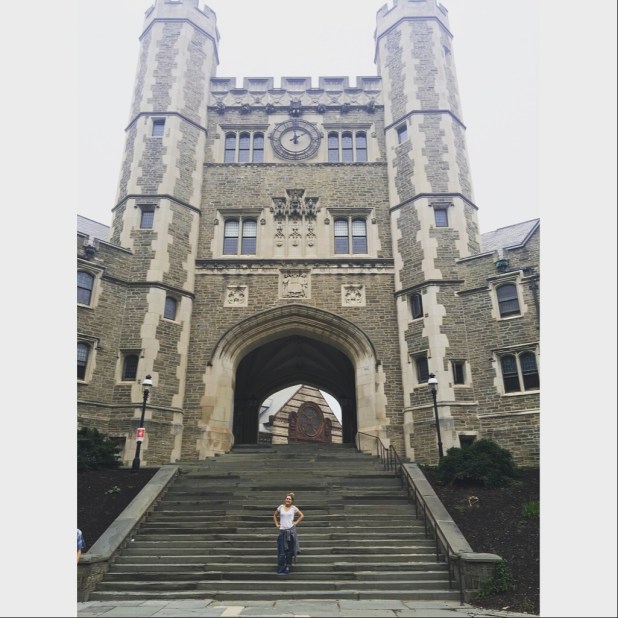
We toured Princeton and saw Einstein’s house. I was able to see the Physics and Astrophysics buildings on the campus. Below are photos of me at Princeton. The three in the photo in front of Einstein’s house are physics majors from other universities, also participating in the Research Experience for Undergraduates this summer at Rutgers. I left the campus with goals of being a graduate student there in the fall of 2017.

For the 4th of July, we all went to the beach to unwind. It is safe to say I am making lifetime friendships. It is wonderful to see what happens when you make 40 scientists live, work, and play together for a summer. We are all from different fields, yet we all get along tremendously and have spent the summer talking about life and science. Photo Jul 04, 8 19 51 PM

I will end this post on yet another high note. I have been offered a Teaching Assistant for the Fall Semester ASTR 362: Observational Astronomy course with my research advisor at UM. I will be happily helping to shape 13 minds. I will get to teach them Python, observing, and how to produce a great scientific paper. This was my favorite course my Sophomore year at the University, and now to get to teach it makes me beyond happy. I only have a few more weeks at my REU, and I have a feeling I will be leaving it with a longing to come back to the East Coast and to see my new found friends again.

“The Argentinian Melting Pot”

While abroad, our group is taking two classes at the University of Belgrano with two professors there.  One of our classes is related to culture of Latin America and within Argentina specifically.  Another aspect of discrimination she had discussed with us was the way that Argentinians behave around all the foreigners that live around them in the city.  There is a large population of Chinese who own many of the supermarkets, a lot of Italian influence, and also a neighborhood named after the amount of Jewish people that have immigrated to the area.  She spent a class discussing how these different cultures are referred to by many as slang terms like Chinos or Jews.

As we’ve spent much time in all different parts of the city, these areas of certainly distinct and carry their own value within the culture of Buenos Aires and even Argentina.  These areas are unique to the city with the kinds of foods that are sold, the people that live there, the way the neighborhood is designed, and sometimes even the language spoken within the corners of the streets.  These districts have their own identity and after hearing about these areas from locals like our host families, discrimination can and is present among fellow Argentinians with different original backgrounds.

I think because of what I have learned from my host family and around the city, I am becoming more interested in the idea of discrimination between groups that may not necessarily be “indigenous,” but rather groups that are considered “minorities” within such a large city.  This other aspect of discrimination is something I never thought about before arriving abroad, but I think it is another important part of racism and discrimination within places that contain more than one different culture.  We like to the think of the United States as “The Melting Pot,” but while abroad, my eyes were definitely opened to how much influence all countries have on one another and the kind of changes they create.

When thinking about my final project, I am wondering if there is a way I am able to combine some of my ideas with what I have experienced.  With three weeks left in the semester and in Argentina, I’m hoping to visit more distinct neighborhoods to learn more about the diversity of Buenos Aires and all that it has to offer.


Thoughts…

I have been in Spain now for about 10 months, and things are finally beginning to wind down as the end of my study abroad draws nearer. Exams are over (phew!) and most of the other international students are leaving sunny Málaga to return to their home countries and continue with their normal lives. I, however, have extended my stay until the middle of August, which leaves me with a fair amount of time on my own, as most of the people I have come to know are already gone. The thought of returning home is bittersweet for me…I love it here. This year has been a whirlwind adventure of travel, new people, new experiences, etc. Not all of it has been great, of course. But these are the things you learn from the most. But I also long for the mountains, nature, and the freedom of Montana. What they say is true–you never really know what you have until it’s gone.

I really feel like I have changed as a person over the course of my study abroad here. Arriving as one of the only Americans studying at the University of Málaga, I was forced so far out of my comfort zone. I consider myself an introvert and I have never been extremely outgoing nor exceedingly social. But being thrust into an entirely new society and culture surrounded by people I didn’t know really doesn’t give you the option of sticking to old habits. And I am so thankful for this. I made lifelong friends with people from all over the world, learned new languages, and truly gained a more broadened and global perspective on things. Not to mention the level of independence I feel I have acquired here. I came to Spain 19 years old and a little intimidated as I didn’t know anybody studying in the same city as me! The longest I had gone without seeing my family was about 5 months in high school when I participated in an exchange program in Argentina, but even then I was living with a host family. This was something entirely different. I found myself a flat with a few other international students, opened a bank account, and got myself a phone contract. These things may seem insignificant, but they are things I never had to do on my own before. I was truly living on my own and supporting myself for the first time (not counting the dorms) and in a foreign country! Not having a car was rough for the first couple of weeks, but I soon worked out how to navigate the bus and metro system. I think the thing that really made me feel like I was becoming my own person, though, was the travel I did. I took trips all over Europe (and technically Africa) on my own or with friends. I visited Gibraltar, Morocco, Sweden, Portugal, England, Scotland, and countless cities all over Spain. My favorite, however, had to be the England and Scotland trip, as I went completely alone. I was a little scared to travel alone, but I am so glad I did. It was so liberating! I planned my trip according to my interests, I could do things at my own pace, eat whatever I wanted, whenever I wanted, and it gave me the opportunity to meet new people and do things that I would not likely have done had I been traveling with others. My favorite memory has to be of the night I met a Scottish guy staying in my hostel in the highlands and we ended up going to hear some traditional Scottish music. It turned out to be one of the best nights of the whole trip, and it was spent with complete strangers! I definitely recommend solo travel to anyone and I will be going again for sure! I think it is incredibly beneficial and everyone should try it at least once in their lives.

Over the next month and a half I will be mostly alone, something that made me a little uneasy before, but now I know that I can make the most of my short time left here in this wonderful country! Ya falta poco.

Hasta luego,

Annalea