Poverty and the Environment

Being an Environmental Studies student I’ve taken whole classes based on the relationship between people and the natural world around them. One common correlation made in such classes is that between the poor and polluted environments. I’ve been taught that, more often than not, the poor live in and around polluted areas while the wealthy experience the luxury of healthy, environmental conditions. The poor carry the burdens of pollution and climate change and feel the effects of environmental exploitation more strongly than other social classes. Similarly, damage to the environment inflicted by society cannot be addressed until the issues of poverty and other social inequalities are met. Having been taught all this in recent years, I never truly understood the correlations until seeing them firsthand in Nicaragua.

After arriving in San Juan del Sur, Nicaragua, one of the first things I noticed besides the stunning beaches, quaint shops and houses, and constant motion of the people was the litter. It was everywhere. And by everywhere, I mean everywhere. Bottles, bags, cans, wrappers and more blanketed the forest floors along every highway, dirt roads, and driveways. As my trip led me to other regions of the country this observation did not change. (With the exception of the northern, rural mountains and the southern river border with Costa Rica where populations were so small and poverty so extreme that they didn’t have anything to throw out as litter.) Litter blustered across highways and gathered in ditches. It congregated in back yards and was raked into piles to be burned. Smoke spiraled up from communities at all hours of the day and night accompanied by the distinct and unpleasant smell of burning trash. It was disgusting. I looked around and was disappointed in the Nicaraguan people. My first thoughts were ‘How could they let it get this bad? How can they throw their things out into the roads, the lakes, the forests, and not care about how it looks or the damage it does to the environment? How can they drive these roads every day and not feel the desire to do something about the trash? Not organize to clean it up?’

It took a few days for me to realize why they didn’t, why they couldn’t do anything about the pollution and why it got to be a problem in the first place. Poverty. When you’re worried about feeding your children and buying clean water and paying the electric bill (if you can afford electricity) it’s hard to justify paying for proper waste removal. When you work all day and have to take care of your children and other assorted relatives at night and prepare the plantains for the week and do the laundry or work a night shift at the family store or restaurant you don’t exactly have time to volunteer picking up trash along the road or lake shore. It’s Maslow’s Hierarchy of Needs at its finest. Until the people have their basic needs (food, shelter, and safety) met they won’t worry about anything else. Likewise, when your government is still focused on implementing new and better education programs, health care, and transportation systems and campaigning so the current president will get reelected for a third consecutive term, they can’t afford the resources to fund any sort of trash clean-up program.

My first week in Nicaragua was spent solely in San Juan del Sur attending a language school during the day and participating in various cultural activities in the evening. For the second week, my companion Emma and I traveled back to Managua (the capital of Nicaragua) to meet up with professors Dan Spencer and Patrick Burke and the other members of our two week study abroad. We met with several organizations and people in the city and countryside who provided me with further examples of the interconnectedness of poverty and the environment. One of our first meetings was with a women’s health center that was developed to serve a region of the capital where women were dying of unknown causes. The psychologist from the center who met with us explained the source of the problem which they uncovered with a little investigating. The shores of Lake Managua (the immense body of water along which the capital is nestled) had once been used as a dumping grounds for the city’s waste. When a new location for the dump site was chosen, the old site was filled in and upon it the poorest of the poor built their communities. Over time, the buried waste festered and seeped its way into the people’s soil and water sources. This, in combination with living in close quarters to the extremely polluted lake, meant it was only a matter of time before cancers and other diseases broke out within the community.

Similar stories were told by and about workers on tobacco and sugar cane plantations. Just like the poor in the cities who, being desperate for a home, were left to live in the least desirable locations, desperation for an income leads the poor in the country to take up the least desirable jobs. When it comes to agriculture, Nicaragua does not have the same regulations on chemicals as the United States and some very toxic pesticides, herbicides, insecticides, and fungicides are used on cash crops. As these chemicals are absorbed into the soil and as rains wash them into waterways, their concentrations have grown to dangerous levels in certain drinking water reserves. Resulting from this, in the sugar cane town of Chichigalpa, 3-4 people are dying a day of renal and other cancers. Meanwhile, the wealthy who can afford purified water and work and live away from chemicals and waste, are unaffected.

Also in regards to the issue of clean water is the proposed trans-oceanic canal. The canal will bring in salt water and added pollution to water sources of the communities it passes. For towns like San Juan del Sur where only those in deepest poverty drink the tap water which others use solely for laundry and personal hygiene, health problems are predicted to explode. Many of the poor who drink the tap water already suffer from kidney problems and any added contamination (or chlorine added to counter contamination) will only exemplify the occurrence of kidney stones and cancers.

However, it’s not only the actions and events in Nicaragua taking a toll on the nation’s poor. As is the case around the world, the effects of climate change are becoming more and more evident and are no exception to the poverty-environment relationship. While staying with rural families working on coffee farms in the northern mountains of Nicaragua, we saw why Nicaragua is the 11th country most affect by climate change in the world. Coffee must be grown within a very specific temperature gradient and in the tropical country of Nicaragua these temperatures are only found at higher elevations. However, with warming, global temperatures, the elevations at which coffee must be grown is becoming higher and higher, reducing the land available for coffee production.   The families we stayed with were entirely dependent on the coffee industry when signs of climate change first appeared and they are now struggling to find  additional sources of income to compliment their dwindling coffee crops. Likewise, climate change is altering the patterns of the dry and rainy seasons that Nicaraguan farmers rely on. The rainy season is becoming rainier and the dry season drier. Weather patterns are becoming more unpredictable, meaning many farmers are putting their crops in too early or too late. The result of this is little or no harvest and a diminished income for the year.  Altogether, climate change is wrecking havoc across Nicaragua and not only is it being felt by just the poor, but it continues to sink the poor further into poverty.

For me, it took a trip halfway across the world to truly understand the relationship between poverty and the environment. While everyone contributes to waste, to climate change, and demands the food products being laden with pesticides, it’s a very narrow margin of society that feels the negative outcomes. Unfortunately, it is the poor of the world who suffer the most negative effects and until social and economic equality are achieved environmental issues cannot be addressed and environmental justice will not be served.
A Sense of History

Recently, I listened to a former professor of an Irish university speak on James Joyce’s famous (or infamous, depending on how one feels about literature) novel Ulysses. After his lecture, two things stuck out to me. One was the absolute reverence that the Irish people have for literature and its authors; the lecturer was so passionate about Ulysses. His readings of and explanations of the novel made the literature come alive in a way I have never experienced before. The other thing that remained in my head was the deep sense of history that the Irish possess.

The lecturer told us a story about the first time he tried to purchase a copy of the novel Ulysses. Ulysses was banned upon its publication in several countries, including America, for being ‘indecent.’ It was never formally banned in Ireland, but was taboo to purchase. Our lecturer tried to purchase it one day as a college student in the early 1960’s. The bookstore he went to happened to be the only one in Ireland that carried the book, and their policy was to keep one copy on the shelf way in the back of the store. Very rarely was this book bought in Ireland. This bookstore kept their stock up from one box of copies of Ulysses for years. When he tried to purchase the book, our lecturer was 18. In Ireland at the time, that was still a minor. He was told that he would need a letter of permission from his parents, his parish priest, or both in order to purchase the book. He came up with an Irish solution to an Irish problem, as he put it: he went to one of his much older friends, gave him the money, and had his friend buy the book in his place. While it ended well for him and he got the book, his story made me realize just how longstanding some ideals are in this country.

Nowhere was the presence of longstanding ideals more evident than in Belfast, Northern Ireland. Some of the class took a trip there to get a handle on the history, and it was quite the experience. Conflict is still very much alive between the Catholics and the Protestants. While bombed out buildings have been largely repaired, one can feel the tension in the area. The Protestants have their streets, and the Catholics have theirs. They are still separated by a giant wall known as “The Peace Wall.” There are gates on this wall that are only open at certain times of day. The two sides absolutely do not mix with one another, and each holds on to and fights for their set of ideals. One of the most eerie things I witnessed to this effect was two children on the Protestant side (which supports Britain) standing in front of their house waving British flags and chanting “UDA! UDA!” In the Troubles and other Northern Irish conflicts, the UDA is the Protestant militant branch, equivalent to the IRA. Seeing these children, who could not have been more than six years old, chant in support of a militant group they surely did not understand really drove home how deep these beliefs are. What side one is on is something children learn from birth. Like the past belief that Ulysses was indecent, the ideals of the Protestants and Catholics endure through generations. Unfortunately, unlike the belief about Ulysses, these ideals remain and perpetuate a long conflict. Seeing the state of Belfast after so many years of conflict made me wonder where the ideals stopped and the humans began.

How do you take your coffee?

I have a weird relationship with coffee. Some days I can’t live without it; other days I feel annoyed with the smell reeking from my hands (I work at a coffee shop when I’m not busy doing cool things like traveling). After spending three days in a homestay in the coffee growing cooperative community of El Sontule, I have a much deeper appreciation for the little bean that wakes the world up and keeps it running.

El Sontule has one of the most interesting community dynamics. First, the entire coffee system is run by a cooperative of women. In the city of Managua, the poor areas have the biggest issues with machismo culture and the devaluation of women. El Sontule definitely isn’t made of money, and is a very rural community, yet this community has the most progressive culture we have seen in Nicaragua. Men and women are equal, with men spreading awareness of breaking down gender stereotypes. Both genders share in doing housework, tending to the community garden and farm, and raising the children. Women run the entire fair trade organic coffee cooperative. The community shares in the work and the benefits. For example, not all families have the means to host a homestay, but those can still receive help like extra food from the other families in the cooperative.

  On top of a mountain in El Sontule. We listened to a heart-wrenching story of community members hiding here in the bushes while the Contra searched and invaded neighboring communities during the war.
On top of being a very fair community run by inspiring women, the community school is miles ahead of some United States education programs. In primary school, students learn about sexual and reproductive health, sustainability, environmental concerns, and many other issues that most schools either teach much later in education or ignore completely. The teachers are parents and farmers within the community. They have this radical idea of listening to their community’s needs and responding in a way that will create positive outcomes for generations. Instead of gettting caught up in rote memorization or the tragedy of “this is how we’ve always done it,” this small community has big ideas on how to create a brighter future for their children.

  With MaryAnn, our host mother’s 17 month old granddaughter. Also known as the cutest little person ever!
An unfortunate theme we saw through the community was how much they are affected by climate change. This is hardly fair considering the extremely small carbon footprint of the people of El Sontule. These people have no running water or refrigeration, and just received electricity through solar panels purchased by members of the cooperative. Even with the solar panels, electricity is only used for radios, single lightbulbs at night, and the one family phone. And how are these people repaid? They are experiencing the worst drought and coffee rust known to their community, and it will take several years until they have another successful coffee harvest. This gave a lot of us some perspective on the moral issues of climate change. Those who depend on the environment the most and harm it the least are the most dramatically affected by those who use far more than their fair share.

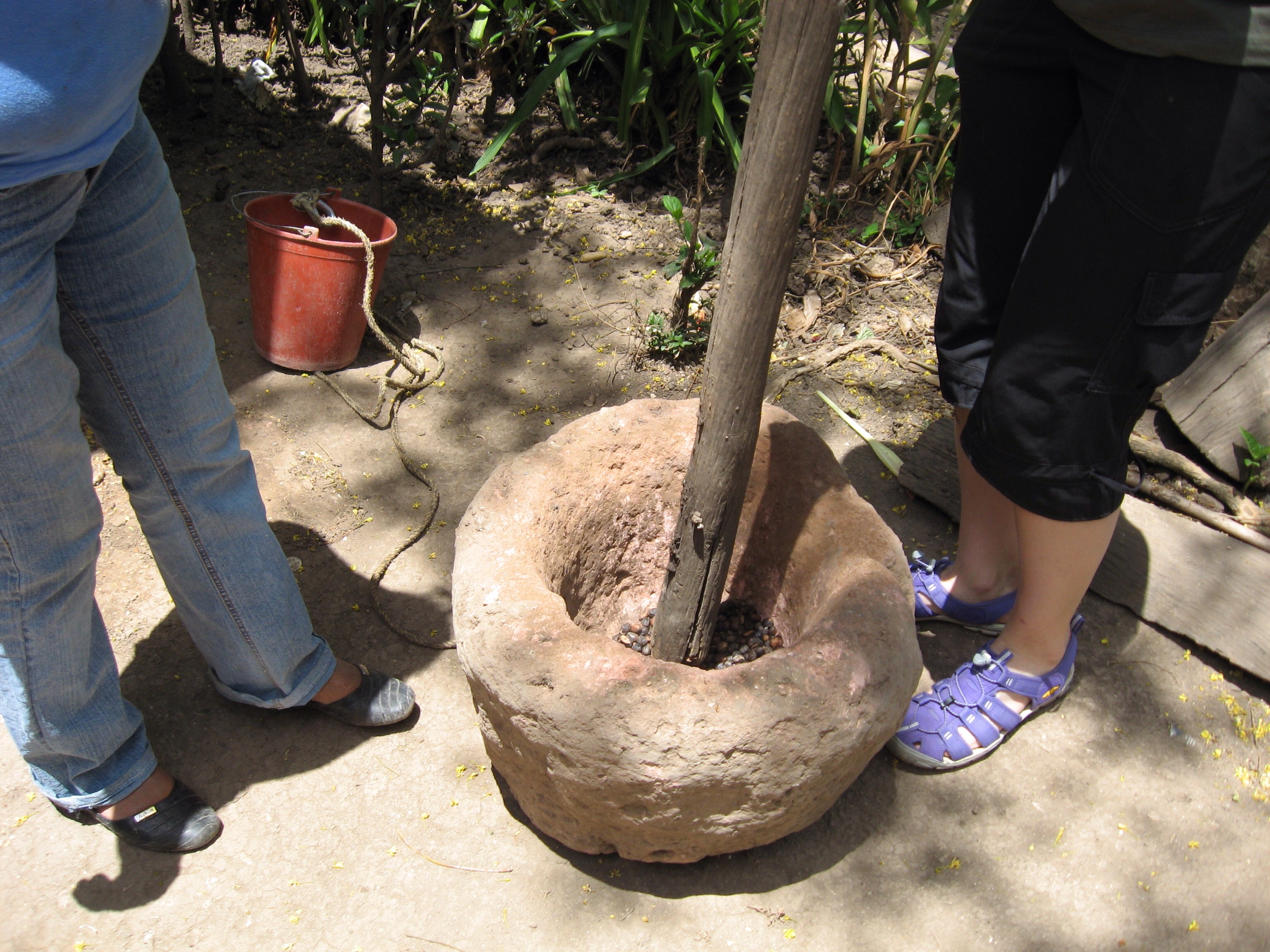
  Our host mother teaching us how to separate the coffee bean from the shell.
Not only did we get to build a relationship with theses coffee growers through homestays, but we also got to see the process of coffee cupping. Coffee cupping is how coffee gets its quality grades and is assessed for aroma, fragrance, body, and taste. This is not an easy or quick process. It requires a professional nose and palette, and only happens after years of labor in the field and weeks of milling, drying, and shelling. After learning the entire process, a single cup of coffee seems like so much more.

When people would ask, “how do you take your coffee?”, I would reply, “with milk and sugar.” Now, if someone asks me the same question, I’ll remember the generations of work put in by the beautiful women in the cooperative, the hardships they face with climate change, the efforts they make to improve life for their children, and the long and involved process of turning a seed into a steaming cup o’ joe.

What’s the Word?

We were all still covered in brown paint and dirt from the activities of the previous days when we met with Mark Sorensen in a dimly lit school room. Mark is the founder of an off the grid charter school near the Navajo Reservation called the Star School, where students are not only taught mandatory U.S. curriculum but about Navajo language and culture and the importance of environmental thinking.  We stood in a circle in the middle of the room and passed around a small bag of corn pollen.  Our fingers that had painted outbuildings, constructed a cob oven, and shaped rock gardens dipped in to take a pinch of the delicate powder.  They brought fine gold to touch the tips of our tongues, the center of our foreheads, and the crown of our hair.  The remaining pollen that stuck to these fingers was sprinkled in front of us as we spoke the Navajo words “Hozho nahaste.” We were told to think beautiful thoughts about the path that lay before us during this process as the ceremony is a blessing for safe and happy travels.

Hozho Nahaste roughly translates to beautiful pathway, but there is much more implied when this phrase is spoken.  As Gary Witherspoon explains in his paper “Creating the World through Language,” hozho expresses such concepts as beauty, perfection, harmony, goodness, normality, success, well-being, blessedness, and order.”  Witherspoon uses the next four pages to discuss the cultural frame of reference that is expressed through a single word.  To a speaker of Navajo, hozho evokes all of the meaning and emotion that builds up over the centuries it takes for cultures to evolve.

The path set before me led to the Dark Canyon Wilderness in Southern Utah.  As the weight of my pack pulled on my body, thoughts of the weight single words can carry were on my mind.  We made our way down canyon and passed through clouds of vanilla wafting off of ponderosa pines that towered over blankets of purple, pink, and orange wildflowers.  It wouldn’t have felt like the Colorado Plateau of not for the sandstone cliffs creating the backdrop for this vegetation.  Beauty.  Perfection.  Harmony.  These words are Dark Canyon Wilderness just as much as they are hozho.

The word wilderness was once used to describe places of danger and fear.  It was a place where brave folks went to conquer the land and tame it for human use. Presently, the word is given a capital “W” and describes land that are pristine and remote.  Humans are considered visitors here with the thought that their permanent presence will disturb natural systems.  People enter the wilderness for healing and peace of mind. We found this in clear deep plunge pools and fossil-filled limestone over the next few days as we descended into Dark Canyon.  “Did you guys notice when we crossed the wilderness boundary?” our instructor asked on day four.  None of us had.  We never would have known that the land we walked across was defined as something besides wilderness id we hadn’t been told.  I still felt hozho on this path.

What does this human-made boundary mean? As far as I could see, it signified an arbitrary sense that some lands are more worth protecting than others, a sense that can be justified through creating a distinction between the human and non-human world.  My path led me to the fiery blossom of a claret cup cactus in the wilderness.  It led me to the vibrant green of moss that carpets the sandstone stream bed.  It flourishes under the glossy finish of sunlight on shallow water, and it lies outside of wilderness.  I walked along my path as a part of the Dark Canyon system, as my steps compacted the soil where plants might have grown and my breath contributed to the carbon cycle.   Definitions have warped our views on what is worth saving.  Where do you experience hozho? Is it worth preserving?

11224209_1003769202968946_7430847762900249837_n

Brazos de Amor

My time here in Nicaragua is definitely winding down. I still have a month until I’m home, but the majority of that time will be spent traveling, which means I have begun to say goodbye to the things I’ve routinely been doing. My least favorite goodbye was to Brazos de Amor, the elementary school where I’ve been giving English classes. Those mornings with the niños were often the highlight of my week and overall the coolest part of my time here. I mean, they weren’t all fun and games, but they were incredibly rewarding. I sort of got the hang of giving lessons by looking up a lot of ideas online, getting input from other teachers, and winging it. But planning classes is hard, especially for little ones who have short attention spans! Sometimes it was also hard for me to explain things in Spanish, but the kids were helpful and we were always able to figure it out. By our last class, my 6th graders were able to form simple sentences about themselves and their families, count to 100, come up with an English word for (almost) every letter in the alphabet, and sing a handful of songs. The 1st graders couldn’t get enough of the “Hello” song, the 2nd graders never stopped bombarding me with hugs before I left class, the 3rd graders always wanted to know “How do you say — in English?,” and the 4th graders overcame the fear of speaking English in front of their peers. Gosh, I am so stinking proud of them. They are amazing. They come from families where life is not easy. Some are abused and malnourished. I knew that because the director told me before I began teaching, but there are also things I could see. Some of the kids are tiny for their age. Sometimes a student would be totally withdrawn from what was going on in class, looking way too preoccupied for an 8 year old. It’s heartbreaking. They would fight pretty regularly, from poking each other with pencils to punching to straight up face-offs in which I got between them and escorted them back to their desks. These would end in tears, anger, continued provocation, and more face-offs. I didn’t know how to handle it at all. I didn’t really know how to reprimand them in Spanish, except to say something like “We don’t fight.” I felt helpless, overwhelmed and just sad that they are learning such aggressive behavior at a young age. Some days, the kids were super rowdy and I could not redirect their focus to the lesson. I have so much respect for the teachers there. They are incredibly patient and loving, but they also keep the students disciplined. There were multiple times during my classes when the teacher was outside and the kids were straight up out of control – running around, hitting each other, playing Pokemon, coloring, yelling, and totally oblivious to my attempts to restore order. Then their teacher would come in, and, with just a look and a few words, the students would sit back down and look attentively at the board. It was moments like those, or when I underestimated the amount of time an activity or lesson would take and did not know what to do next, when I realized how amazing teachers are. It takes this combination of love, authority, knowledge, patience, organization, and lots of other characteristics…Yep, teachers are amazing. Other memorable moments at Brazos de Amor included the fumigation guy coming in and blasting the classrooms with gases while we waited outside; the day all the students received free hair gel (they were stoked); nurses coming and giving immunizations, which caused a girl to throw up during our English class; and the mothers’ day celebration in which students recited poems they’d written, danced, sang and performed skits for their mothers. Basically, every day was unique. I love those kids. I love entering the school and having them say “Good morning, teacher!” I love when something clicks, and English makes a little bit more sense to them. I love when the 2nd grade teacher asks me to write down some English words so she can keep teaching when I’m gone. I love when they give me adorable drawings. I love when the kids surround me and try to get to the center to hug me and I can barely keep my balance. I love their laughs. I love that they are willing and excited to learn even when their life is tough. What an amazing opportunity. I will truly miss those niños.

Challenging Perspectives

There’s nothing like travel to make people feel naive. I’m not saying this is a bad thing; travel gives us the opportunity to see, hear, and live other perspectives. As someone who has grown up in the United States middle class, I thought my perspectives were spot on. However, as I sit here listening to the breeze through the palm trees on my third night in Nicaragua, I realize that there is way more to consider about the world around us that must be experienced, that cannot be taught.

 Lake Managua at sunset

As I said, this is my third night in Nicaragua. This two week study abroad experience takes us through urban areas, the rural countryside, and the forest. The past two days in Managua have been spent meeting with various groups ranging from human rights activists and impoverished women’s clinics, to the manager of a maquila, commonly known as a free trade zone (think sweat shop). 

I came to Nicaragua with the intent to study health disparities and how both the government and NGOs are addressing these issues. When most people think of health, they think of nutrition and hygiene. However, the health issue we have focused on for most of our trip so far has been human rights. “But Tori, human rights have nothing to do with health!” What some people (and unfortunately, professionals) don’t understand is that human rights and safety are huge factors in whether or not someone can improve their wellness. For example, El Centro de Mujeres Acahual provides healthcare services at a low cost to women in the poorest neighborhood of Managua. However, they aren’t just Pap smears and condoms; this center helps women and children out of abusive relationships and provides resources to stop the cycle of violence. Not only did we learn about how cervical cancer rates have drastically decline since the clinic opened, but we also heard heart-wrenching stories of abuse. Health is more than physical, but also emotional and social.

 Poster in El Centro de Mujeres Acahual describing the “route of access to justice.”
Another instance where this new perspective on health issues came about was when we visited the maquila. This factory has been deemed a model for how other factories should run. Although the wages are far from fair and the hours and labor are unimaginably difficult, the general manager argues that this system raises people from misery to poverty. It’s a system set up for basic survival, not to bring people into the middle class. This factory has an open door policy, provides bonuses for Christmas and employee anniversaries, provides some payment and leave for pregnant women, has an on-site clinic, and has a management system devoted to helping laborers through loan and medical bill assistance programs. Wow. When I think of sweat shops, I think of a small child missing fingers, starving at the sewing machine. Although this factory contradicted my previous beliefs, I still know that this is the exception from the norm based off responses from the labor union and human rights center. However, it does give me hope that there are more responsible people like the manager see met with, and that more factories will follow this lead to help employees improve their quality of life at what ever level possible.

Tomorrow, we head to the rural countryside of Estelí to live with families who grow both conventional and organic fair trade coffee. Let’s hope my blood to caffeine ratio will stabilize by my next post!

Paz y salud. ¡Hasta luego!

Perspective, perspective, perspective

For my last blog post for GLI I decided it would only be fitting to write about three different perspectives of life.  One from a Polish-Greek easy going and quite well humored guy, another of an American-Greek beauty who is fierce, but she also has a full heart and fun personality with great energy, and last but absolutely not least a friend from Egypt who can brighten up anyone’s day with his infectious light-hearted spirit.

For most of us, our GLI capstone group and topic have been assigned.  The focus of my group’s project is sustainability and my time here in Greece is unfortunately coming to an end; however, the bitter, bittersweet ending of my journey here is not what I am going to share.  Instead, I chose to interview three incredible, unique, and inspiring young individuals.  I bombarded all three with slightly random questions dealing with their personal lives’ and where they are from, then questions about recycling and how their culture or communities are impacted by the ideas or practice of sustainability.

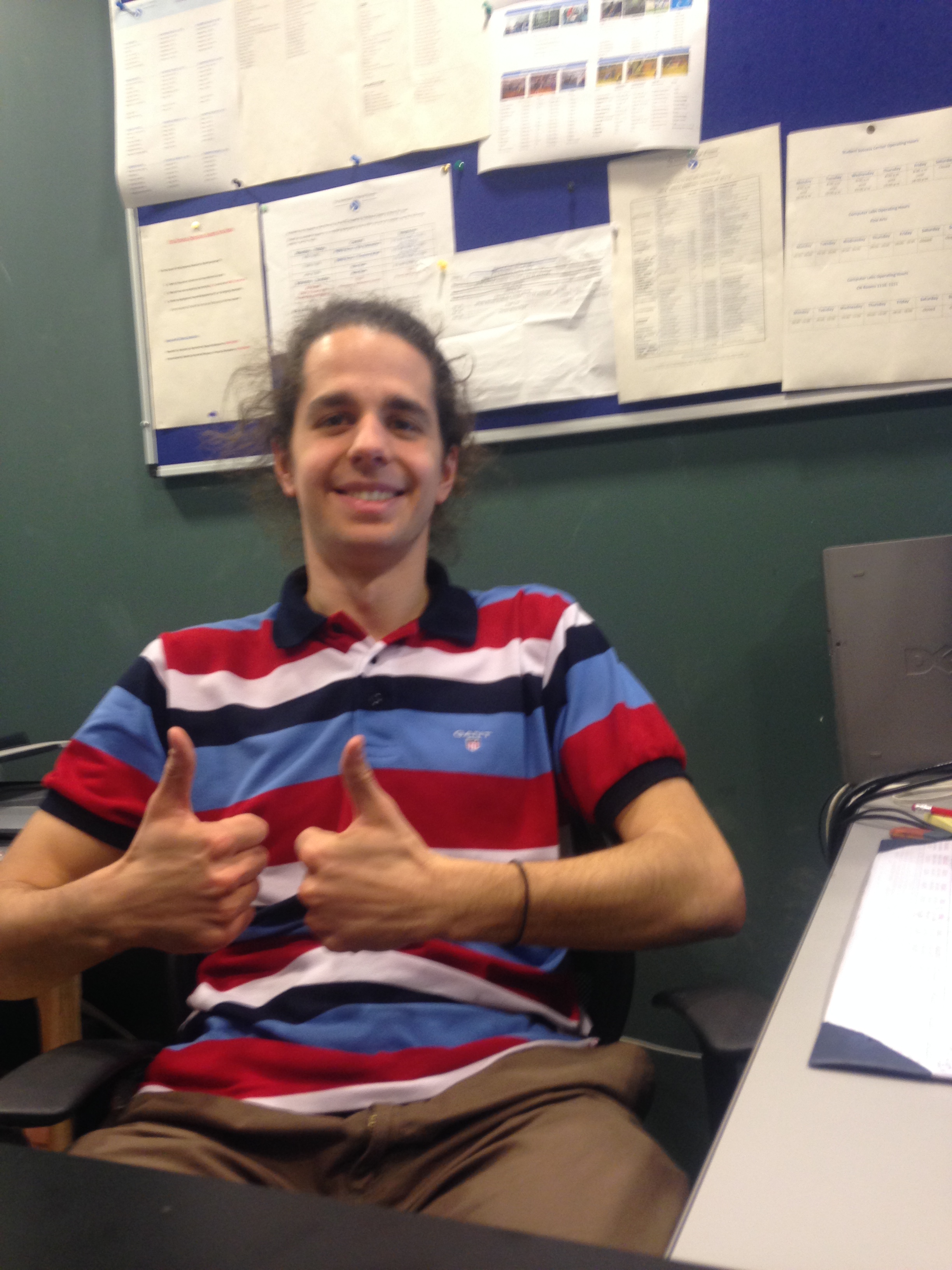
Let me introduce first, Vassilis Goumas, he is the residential assistant of the apartment building I have been living in the past four months, but his title of “RA” does not do him justice.  Vasssilis is knowledgeable and willing to help you with any “personal” problem you may come across and answer any questions about really anything.  This is his junior year at the American College of Greece and he is studying environmental science and economics, which is why he gave great insight on sustainability and personal wellness of the Greek culture.  He grew up in Poland till eight years old and he then moved to Greece, as a child he lived in a friendly neighborhood for families with children and was encouraged to play.  I asked him if he feels he gets enough physical activity now, as a college student.  By walking a lot in the city of Athens and just doing things he enjoys like hiking.  However, he also commented on “finding a middle ground for people exercising in Greece – rare,” and “there are two extremes, people who sit around and people who are always exercising.”

004

In Greece the two main cities where there is the dense population are Athens and Thessaloniki filled with millions of people.  The smaller cities and towns are the rural communities where people’s families usually originate from and are called villages. It’s in the villages where the strong family communities provide stability and support for each other and people are in habit more sustainable and conscious of their resources.  Greece has a culture where family is the center of everything and the individuality comes second.

I was so fortunate to steal some of Konstantina’s time and hassle her with questions about growing up as a Greek on the East Coast.  She was honest and gave an incredible perspective as a Greek-American New Englander, studying tourism and hospitality.  Konstantina also visits her village where some of her relatives reside.  I asked her how accessible it is to recycle at home, on the east coast versus Greece, and she brought up several comparisons, like the pressure of recycling and mentality people have in her area to recycle is encouraged (in the U.S.) but in Greece it’s not something as stressed about and the mindset of sustainability is not popular idea.  Even though recycling is more accessible to the general public in the U.S. it’s still an individual approach to a lifestyle and choice.  Her piece of advice is “care about your environment my friends (WE are ruining this beautiful place we call home!), and take a moment to enjoy what’s around you!”

007

The last perspective I’m sharing with all of you is from a dear friend, I’m so lucky to have met at the beginning of the year.  Omar was born and raised in Cairo, Egypt, and is studying communication and advertising here in Greece.  His interests are in video editing, film and cinematography.  I asked Omar all about his life and what it was like growing up in Egypt.  He told me people are divided in the city of Cairo, as a hierarchy and division the status of wealth there are two extremes of poor and wealthy, the middle class is a lower percentage compared to either end of the socioeconomic spectrum.  A big problem is the streets are flooded with trash and Omar told me he feels it’s getting better because the government is beginning to enforce rules.

005

My last four months abroad have been maybe the best four consecutive months of my life.  The people who I’ve crossed paths with, had short or long conversations with have made me reevaluate the patterns of my own life and the joy of kindness. Even the strangers who took a chance to start conversation with me and those who I simply talked to once* were memorable and left me reevaluating the kindness of strangers because the way I see it most people are a little lonely and need a little human eye contact, if only for a few minutes or so.

*I like to think of this as a one hit wonder conversation, for example, meeting someone on the metro or bus who just sparks a conversation about anything with you and both of you have probably never crossed paths or maybe you have and just didn’t know. Then when it’s time to part ways and the probability is high of not crossing paths again, thus, a one hit wonder conversation.

The realization of what culture is

So I readily admit that I was one of those people who originally signed up for GLI because it was easy to click ‘yes’ and because I got to travel from it. I know, I know, but really, what did I know at the time? I was 18, a little bit younger and more naive than I am now. It sounded cool and I got to learn about more cultures.

The thing about that was that I really didn’t understand the word ‘culture’. I went the first 18 years of my life without really understanding what culture is, at least from the perspective that this experience has taught me to (Disclaimer: this is my personal definition of culture and identity, not to be applied to culture as a whole. I’m an Anthropologist, I realize the nebulous-ness of this debate).

The problem stems from the fact that I was raised in the same house, with the same people, in the same neighborhood for my entire childhood. I thought that everyone ate dinner at the same time, everyone ate the same food, everyone had the same general values. At least in America. Eventually I learned this was not the case but it did not sink in. I did not have the opportunity to fully comprehend the differences between cultures until I was physically thrown out of my culture and into someone else’s.

Which was possibly the best experience I’ve ever had. Mark Twain said, “Travel is fatal to prejudice, bigotry, and narrow-mindedness, and many of our people need it sorely on these accounts. Broad, wholesome, charitable views of men and things cannot be acquired by vegetating in one little corner of the earth all one’s lifetime.” Truer words have never been written down. Admittedly political correctness acknowledges the rudeness of the quote, but the unbiased truth still stands. Learning and living in places where people’s world views are different, sometimes entirely so, from my own has forced me to see that culture is not just American – it is French, Italian, Japanese, Egyptian, and all the other nations of the world. Culture is distinct and wonderful wherever you go. People are different. Culture is a facet and a way to sum up those societal, political, and economic differences.

It was an important lesson to learn. It is also impossible to adequately describe another’s culture. I can’t even adequately describe my own and I’ve been living in it for twenty one years. Culture is internal as much as it is external. I hope to eventually be able to share my experiences in other cultures, but first I feel like I need to meditate and mentally dissect everything that I’ve experienced. I’m even mentally dissecting things right now. I’m still figuring things out as I go along, which is good because you never stop learning.

-Megan Nishida

We are now in the mountains and they are in us – John Muir

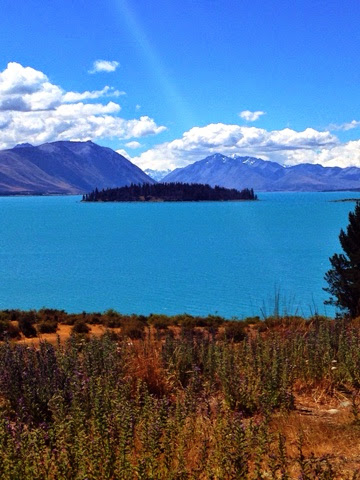
I don’t know how it’s possible but the days seem to get better and better as I make my way further down south. I scrambled through the city of Christchurch looking for my bus and finally a nice man on a walk took me the right way. The next stop was Tekapo where I was hoping see some mountains, that I already miss so much. When I arrived in Tekapo I was instantly overwhelmed by the bright blue lake and the glacier topped mountain in the far distance. It was absolutely stunning and the bluest lake I’d ever seen. I hung out in a coffee shop charging my phone for while and taking advantage of the free wifi, which is harder to come by.  My plan for Tekapo was to hike up to Macaulay Hut and stay there for a couple nights. After talking to the information desk I found out that it was another 40Km up to the trial head but I thought why not! 


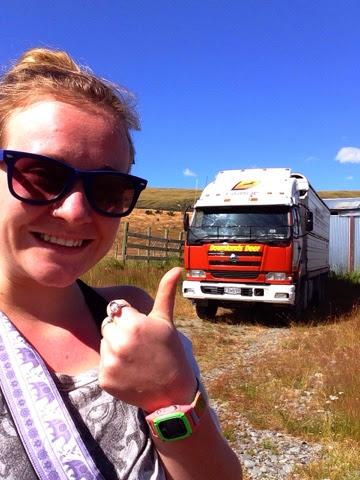
I started walking up the Lilybank road and soon found out that catching a ride wasn’t going to be so easy. The paved road soon turned into a dirt road and there were few cars that wouldn’t pay me any attention. After walking for an hour and a half while doubting my decision a semi truck turned the corner. I was a tad skeptical but at the last minute put my thumb up.  It’s actually been on my bucket list to ride in a semi and now I can cross that one off (sorry mom!). Alan was the driver and he was taking two crates of deer back to the farm at the end of the road which was right where I was headed. He was such a nice man and told me all about New Zealand animals which are all most all introduced like deer, tahr, cow, sheep and much more. You can hunt New Zealand without a permit because they thought of as a nuisance or a pest. However, it’s one of there biggest exports so it’s quite a mix up of how to manage it all. All this I learned in a quick ride with in a semi full of deer, I’d say what an experience! We dropped off the deer at a farm with a guy named Jonny.  I got to see the whole process and even see his two smart dogs herd the cow and deer into the right fenced off areas.


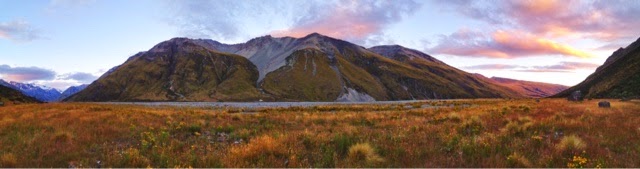
Jonny and his two adorable dogs took me part way to the Macaulay Hut. It was a lovely ride in to the valley that had towering mountains on either side.  Jonny showed me all the places he skies right in his backyard and told me all the places he’s skied around the world. I was quite jealous and long to ski around the world someday. He dropped me off in what’s called Boulder field as there are huge boulders laying everywhere. Apparently the boulders  didn’t roll down the mountains but were catapulted from an earthquake 50 some years ago. While in the valley I feared of getting smushed by a flying Boulder in earthquake but I surely lucked out. 

As I sat alone cooking dinner I was absolutely memorized by the unique beauty of the valley, as the mountains so vast and jagged towered over the river bed on each side.  You could see for miles where there used to lay a enormous glacier that now in the distance was so small. Across the river in the middle of a scree field there was a cascade of water coming from the middle of the mountain. The sound of the rushing water echoed up the valley along with the variety of birds singing into the everlasting sunset. 

The night sky was one of the prettiest I’ve ever seen with the silhouette of the tower mountains laying against the mist of the twinkling starts. Not a cloud dare disrupt the beauty along with the absence of city lights. More stars appeared as the night grew older and galaxies above became so clear. It was a whole new side of the universe I had never seen and I enjoyed every second of it. 

After sleeping in and being awakened by the hot sun I finished my hike to the hut. The hut could have been a house it was so big. It had 14 bunks and a huge kitchen area with a stove and running water. There was even a tub down from the hut that you could warm water with a fire and enjoy the nice view of the glacier mountains in the distance.

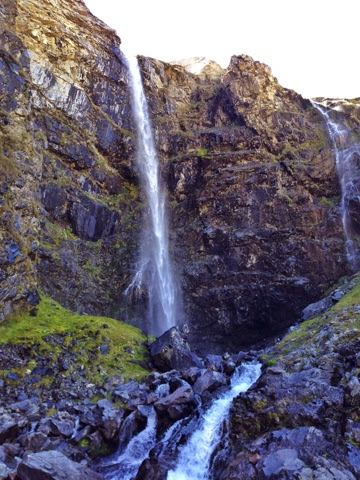
 After settling in I figured I go exploring while I had the chance.  There was a creek running right by the river and a waterfall I could see in the far distance.  I grabbed my bag and was off up the valley jumping from rock to rock following the river. I was surprised with not only one water fall but probably upwards ten. Each one unique and absolutely beautiful. I kept climbing up and soon found myself at an alpine glacier lake. Like Lake Tekapo it was bright blue and so clear that the floor seemed so much closer then it actually was. I decided I would take a swim to cool off and reward myself. I walked out further and further all the way up to my stomach. I stood there for a minute then counted to three out loud multiple times trying to motivate myself to dunk my whole body. I couldn’t bring myself to emerge in the freezing water and chickened out.

When I started hiking down the mountain I saw some tahr in the distance. The only other place in world you can tahr is the Himalayas. They are some what like mountain goats but a grey cooler and not as broad.  I continued walking and two kea landed on a rock ten feet in front of me. I instantly grabbed my camera and got closer to snap some pictures. They are the only alpine patriots in the world, and boy are they stunning and smart too.  They have a beautiful green outside coat but when they fly there wings are a mixture of orange, yellow, red, blue and green. After watching them for a while I carried on but one liked my presence and followed me down the mountain for quite some time. From meeting amazing locals, to hiking the river bed, to wondering the vast mountains and hanging out with kea birds. I gotta say this short trip up the Macaulay River was really a trip of a life time.

To live is to change.

“To live is to change, to acquire the words of a story, and that is the only celebration we mortals really know.”
– Barbara Kingsolver, The Poisonwood Bible

Why did I come here? How have I changed? What Is the story I will tell when I finally come home?

I came to Morocco because I had stopped growing. I was content in Missoula but I wasn’t becoming the person I knew I wanted to be. I had come to a standstill. When I told my mom I wanted to go to Africa she said “Michael why could’t it be France? Britain? New Zealand?” “Because this is what I need to do ma”. I wont say that I chose Morocco simply because it would be a challenge but it was a factor.

After 5 months I think I got exactly what I wanted. I lived, I changed, I gained an unlikely story. I know that I have changed. How I don’t know, I wont know until I see myself reflected in the perplexed eyes of the people I left behind. I know that my life has been altered. I have rediscovered my love for making music, I have learned to unleash courage and that I didn’t even know I had. I have found resilience in my darkest hours, I understand myself better and I cant go back. I am marked by this place, I am still investigating how.

When I return to Montana what will I tell them? That I was Lawrence of Arabia galloping through the desert on on a camel? That shopping malls look exactly the same everywhere you go? No, I will tell them “There were good days and bad, Morocco isn’t better, its not worse, its just like Montana, full of kind generous and welcoming people, breathtaking scenery and experiences that will change your life.”

At the close of my time in Morocco I want to send out some thanks…

To Paola: Thank you for the adventures, for the laughter and tears, you understood me from the start and saw who I was supposed to be, because of you I am closer to becoming him. For that and so much more thank you.

To Noah: Thank you for uncovering my love for music I abandoned it years ago. I will always treasure your spirt and our friendship.

To Nabil: Thank for your generosity, the translations, your laughter and smile. I couldn’t ask for a better example of hospitality, kindness, and understanding. To my moroccan sherpa and dear friend thank you.

To my new friends: Thank you for welcoming me into your lives it has been a great honor to get to know you. All of you have such bright futures I cannot wait to see what where you go next.

To my friends back home: Thank you for answering Facetime calls at 3am. “My love for you burns with the white hot intensity of a thousand suns.”

To my dear brother and sister: This is more an apology. I am sorry that I could not be there for you these last few months I have not been present as I should have I will see you both soon. Thank you both for supporting and encouraging me.

To Nathan: If I’ve learned something here its that it doesn’t matter if I’m watching the sunrise in the Sahara or going on a 3 am Walmart quest, what matters are the people you share it with. I am lucky to be your friend. I treasure our adventures. Thank you for being my friend.

To my mother and father: Thank you for teaching me to be strong for being an example and for letting me go (like you had a choice). Thank you for letting me make mistakes and then helping me up after. I am blessed to have you.

The adventure isn’t important its those you share it with even if its just yourself.

Safe travels thank you for hearing my story,
Michael Nelson

“Hope fades
Into the world of night
Through shadows falling
Out of memory and time
Don’t say: «We have come now to the end»
White shores are calling
You and I will meet again”
– Annie Lennox, Into the west