Bangkok, Thaliand: Part 1

By: Dani Howlett  

Hello!  It has been 5 and a half days since I left Montana on my journey to Bangkok, and they have been days filled with exploration and exhilaration!

After traveling for over 30 hours and stopping in Salt Lake City, Los Angeles, and Tokyo along the way, I arrived in Bangkok and met my new roommate from Tennessee.  We were picked up at arrivals and taken about 45 minutes to our hotel in Old Bangkok. Even though it was dark, the drive was amazing.  We passed under intricately decorated bridges, which were lit up and featured massive framed pictures of the king. The traffic here moves at light speed compared to anywhere in the U.S., with taxis, mopeds, and buses all coming within inches of each other at
tumblr_mouz2yy5A91sx7w9mo1_1280

We arrived at our hotel at about midnight.  We came into our room to find that there were no blankets, towels, toilet paper, or other amenitieshigh speeds.

there for us. Kelsey and I met up with two other guys in the program, and

went out in search of some of the essentials.  By this time it was almost 1 AM, so we didn’t travel too far before

giving up and stopping. Sitting out on the street with my new friends, greeted by so many new sights and smells, I felt completely euphoric. Even though I had only been here for an hour, I could already tell that this trip was going to be even better than I expected! 🙂  Around 2 AM, we made our way back to our rooms at finally went to sleep.

Trying to find our school or any sort of department store was quite a challenge for us on the first day.  We walked and walked and walked, but we were seeing new and exciting things the entire time so it didn’t matter.  We walk through street markets pretty much every day to get around, all of which are 

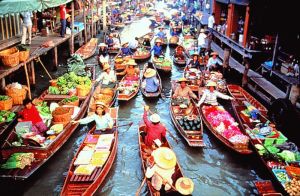
tumblr_mpcqdcVZxE1sx7w9mo1_1280amazing.  SO MUCH is packed onto the sidewalks. You’ll see anything from entire fried fish and exotic looking fruits to knives to huge Buddha statues for sale.  Prices are low (bartering is key) and there is honestly something for everyone. Everything is so close together and it is SO hot that it is kind of hard to shop, but it all adds to the experience!We only slept for about three hours, woke up at 6 AM, and headed right out to explore. We walked around the entire day, and saw a ton of new and exciting things.  Though the inside of our hotel is very clean and nice, we are definitely living in the more run down part of the city.  The sidewalks are kept clean, but certain areas are very dirty and smell pretty bad.  Most of the buildings are pretty decrepit as well.  Even though it is so different, I am really happy that we are located where we are.  I feel like we are getting a better feel of Thailand than the people who stay in the center of New Bangkok or in the beach resorts,which is awesome 🙂

tumblr_mpminiKjoz1sx7w9mo1_400

Also when shopping and trying to get around, the language barrier has been difficult. But with a phrase book and a little charades we have been able to get around pretty well!  Gheet, the owner of the restaurant right next door to our hotel, teaches us new words every time we go in there.  He is so warm and friendly, and has already added a lot to the trip.  Almost every Thai person who speaks at least a little English is so nice and welcoming to us. Today (July 1) a man working at a spa told me he loved me four times, haha.

Anways, after we got back to the hotel from the school, we met up with three other girls in our program.  We walked to dinner at this great restaurant just down the street and I got my first meal in Thailand! It was some egg noodle dish with chicken, and it was delicious.  After that, we came home and I finally caught up on sleep 🙂

The next day, Saturday, was a little slower paced, which was nice.  We did a couple errands and got traditional Thai massages for $8 an hour (which is apparently pretty steep). Either way, it was an AMAZING two hours. I feel so lucky to even be here in the first place, then things like this REALLY make me feel spoiled.

Sunday, I met up with Ashika, Laura, and Jen, and we took the sky train downtown to a massive mall. This was a wild day for me, because I have never been anywhere nearly this big.  The skytrain track just towers over the streets below, but barely makes it a fraction of the way up the massive sky scrapers that it runs in between.  We spent the day at the biggest mall I’ve ever been to, full of things like Gucci, Prada, and so on.  We got delicious food there and walked around for hours.

Monday was orientation for school! The entire group of us met up and walked and took the ferry to campus, which is probably a 20 minute commute.  The orientation was set up really well, and everyone who spoke seemed awesome. We went over our agenda for the month, and we are going to be doing some really amazing things, I am beyond excited!!!  We bought our uniforms and went to lunch, then made our way back to the hotel.

tumblr_mpdb6lu1Rd1sx7w9mo3_1280

Later on that afternoon, seven of the girls and I took taxis to Khao San Road, which is much more touristy than anywhere else we have been, but for good reason! It was SO awesome! Its full of awesome shopping and bars and food and massage places and all of that stuff.  We went to the spa and got ‘fish pedicures’.  We sat side by side and put our feet into huge tanks full of ‘garra rafa’ fish, and they nibbled at our feet for 15 minutes. It was CRAZY feeling haha but we had so much fun! Then we went out to a couple of different bars, which was awesome, then got food and came home 🙂

Sorry this one was so long! I had some catching up to do but from now on I will try to update this regularly and make the posts a lot shorter 🙂 I’m off to our first day of class!
Disappointment

By: Danielle Barnes-Smith

The thing about studying abroad/relationships/life-in-general is that it’s full of disappointment.
They call it “culture shock.” It’s kind of like when someone mashes cauliflower so that the dish looks like mashed potatoes and calls it “nutritious.”

I call it disappointment.

It’s disappointing because through our kitchen window we can see beautiful lights and an old church, but if you look down you see garbage that washed up from some litter hurricane and air conditioner that definitely serves no purpose to humanity anymore.

It’s disappointing because even though tickets to Paris are cheap, cheap can still be expensive when you’re in college and newlywed (who would have known?).

It’s disappointing because a lot of expectations don’t get filled.

When I was accepted to study abroad, I still had several months before the departure date on the plane tickets, so there was plenty of time to romanticize. I imagined I would have been to London, Scotland, and the Stonehenge within the first month. I imagined that the water wouldn’t give me a weird stomach thing (although bad gas is a really good way to tell if your spouse truly loves you). I imagined I would make twenty Irish friends and have drank my share of Guinness.

I have yet to go to London, Scotland, or Stonehenge because time and money is surprisingly short. The water does give me a weird stomach thing. I haven’t made any Irish friends. And buying Guinness all the time is actually quite expensive and fattening.

So it’s full of disappointment. In order to avoid the disappointment, I advise avoiding going abroad at all. It’s much easier.

However, if you still want an incredible experience, don’t stop reading.

Incredible experience? But, Danielle, you just whined a lot and told us way too much about your digestion.

Well that’s the thing about studying abroad/relationships/life-in-

Ireland 1

general, the best parts are the parts that we don’t have time to romanticize about.

I have not gone to London, Scotland, or Stonehenge, but I have kissed the Blarney Stone, experienced Fota Wildlife Park, and ventured through Ring of Kerry.

The water does do something weird to my stomach, but it’s worth it for how great the butter and goat cheese is here (I’m not even joking).

I have not made twenty Irish friends, but, if I can be so cheesy, I have made some really great European friends and been more social that I am normally inclined to (I’ve made fun of Germans more often than I am normally inclined it). And I’ve had a few pints of Guinness (it’s good with Blackcurrant syrup).

Studying abroad in Ireland is not what I imagined it would be. School is different (not harder, not easier, different). Sometimes I don’t know what anyone is talking about (what is the meaning of pudding?). But if anything is for sure, anything at all, studying abroad, relationships, life: they are all worth it.

A Week in the Indian Jungle

Sunday, January 12, 2014

_MG_6979-1 copy

This past week I was staying at a tiger reserve in central India. We looked at how the tiger reserve and tourism associated with it has helped or harmed the local villagers’ livelihoods. We did profiles on several people within the village, like barbers, doctors, guides, basket weavers, shop owners, and a woman who runs a homestay.

I focused on the woman who was running the home stay. Her name is Shahanaj Baig and she is an amazing woman who is working hard so her kids can have a better life than her. She and her husband are some of the few people from the village of Moharli that have sent their kids to the neighboring city to get an English education. She doesn’t want her kids to come back after school, she wants them to go out and live their dreams and be able to support her when she is too old. She calls it her investment plan.homestay13 copy

This all ties into the environmental issues I have been reporting on.The issue is  environmental vs. social.

The question is whether tourism should be allowed within the core zone of the tiger reserve. Some think that the tigers need to be even more protected than they already are and that the tourism is hurting the tiger populations. But if they shut down the tourism, the people who based their livelihoods off the tourism industry, like Shahanaj, would have to find a different way to make money.

The problem is finding a way to allow tourism that is also not environmentally harmful. I think India has done a phenomenal job solving this problem, at least at the tiger reserve I went to. They have done a lot of things to protect the tigers. They only allow tourism in a small section of the core zone. They only allow a small number of safari jeeps into the reserve everyday, and are very strict about these rules. So far the Indian government has favored the tigers over the economic incentives that come from  tourism.

_MG_6189-1

A tiger we saw while on safari. These tigers are used to seeing humans but are still very wild and dangerous animals

Although they have done a good job of protecting the tigers, man-animal conflict is inevitable. While we were there a local villager who snuck into the jungle to harvest bamboo was eaten by a tiger.

All they found was his leg but authorities won’t take action against the tiger because they want to do all they can to protect  the tigers.

I have two more weeks in Pune and will be looking at the problem of accessing clean water in the slums. I can’t wait to look at some of the deeper environmental and social problems here in India.

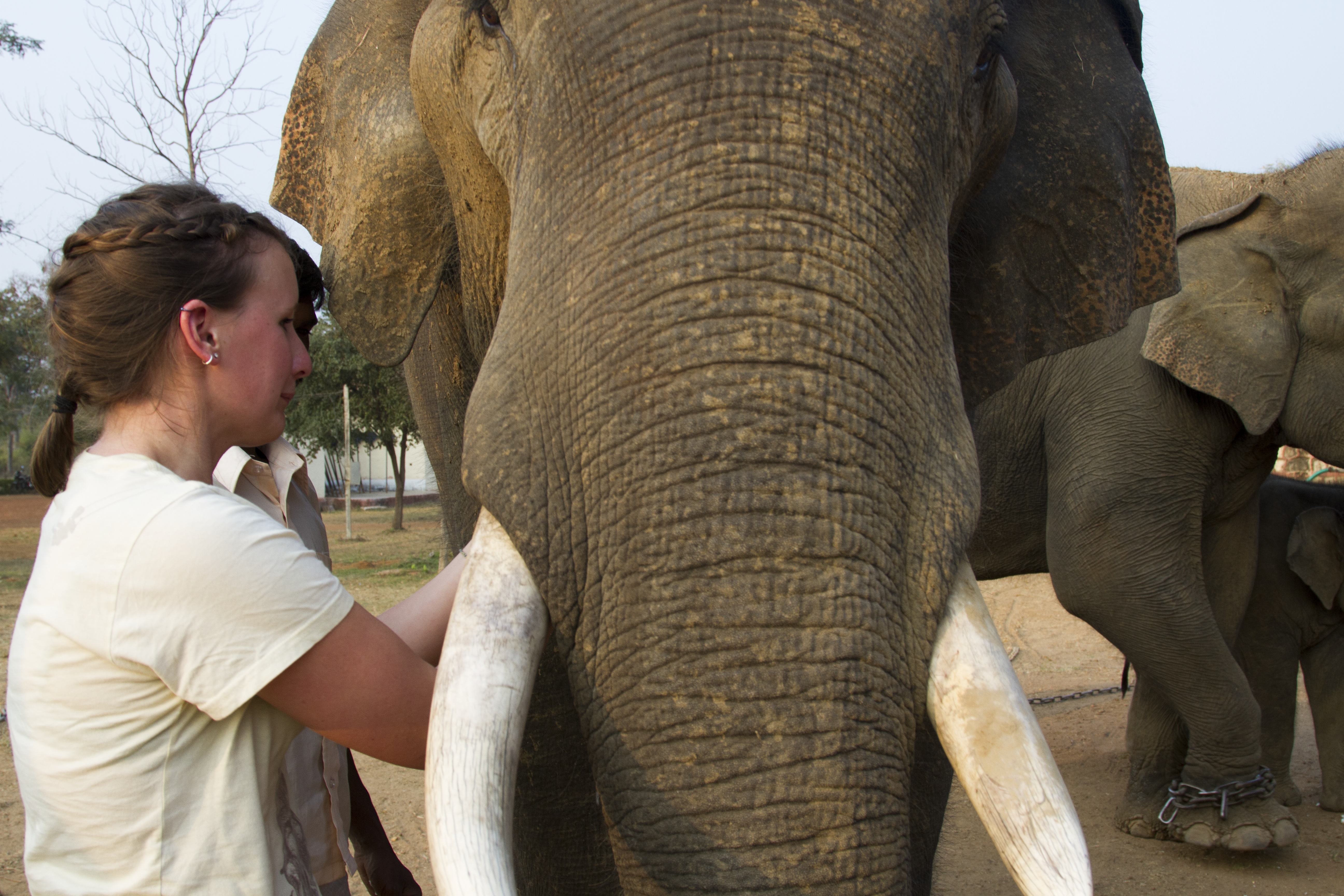
I got to feed an elephant!

The Nearly Dead

By: Spencer Ruchti

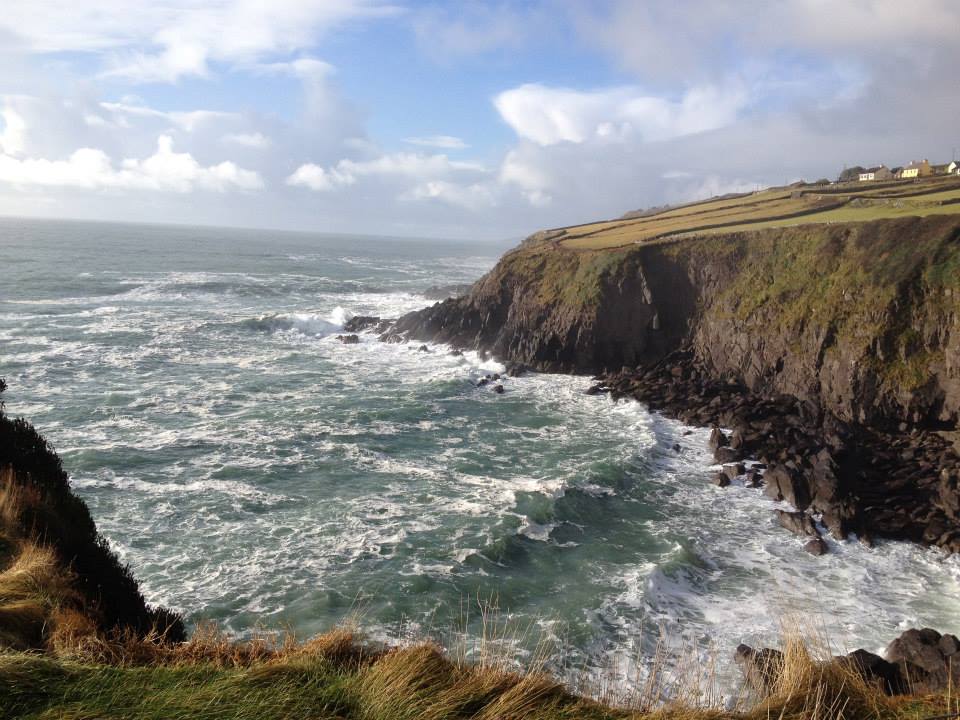
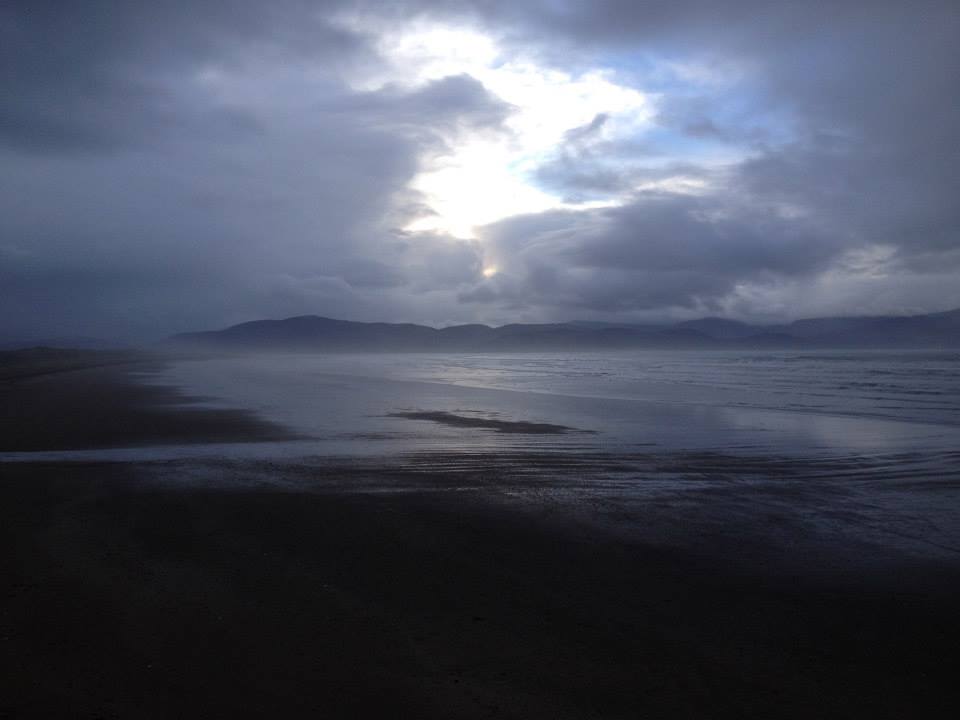
One important aspect of the Ireland experience is, of course, the landscapes. I have 800 pictures on Facebook that prove my point. Below is a poem I wrote that reflected on the awe-inspiring scenery of Ireland. One place in particular, the Dingle coast, inspired me the most. Included below are pictures of the area.

1475960_10203302658153690_719146023_n

A little while down the coast, when the sun finally decided to come out.

The Nearly Dead

Today I saw Dingle.

Today I watched heaven cast its light on the Atlantic
in beams and pillars,
spotlights on a swaying sea.
It had a mood, Tom said,
a tumultuous mood as the cold white frothing sea beat and churned against the polished black stones of the coastline cliffs
in anger, many say.

But I am not of that many.

I believe the sea is too large,
too God-like,
too beautiful to hold that kind of wrath.
It has an ardent passion, but I believe that Father Sea meets Gaia in love
every washing wave a breath breathed by the world.

Today I smelled sand and salt. The foggy fingers of distant rain tore down the sky itself and brought it to the Earth, to the sea old as the sky itself
old as Gods and myths.

There is history in this place, I know.
Time flows like sunlight,
year to year,
eon to eon,
and our time here is but a crash
a wink
a blink
a sinking ship
and in our time here
we find the thrill of death we’ve been looking for.

10203_10203302648033437_1155298252_n

The Dingle coast. Like the sun’s fighting through the clouds.

Because the purpose of life is eventually death.
Not in the sen of an end
telos
but in the thrill.
The thrill of near death that brings us closer.
The one that reminds us we are living creates
who see color
and light
and wind
and rain, most certainly rain.

The thrill of near death.
The feeling we get when standing on the walls of sheer
seven hundred foot cliffs, as wind threatens
and rain tears and we’re left with nothing but veils of fog.
The awe of the mad sky and green land breathing upon one another.
The anxiety of climbing rocks shaped like stairs shaped like something else and else
and else
and understanding that the Earth laid them down through the gale storms the hot slithering magma and the legends we know them by.

Ireland is the thrill of near death.

We cast cold eyes
on life
on death
forging in the smithys of our souls
that which we shall never forget. The green that all life must pass through.

We seek not adventure, but eh beauty and warm, expanding peace that we would welcome to our graves.
The white sun that brings us to our knees.

We are the Nearly Dead.

1464637_10203302665233867_752605792_n

The view from Dunbeg Fort.

The Psychology of Writers

By: Spencer Ruchti

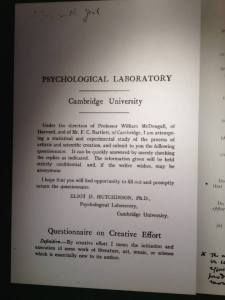
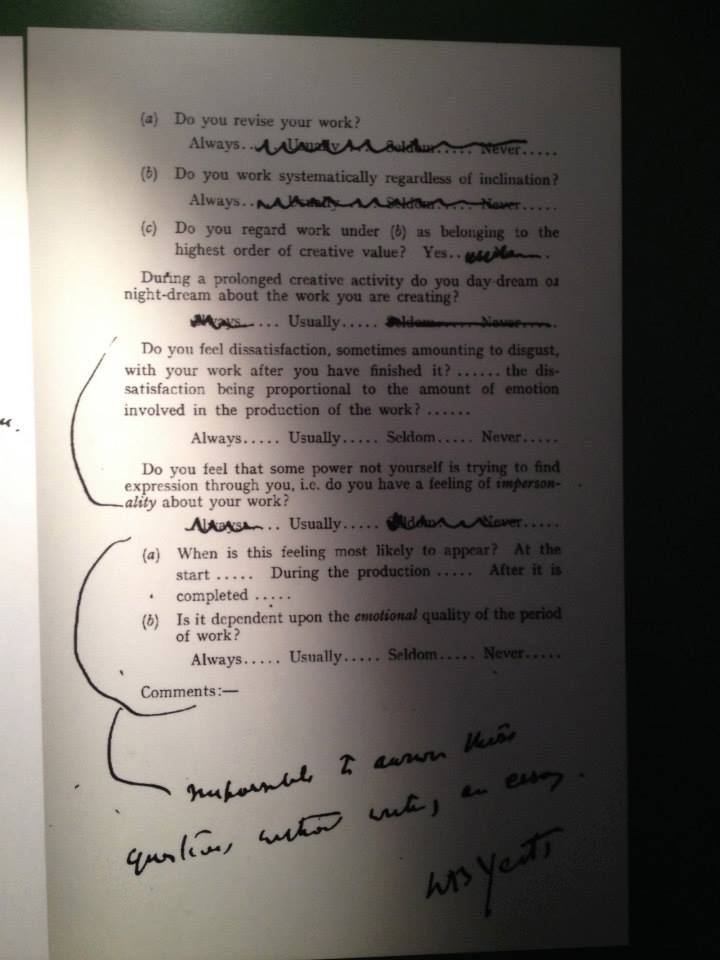
Looking through the Yeats museum in Ireland’s National Library, I came across some interesting documents. Psychology researcher Eliot Hutchinson from Cambridge University in 1949 made an attempt to understand the psychology of writers, much like the research I wish to conduct. Hutchinson sent a “Questionnaire on Creative Effort” to Yeats, among other great writers of the time. At first I laughed. Measuring creative effort through a questionnaire? Hilarious. But as I read the questions, I realized Hutchinson was a man who understood the creative process. He understood the woes of a writer in search of a Muse, the absence of “productive inclination,” the nature of inspiration and daydreaming, the disgust a writer often feels at his or own work. He understood, yet he was a man like myself, trying to translate those feelings, those frustrations, those inspirations into a science; a calculated process wherein one might unlock the biological doors to infinite muse and sublime art. And not unlike myself, from the nature of the questionnaire, I believe Hutchinson had difficulty capturing this artistic nature within a scientific process (though I haven’t read the book in which he incorporates this reasearch, How to Think Creatively, and though the book dates back to 1949 (which is “outdated” in terms of proper scientific research), I plan on ordering it from Amazon and reading it in the future as part of research). Which brought me to think: What if, by studying the biology/neurology of great writers, I’m going about it all wrong? I think I might need to start focusing on psychology, rather than biology, of great writers, for you cannot study the creative mind through pure science, just as you cannot understand a mountain with a microscope. By breaking an art or artist down, you fail to apprehend and understand the collective picture. Hard sciences, like biology, unfortunately, make an attempt to understand the world by dividing it into its most basic parts and building upwards. May one appreciate a sunset by examining light particles? Surely not. Psychology is much better suited for such a task than biology/neurology, with its basis in philosophy and the overall behaviors of the mind rather than its anatomical functions.  

1522038_10203339710519976_613024421_n

The Psychology of Creativity questionnaire, used as research in “How to Think Creatively.”

15663_10203339713680055_1461736459_n

Page 1 of the questionnaire. This questionnaire was not published in the book (I know, because I own a copy).

1619526_10203339712000013_1364861692_n

1525316_10203339712360022_658326198_n

Page 3 of the questionnaire

1511729_10203339712720031_1617908362_n

Page 4 of the questionnaire. Notice Yeats’ sidenotes.

James Joyce – The Dubliner, The Writer; The Genius, The Jerk

1560377_10203339696519626_1526778284_n

My affection for Joyce knows no bounds. (James Joyce statue in Dublin outside of Parnell Square.)

By: Spencer Ruchti

James Joyce: A Dubliner born, a writer made. So successful that Ulysses is known to many, including myself, as the greatest novel ever written. Joyce’s masterpiece breaks the reality of what is “normal” and “conventional” in any novel setting – it takes the English word and language and it makes a mockery out of it. Suddenly, it was known to the world that anything could be done with language and the novel. Joyce wrote the chapter “Siren” in the form of a fugue, a type of musical composition. If you have no idea what I mean, or how a writer could compose music from language, you’re among millions who ponder at Joyce’s genius. Joyce captured the essence of the human conscience through his zigging-and-zagging “stream-of-consciousness” narration. He broke the form, tore reality. Laughed at what most writers strove for and created a new language.

1510936_10203339719680205_176896178_n

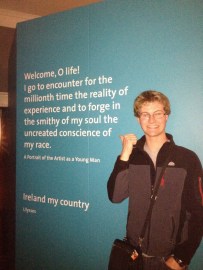
My favorite Joycian quote. Who wouldn’t want to forge something in the smithy of his or her soul?

And Joyce recognized his own genius. He touted it. In his first meeting with renowned poet W.B. Yeats, at the age of 20, Joyce said he was disappointed because Yeats was too old, and Joyce would thus have no influence on his work. He cajoled his family and friends for money, came home a drunken, sometimes abusive mess, and became wrapped up in his own work with rare concern for others; even those who helped him in his struggle to publish were often forgotten after. The man was constantly moving on and on and on, lathering in his own genius until he finally lost sight of humanity. But he was a genius. My God, he was a genius.

Why must genius be privy to loss of proper human morality? Of connection to humankind? The line between insanity and superior intelligence grows thinner and thinner when it comes to the lives of the artists of our age. Which is why the world in which they develop, the art that influences them, the surrounding land and humanity that brings them to awe and tears, is important in deciphering the psychology, the frame of mind a writer grows into like a second skin; what factors, and at what point do madness and genius diverge? Are they two paths of the same branch, or are they opposite ends of the spectrum?

How might one unlock genius?