
Once I had been in the culture for a couple days I finally started to appreciate it and truly understand it and the people. It was strange at first though, because if a women is showing her knees she is considered a prostitute and the men will try to rape her, because they believe that this is what this type of women wants. That was a big culture shock. Another major one, was their court system. There is a court system and people can go to prison/jail, but if someone is murdered, the murderer will get away with it. This is because a dead body cannot defend oneself so there is no one to accuse the murderer of it, even if their was a witness. Being from America this seemed absolutely crazy. There were a lot of eye opening experiences, sadly there was a women who was found dead in the river at the bottom of our village. There was many sick children that came to the clinic looking for help. My time at the clinic was very well spent. I mainly did vitals of patients, taking their BP, heart rate, and symptoms to see if any testing for malaria or an STI needed to be done. When I wasn’t taking vitals, I was either examining patients with Alison and Kelsey who are both PA’s, working in the lab, working with the HIV center, or helping in the Maternity center. When I was with Alison and Kelsey I patiently watched while the translator translated and then once the patient was cleared they would explain everything to me. When I was in the lab I would look through a microscope of samples of blood, or do pH testing of urine. When I worked in the HIV center we had an OVC program which was for orphaned children who’s parents died of HIV and now they have HIV. I would transcribe for the main HIV doctor and help examine the children and their charts. In the maternity center I was able to feel babies inside or women and determine if they women’s growth was healthy and discuss their living situation and make sure it was safe and healthy for the baby. I learned to love the people of Bulaki and everything about it. I loved the people and especially the children, they loved the white people, which they called us Muzungu. They were so cute, I’ll never forget them, or any of the people in Bulaki.
Category Archives: Uncategorized
Uganda Have a Good Time
Since I never had the opportunity to blog when I was in Uganda, in the small village of Bulaki I am starting my blogging journey now after my Ugandan journey has sadly come to an end. The start of my journey was a very interesting start. After an hour delay with only a short 45 minute layover, I almost missed my connecting flight from Minneapolis to Paris. Thankfully I made it with only minutes to spare, I was full on sprinting through the airport. Once I survived my 9 hour flight to Paris, my connecting flight to Nairobi was completely cancelled, this made the journey real interesting. They redirected me to Istanbul, Turkey then on to Rwanda then finally on to Uganda. I arrived 6 hours later then when I was suppose to, so I was still able to go with the driver that Alison and Kelsey (my sister and her friend), were taking to the village where we stayed and aided at the medical clinic. It was a long 7 hour car ride in the heat of Uganda. It is a very beautiful country. In Kampala the capital of Uganda it is overly populated and disgustingly polluted. There is garbage everywhere and the air is hard to breathe, it hurts my lungs and gives me headaches. Once outside of Kampala it is beautiful, prairies with hills in the distance, and as we travel closer and closer to our village the area is turning into a jungle. Hills turn to mountains, bushes turn into large lush trees, and over population turns into solitude and beauty. In Uganda, pedestrians do not have the right away,, so it is dangerous for them, but also dangerous for us. If you hit a person, you are not suppose to stop, because then any of the locals who may have witnessed the accident will try to attack and kill anyone in the car. Most people there drive “Bota-Bota’s” which is equivalent to a dirt bike here. The Bota Bota taxi drivers are crazy, they have no fears. We had to go through another village to reach ours, and it happened to be their market day, so we got stuck in a full blown market and didn’t move for roughly 30 minutes, once we could find a way through the packed crazy market we reached our village and went to the “guest house” which is where we stayed. It was a lovely home, it was not like the traditional african mud homes that most people had in the village it was a nice and clean brick home. I instantly fell in love with our little village. We went to the clinic which was a short but hilly hike to the clinic from the house. We got a brief run through on how the clinic works and just explored and met all the stay. The clinic is fully equipped with local doctors and staff to keep the clinic running functionally. All the staff is very kind and welcoming. My journey getting to Uganda and my first day was extremely eventful, but wonderful, it was exactly what I was looking for in an around the globe experience on my own.
Time, and the Tide that Takes Us
Hello fellow GLI’ers, travelers, inquirers, and spectators alike. This may be one the first times you have heard from me in GLI almost entirely – I like to sit quietly and develop in the background, but I am feeling inspired to bottle up my new life and attempt to share it with you.
If you are not in the mood to read – this is not for you at the moment, because I must ask you to take a minute center yourself and digest what I am going to share with you despite your own wonderful experiences thus far (which I have been keeping up on – don’t worry.) This entry will take time and thought, so please do not continue if you are in an environment where this is not facilitated. For those of you interested – take apart each moment as if you were experiencing them yourself.
And so it goes . . .
You may want to hear that I am having a new experience and it was a struggle at first but I developed and now I am here, yadee yadee ya. I cannot offer you this, I have something else to illustrate to you in this entry – a more interpersonal look into what it is to leave our lives behind and absorb the lessons this complex globe has presented us with. I am in Jakarta – 7th most populated city in the world with 22 million people in the area (don’t believe Google – the city is broken into parts) and the economic capital of Indonesia. This place tests the senses in every way it can; polluted, congested (voted worst traffic in the world – and its true, believe me,) corrupt, dangerous, and entirely beautiful. To risk your life every day just crossing the street has gifted me something few will ever gain – especially among our peer group. My life has slowed down – it is survival in this place. I watch children bathe in trash-filled rivers of some rancid color in the mornings, you even get sick from the rain if your not careful – the air is thick with cigarette smoke and vehicle emissions – it is a sea of motorcycles. Metal shacks, homes that are made up of trash bags and plastic under the bridges. The rich with their walled off homes and broken glass barriers right next door. It is a city of extremes. I go to bed each day in this city thankful I made it through – and I love every bit of that feeling. So far I have been held at knife point, nearly robbed in taxis, faced near deaths on motorcycles (they are called Ojeks and they are just dudes that will take your money to get you places; quite efficient because they weave in and out of cars in traffic jams – costs about 3 bucks and is a cheap thrill,) giant six foot deep holes in the sidewalk that lead to the under-city flood ways. When I say sidewalk I mean slabs of stone suspended above the deep drain ditches and not removed from traffic. To some this may sound horrifying – though I hope not all of you because I have found my strength in these conditions. Some days I will talk with the children playing futbol in the streets and watch them laugh at my terrible language skills (they speak Bahasa.) I see young men and women picking up trash to build a home on the side of the street — it really makes me take the time to not only appreciate my position but become bitter with it. To think our lives are so easy back home that we create out own problems just to have them; our phones being slow, our clothes not matching, the food wasn’t warm enough, our “horrible” homework and the opportunity to become educated from our efforts. I understand this is pessimistic – but perhaps we don’t spend enough time acknowledging this fact. Too often do we hide behind the phrases like “we are so lucky” and “there are hungry children in the world,” this is simply not justice, but rather a pathetic coping mechanism we have adopted. But let me shed some light on why I am speaking in this way – subjects that make us uncomfortable are often where answers worth investigating reside. We cannot punish ourselves for our upbringing nor can we neglect the path of understanding. We were told growing up “be yourself,” which is all fine and dandy but they forgot to mention one important piece – it is not just a sugary pursuit, there are in fact consequences if we do not truly find ourselves. Travel is the way door to this beginning – it is not just an opportunity it is an obligation. And as everyone knows – a good beginning is everything, for it influences everything thereafter. But there is a trap in this too, I do not mean (as some of you must be rolling your eyes saying “I know, I know,”) the type of travel as in go to a country and hit the clubs and hike a mountain or two, I do not mean stay in three – four star hotels, in a place that will cater to your cultural misunderstandings – I do not mean just open these doors, you kick them open and throw yourself into the unknown. There is nothing like depending on yourself to take action when on the inside you just want to shut down, stop everything, and go home. You will be hurt, and shocked, disoriented, even depressed – yet these are all indications that you are becoming what is at your core. It is so sad to think some of us or our peers will never get to discover this until much later – if their lucky. Buried in their Facebooks and Snapchats and whatever else consumes us these days.
So yes, this world is new, the culture is vibrant, it is intoxicating and shocking and just about every other cliche descriptor you wish to throw forth – but I wanted to bring to you growth at a deeper level. Of course it is different for everyone – that is the beautiful part of exploring – you never quite see it all.
To those of you growing with me. . . I commend you and your innate need to see this world, it is not for everyone. For those of you reading this that may be considering an experience such as this, it is your duty as a curious human – a biological product of adaption, struggle, love, and compassion – to allow yourself this opportunity. My advice – go somewhere that makes you completely uncomfortable and scared and take it with stride – you will forever be able to overcome the challenges in life we never understood in our first world silver spoon. Let me take this moment to recognize that I am sorry if this offends anyone – I do not ignore that we all have had very real problems in our lives back home, but a little perspective may grant you more insight than you’re prepared for; a beautiful thing. Hell, the first two weeks I was here I was exploring Jakarta’s night life with some exchange students and a few locals and it was a wonderful night, until I walked outside at 4 a.m. and in the midst of my laughter watched a car smash into three idle motorcyclists about 15 feet from myself and drive off into the city – I was informed this is a very common thing here as well as instances wires being run from tree to tree on the street at night at about neck level by gangs. I ran over and saw a man who I was almost certain was dead – that eerie limpness that you just can’t fake. On top of it all – one of the club security picked him up by his arm and let his neck hang – I thought to myself if he wasn’t dead a before that, he most certainly is now. My heart was racing but I had a little knowledge of first response. I was able to get his helmet off and I sat his limp body up and held his airway straight up and down. he was frothing and non responsive. He remained this way for about 5 or 6 minutes – hard to tell with that much adrenaline. I then heard him trying to breath – before that I couldn’t find a pulse but once again that might have been my adrenaline. Finally I sort of slapped him awake and kept his airway clear – his leg was obviously contorted but we eventually were able to get him into a car and off to the hospital he went – I have no idea what happened to him. That experience will give anyone a sense of value in the things we didn’t quite recognize in our easy lives. Though do not let this illustrate the whole of my travels – this is not sin city. The people here are actually very warm, much more so than our clique like structure back home. They are happy – I believe this is due to the fact they must take it one step at a time – and not plan out their whole future in one sitting. Its hard to explain but it just works differently. I am glad to have been gifted this perspective. I will be able to carry it home with me and live a much more rational and caring life. I can’t even remember what a hot shower feels like or what its like to drink from the tap whenever I please.
I hope this does a little justice to the very complex and beautiful task of a traveler – these experiences are fungible aspects of me as whole.
Thank you GLI – and to my peers I wish you the best of luck. Its easy to travel and not have traveled at all – but from your blogs I can see you are all well suited to take this for what it is. You are all beautiful people – please enjoy every piece of this time. You’ll never get it back.
I encourage you all to consider, and criticize my words in a passionate light.
From one side of the world to another,
-Leland H![IMG_0993[1]](https://glimontana.com/wp-content/uploads/2015/03/img_09931.jpg?w=225&h=300)
Bush Man Bruce
Due to the season being different in New Zealand I was able to travel around the South Island for 6 weeks before school started. I had an amazing time exploring the new area and meeting people from all over the world. One of my favorite experiences was meeting Bruce. Here’s the story!
After a nice soundless night in the first hut on the Hollyford track I woke up eager to continue hiking. I climbed up a small pass through the forest not really knowing what to expect in the next couple days even hours, as the whole trip depended on the weather. The next couple days of the Hollyford track were going to be long 20 plus kilometer days. It was suppose to be a spectacular track but with rain there would be no views and slippery rocks on the Demon trail. I hiked on thinking of all my options hoping to run into a ranger to ask about the weather.
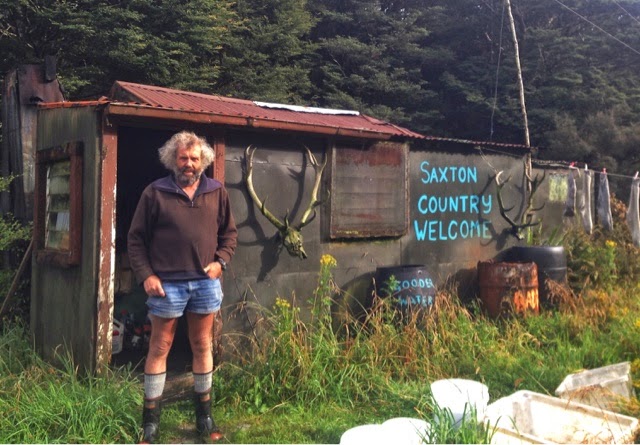
Luckily, I came to Pyke Lodge, a catered hut for guided walks. I didn’t even hesitate and went in to ask about the weather. Liz the host ended up giving me a print out of the weeks weather, some tea and a bag of cookies. Before Liz had printed out the forecast, an older man, also sipping on a cup of tea, had told me the whole weeks worth of weather, which mostly consisted of rain. I was a tad disappointed but was more intrigued to here more about this mysterious man that looked quite rugged. He had crazy grey hair that stood up like he’d be electrocuted and a medium size beard to match. He wore high rain boots, short jean shorts and a collared turquoise V-neck. His name was Bruce Reay and he was a bush man that lived off eel fishing and possum hunting. He told me he lived in a hut upstream at the end of Lake Alabaster, which had been his home now for five years. He has lived in the bush since 1978 in a variety of areas mostly on the west coast of the South Island. You might be wondering what exactly it mean to live in the bush. Well it basically means you live in the middle of no where away from society, on your own. Kind of like something you see on the discovery channel. Bruce is one of the few left to live out in the bush as it is a dying culture.
While sipping on my tea Bruce asked if I fished and I told him I was quite the fisher women. He offered to take me up to the next hut in his boat and fish along the way. I couldn’t say no and was thrilled, as I’ve been wanting to fish since I’ve got to New Zealand. He had a small white blow up raft with a small motor attached, that he called Anemic. He called his other yellow boat Hepatitis. We started trolling for fish and the first questions he asked me were, how long I had my nose piercing, if I had any tattoos and if I was a smoker. It was his three go to question to instantly judge someone’s character. It was quite amusing and reminded me so much of my Papa Bill who also thinks piercings, tattoos and smoking are revolting. Despite my piercings Bruce decided to still take me fishing and asked more “real” questions to get ask feel for who I was.
To continue the adventurous day Bruce invited me to go possum hunting and to stay at his hut, since it was gonna rain for the next couple days. I was a tad skeptical but knew it was a one and a life time experience to be a “bush women” for the next couple days. Bruce had 20 or so possum traps set up randomly deep in the forest. There were lucky pink markers that lead us to each trap but Bruce knew the forest like the back of his hand. Unfortunately the traps were all empty which i was kind of happy about as the next steps seemed a bit gruesome. To kill the possum you whack it on the head with a hammer then proceed to pull all of its fur out. Possums are a considered a pest in New Zealand but I still feel bad for the little guys.
Bruce’s hut was upstream the river and he couldn’t take both my backpack and I in his small boat. So he dropped me off on the side of the river and drew me a map on a magazine of how to get to his hut. I jumped off the boat and realized I was now truly off the beaten path. I’ve bushwhacked before but this time was a bit different as I only had a hand drawn map to guide me to an unknown destination. I followed all of Bruce’s key points on the map crossing creeks, pushing through dense bushes and walking through grass two times the size of me. I was really glad at this point there are no big animals or poisonous animals in New Zealand that would attach me. I came to another pond that wasn’t on the map and got a bit nervous that I was in the completely wrong area. I walked toward the river and was relieved to see Bruce down the river getting fire wood.
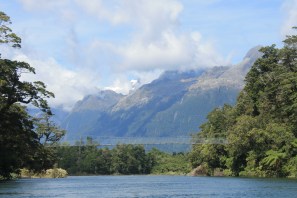
Bruce’s hut was a pretty small and made out of rusty old metal. He got his drinking water from the rain that dripped down off his roof into buckets that said gooder water and badder water. The view tho! It was spectacular. There was a huge waterfall on the side of the mountain and beyond that towered glorious Mt. Madeline.
I came to find out that living in the bush was much more luxurious then I imagined. Bruce had a satellite phone that he texted his friends daily with. He had plenty of food that wasn’t half bad. He had a radio to call different huts and get the weather each day. He had another radio to listen to music. He also had quite the library of magazines, books and newspapers. He had generator to run the lights and charge his phone and power his radios. Even a helicopter brings in his food, fuel and mail every three months and he can catch a ride on it to go into town every once in a while. To my surprise he seemed to have a lot for living in the bush.
For dinner that night Bruce cooked me a lovely meals of fresh brown trout, potatoes, corn and beats. I could tell it was the meal he ate almost every night but it was surprisingly pretty good. Bruce told me story after story the first night along with many jokes. He was so excited to have company and I eventually had to tell him that I needed to go to bed, as it was already 12:30.
The next morning the rain, as expected, started to come in. We waited for a break in the storm so we could go see the Olivine waterfall up steam. We thought we were in the clear but of coarse when we got in the boat it started to pour. It didn’t stop us and we got to the waterfall just in time for the sun to peak out of the clouds. It was a huge 70ft waterfall coming out of a gorge that twisted up the mountain. Bruce told me a couple of kayakers wanted to go down it a couple years ago but chickened out when they saw the real thing. I would have too.
It came time for me to part ways with Bruce and get back to society. Living in the bush was much different then I imagined but very peaceful. Bruce said he asks people “could live in bush?” If they said yes he then asks “would you live in the bush?” It was interesting to think about but made me realize it takes a certain kind of person to live out alone in such a remote area. I was fascinated by how passionate Bruce was about where he lives and how he makes a living off the land.
Bruce didn’t live in the bush because he hated people, or because he hated society. He truly just loved being out in the vast remote area that held the true peace of the world. Bruce told me he’s just always put the bush first and that’s where his true home is. When I first told Bruce I was studying conservation he had a discussed look on his face and I soon found out why. DOC (Department of Conservation) has been trying to get him out of the area for a couple years. Despite all the court dates, lawyer fees and DOC nonsense, Bruce continues to fight for what he loves which is quite inspiring. I never in a million years thought I would have an opportunity to see what life is like in the bush and it will be a memory that I will never forget. Staying with Bruce was an truly a one in a life time experience and an eye opener to the true appreciation for the beauty and gift of the Mother Nature.

Feeling Nomadic
The term nomadic is generally associated with feeling lost or feeling like you don’t belong. This word has really resonated with me in the past few days, but not for the same reasons. Nomadic simply means not endemic, or not from one place. Maybe everyone with a bit of wanderlust doesn’t really belong in just one place. Maybe, being nomadic means that a little bit of you belongs everywhere.Hobart has been an incredible experience and after just a few weeks I could already feel it becoming home; but, just because Hobart feels like home doesn’t mean Missoula or Idaho Falls feels any less like home. I have become nomadic. A girl with homes in both hemispheres.
Study abroad has been the best decision I have made thus far. It provides so many opportunities for personal growth, new friendships, getting out of your comfort zone, and exposure to situations you never could have dreamed possible. I’ve been in Australia for two months now and I’ve fed kangaroos, chased a possum from my tent, made incredible friends, eaten so much Nutella, been judged for eating peanut butter, saw a platypus while white water rafting, gone to markets, and so much more. It’s amazing what happens when you have to find your own way in a country you’ve never been to. People assume that Australia is just like the states, and parts of it are, but overall it’s the experiences you have that make a place what it is.
I’m incredibly luck to have five pretty fantastic flatmates. As a group we have three Aussies, two Americans, and one girl from Holland. They have made my transition to Hobart so easy and I couldn’t have asked for better friends. We spend so much time laughing and watching stupid shows. Just in case you’re interested, Aussie TV is mostly the crappy TV shows that no one watches in the US. My flatmates joke that they are “the shows of my people.” We have definitely become quite and eclectic family of sorts.
The biggest changes I’ve seen while I’ve been here have been in myself. I have been forced to be less indecisive and to go do what I want to regardless of whether or not someone comes with me. The level of independence required to be somewhere alone is huge. It also makes you value your friends and family that much more. I no longer fear that the most important people in my life will disappear if I leave. The people that are most important will make an effort to stay no matter where you are. I’m almost as far away as I can be from the US and my best friends and I still talk. In this day and age, we can change nomadic to mean homes everywhere, because even if you aren’t around physically, it doesn’t mean you’re gone.
Soccer? I think you mean futbol.
Coming from the United States to Chile, I knew that soccer was the national sport and Chile’s team performed well at the last world cup. Beyond that, I know very little about soccer. Growing up in the U.S. there were always a multitude of sports available to play as a child. From basketball to baseball to crew, Americans are known to be exceptional at many sports. Soccer however, is not one of them. A three sport athlete of Football, Baseball, and Racquetball in high school, I had not played in an organized soccer game since I was roughly 8 years old. Sports wise, coming to Chile was quite the wake up call.
The first day of orientation, I began talking to a boy from Medellin, Colombia. Immediately, he started talking to me about soccer. Unable to tell him more than who a few teams are in the Barclay’s Premier League, he began to realize that I did not play soccer.
“How can you even live with yourself!?” He asked me in Spanish. “Soccer is why I wake up every morning, nothing makes me happier than going out onto the field and scoring Golazo’s with my friends.” From that point on, I knew this was going to be a culture shock that I did not expect.
Whether I’ve met kids from Chile, Colombia, France, Morocco, Nicaragua, and more, they all have one thing in common: they grew up playing soccer. Being the gringo of the group, I have been teased with the stereotypical “American’s are only good at the sports they invented” line over and over. But the biggest thing about it is, it couldn’t be more true. To my horror, my friends decided to organize soccer games twice a week on a turf field nearby. Even though they knew I hadn’t played soccer, they welcomed me to come play with open arms. The first game I played in however, felt like a final exam for a course that I didn’t attend once. Unable to control the ball or make quality passes, the European’s and Latin’s we’re astounded by how bad I was at soccer.
Since, I have made a concerted effort to become serviceable at the sport. With the help of my friends and the continuation of playing for an hour and a half twice a week, I feel that I am experiencing a part of the South American culture that the common tourist never will. Sometimes, the best experiences can come from where you least expect them and personally, I am thrilled that I get to compete at the world’s most popular game with people from all corners of the globe.

Long Live the King of Thailand
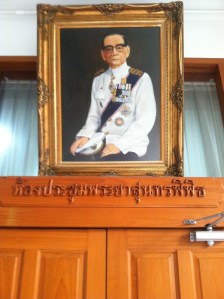
This is a picture of the King that hangs above the entrance to my classroom on the second floor of the political science building at Thammasat University. There is another one inside, and one of his wife the Queen as well.
Images of the King are numerous across the country. As soon as one leaves the parking lot at the large airport outside of town that services most international flights they pass under a large overpass with a huge picture of him that is lit at night, greeting you before anything else can.
Every Thai household has numerous pictures of him. They seem to be most common near the entry ways, but in most houses I have been in they have one in almost every room, oftentimes hanging on the wall amongst the family portraits, or sometimes just above the family portraits in a row of his own.
Many cab drivers keep images of him somewhere on the dashboard, and restaurants all have them hanging around the seating area.
There will be huge structures that look like monuments in the median of the road throughout the city, and when you pass particularly big ones in a taxi the driver will look at it and take his hands off the steering wheel to press them together and give a slight bow as we drive by. The same happens on a bus. You can look around and see about half the people on the bus do the exact same thing.
Every day at 6:00 p.m., if you are near a large public space, the national anthem is blared over loudspeakers. If you happen to be near a TV then you will notice all the normal programming cut out and head straight to the national anthem on the hour as well. The screens play a series of photographs of the King, interspersed with patriotic clips that often portray military might, like jets flying through the sky.
I’m told it’s irrelevant to religion, and a Thai person would revere the King where he was Buddhist, Muslim, or any other religion. The vast majority of Thai people that I am around every day are Buddhist, but I will look forward to examining that more closely when I head North in a couple weeks where there is more religious diversity.
Here is a clip of what shows on TV with the audio of the anthem as well, so you can experience it for yourself: https://www.youtube.com/watch?v=OBDKah2nnvw
And, since words aren’t coming easy, this is largely the feeling it evokes in me: https://www.youtube.com/watch?v=1N77NaxlGlU (definitely the “We’re not in Kansas anymore than the Good witch/Bad witch commentary. No veiled political statements here, only appreciation at a culture that is far different than my own!).
*For more Thailand posts you can follow my blog too! You can find it at peregrinefrissell.com.
Walking hand in hand with my mothers
I sat on the veranda yesterday afternoon. Above me the sky darkened, clouds drifting and merging until they became one threatening entity. The thunder rolled across the sky as soft gusts began to filter through the town. Slowly, sparsely the rain drops began to fall, warming up for the torrent of rain that soon followed. This is a storm in Africa. Now that we are into the rainy season, storms drift in and out unpredictably. When it rain in Uganda, everything stops. People are chased inside and the streets become quiet. Even the roosters, goats and cows that mingle along the streets are quiet-or at least you can’t hear them over the rain. The rain is a welcome relief after that weeks of dust and heat.
The rain has meant digging. We’ve been busy working with the Bulyantete women digging up the fields. We also spent some time planting maize with the women of Mayindo. Most mornings have been spent in Bulyantete digging. Tony keeps telling me that I’m in for serious work this next month as there is a lot of land to cultivate. But I don’t mind, I love it. We use hoes here instead of a tractor or tiller. The work has the opposite effect on me-instead of tiring, I leave the fields buzzing with a strange jolt of energy that I only find when gardening/farming. As I dig, my mind wanders, my mothers and sisters chatter around me. Luganda fills the air. I can’t understand much of anything-occasionally my name, Namubiru, comes up. I can only guess at what’s being said. Despite my lack of understanding, I find it comforting. We may not be able to understand one another, but there’s mutual happiness. I look forward each morning to seeing them. It’s a funny thing, becoming close with people with so little words exchanged. After the first morning digging, the women sent me home with gifts of food. I knew better than to refuse but it left me troubled. They need the food so much more than I do and yet, here they were giving some to me. I fought back tears on the bodaboda ride home, somewhat unsuccessfully. I’m sure some Ugandans in the passing cars were puzzled by the crying Mzungu on the bodaboda. I didn’t understand and was overwhelmed by the gratitude shown by the gifts. I simple thank you would have been more than enough. I genuinely enjoy being there and working. I suppose it’s a character flaw of mine, but I’ve never been particularly great at accepting thanks with any sort of grace. After a good cry and Andrew’s explanation, I began to understand. It is their character to give to show gratitude. They gave what they did to show how important I am to them. And that, that is powerful. The women, without few words and little understanding, have become my mothers and my sisters whom I love. This is what grassroots volunteering is and what all development work should be. None of the giant, impersonal systems that dominate the development field. Development is more than money or structure or formulas–it’s getting to truly know those you are trying to uplift. It’s knowing their characters- which one of them is the dancer or singer or comedian or the one that’s always laughing. That’s where the seeds of change get their start.
The new land and crops will bring in much needed income for both the women and Hopeline. It will mostly be maize, which requires little water. The effects of climate change have made an already water scarce environment even more vulnerable. The past few seasons have seen too much rain and not enough. Hopefully this season will be different.
After my time with the women, they walk down the dirt paths with us to the main road where we meet either Tiif or Bower (our bodaboda drivers-their names may be misspelled). Often, one will take my hand as we stroll, unhurried down the path. And I’m overcome by joy at being here, worlds away from home, walking hand in hand with my mothers.
*(I, of course, have not forgotten my family and friends at home. I love and miss them dearly and do not mean to imply any differently. My heart has simply grown to hold my Ugandan family as well.)
Beneath the mango tree
The internet cafe where I sit now is a fair distance from my house and
usually leaves me dusty and sweaty but not today. The rain has blessed
all with it’s sweet, cool presence. Before today, rain fell shortly in
pockets, but today it lingers and is a much needed relief from the hot
and dry weather. The past week has been especially dusty. I returned
home from the projects orange which incited much laughter from Tony.
Red dirt is my new accessory these days-which is just fine with me.
I began the week at the medical clinic where I was tasked with handing
out medication. Many were for malaria. The treatment of malaria here
is just like a common cold in the states. Overall cases and deaths
from malaria are much lower in the area. The drugs in Uganda come from
India and are less effective than those you would find in the US. This
means that more pills must be given out making it a challenge to keep
medications stocked. I also learned how to test for HIV and malaria.
After showing me twice, the doctor was more than willing to let me
poke a stranger-me, a history major. I passed that day as I’m a bit
hesitant about poking people with needles however small, but I suspect
I’ll be testing patients no problem by the end of my time here. I
enjoy working at the clinic, learning and building important skills
that I wouldn’t gain anywhere else.
This week we said goodbye to Jacky. Her impact upon Hopeline and the
family cannot be put into words. Though she will return later this
year, her presence is still very much missed. The last two days of the
week we spent with the Mayindo and Bulyantete women, celebrating
Jacky’s time here and saying goodbye. At Mayindo, I learned how to
prepare matooke the traditional way. The process of peeling and
wrapping the matooke in banana leaves is precise and your performance
is used to judge whether or not you’re ready for a husband. I’m not
sure it’s used so much anymore, but much laughter was had at my poor
wrapping skills. I did alright at making kabalagala (sort of like
banana pancakes), so perhaps I’d make an okay wife.
At Bulyantete, I made chapatis. I love chapatis, so I was more than
willing to learn. It’s something I will definitely be making at home.
Part way through the day, we walked to the to get water. The distance
traveled everyday, 4 or more times a day, just for water is
outstanding. With any luck, construction on a new, better positioned
well will begin this week. The Bulyantete women recently began a brick
making business, for which water is essential. The new well will make
there work a bit easier.
We spent the last few hours of our week in the shade of a mango tree,
with thunder and rain showers circling our spot among the trees. Good
food, laughter and love filled the air as the women said goodbye, if
only for a little while, to a friend and sister. Tomorrow, I begin my
time volunteering alone until the next volunteer arrives at the end of
this month. It’s sure to be a challenging but enlightening week as I
get know everyone a bit better. Thus far, it’s been hard to tell where
the students are in their education as well as where the ladies are
with English. I’m hoping to share a bit of basketball with the boys
this week, but we’ll have to see. For now, I’m enjoying the last few
hours of my Sunday in the cool aftermath of the rain.
Mzungu, bodabodas, and soul-shaking welcomes
I’m not sure where to begin. My first week in Uganda has been nothing short of amazing. There is so much to convey from only a week. I’m finding it hard to remember that I’ve been here only a week, it feels like forever. I’ve been amazed at how naturally I’ve flowed into this life and to the work. I already know leaving will be among the hardest things I have had to do in my life. The people I live with and the children, women and boys that I work with, have already made their way into my heart. The amount of love and sincere welcome I have experienced have broken me open. The Western hardness that I’ve carried because our culture is so lacking in the warmth that Uganda espouses, has disappeared completely. It was instant, the connections I have made here. I was originally only supposed to volunteer the first month, but I will be staying with Hopeline for the second month as well and I couldn’t be happier.
Hopeline runs two women’s groups, a boys’ group, a school and helps with a medical center in the villages. Tony, the director, is the most selfless, strong and giving person I have ever met. What he is trying to do for his home village is amazing. The women have unimaginably difficult lives, full of work and much misery. Tony and Hopeline have given them the little step up they need to begin to better their lives. Through basket making, chicken coops, wells or the impending brick making business, the women have been able to gain much need income. Many of the women work on Mehta’s sugar cane plantations outside of Lugazi. They must rise early in the morning (4-5am) in order to maybe get work. Lateness is not tolerated. Even if they manage to gain work for the day, often their labor can be cancelled if they fail to find enough sugar cane in the fields. At the end of the month, the most they can expect is 20,000 shillings, or about $8. No one can live on that. Not even here. Often they must look into their children eyes and tell them that there won’t be any food that day. In these circumstances, schooling is but a lofty wish. Yet, despite the hardship of their lives, they have welcomed me with open arms and souls. The welcome ceremony from the women was like nothing else I’ve ever experienced. Singing, dancing, hugs, and words of welcome were showed upon me. At one point they expressed ‘who are we to host a mzungu like you?’-how do you respond to something like that? For me, it’s more like, ‘who am I to be here with you?’. During the welcome is the hardest I have ever worked to keep from breaking down completely and that was only because I did not want to send the wrong message with my tears. At that time I was completely at a loss as to how I could possibly help the women, but after speaking with Jacky (the volunteer coordinator/co-director of Hopeline), I will be able to put some of my money towards the Bulyantete women’s group to purchase chickens, build a well, and begin a brick building business. I hope to teach them English as well, but I’m still puzzling out how to do that best.
KKoba school has been great. The goal at Kkoba is education, but also to build confidence and foster socialization. The attitude in the villages is bleak. Alcohol and hopelessness is rampant and no child can possibly thrive under those conditions. That is why Kkoba is so important for the kids. Giving kids even a little education in combination with the confidence that gain from interaction with mzungus, their teachers and classmates dramatically improves their lives. Someone who has a bit of education and confidence will fair much better than someone who doesn’t. So far I’ve played with the children (volleyball and bubbles), taught them about the the life cycle of butterflies as well as a bit of addition in the form of a game called math mountain. I hope to teach them more English, math and random science things.
We travel to our projects on the back of bodabodas (motorcycles), which are a main form of transportation here. I loved it from the start. I love whizzing past the lush fields and smiling children waving and screaming ‘mzungu, mzungu-bye mzungu!'(mzungu is the word for foreigner/white person-which is a kick in the pants for me, being that I’m mixed) There is nothing else like it. The group of children that gather in my courtyard grows day by day. Motokas(toys cars), coloring and general play are what I come home to after my time at the projects.
By the end of the week, I had never needed a weekend more. I was beat-mentally, emotionally and physically. I love the work I’m doing, don’t get me wrong, but it is tiring-especially since it was only my first week. I’m not even sure how to capture the poverty. I haven’t written directly about it yet because it’s simply everywhere, all the time. It’s there in the barefoot children at KKoba, it’s in the women who are struggling to feed their families, it’s in the men who were not able to attend school and it’s in the children who greet me on my porch, one of whom will look up at me after I ask about his day to say: ‘it was bad, I don’t have a toy airplane, the dirt burns my feet and I haven’t eaten today’. It’s enough to crush the soul. But it also inspires and strengthens me to do what ever I can to create hope. That is what I get to do- teach and give whatever I can so that maybe, just maybe, hope will grow.
 Beyond the Classroom