Returning to Scotland

Well today is my last day of my epic spring break trip. My trip took me to five different countries and eleven different cities along the way. From Amsterdam to Budapest to Frankfurt I have covered a huge expanse of Europe and history itself. I have seen the different cultures of Europe through language, food, even clothing. I have walked in the footprints of giants and seen history for all its worth. This is a story of the most memorable things I have seen along my trip.

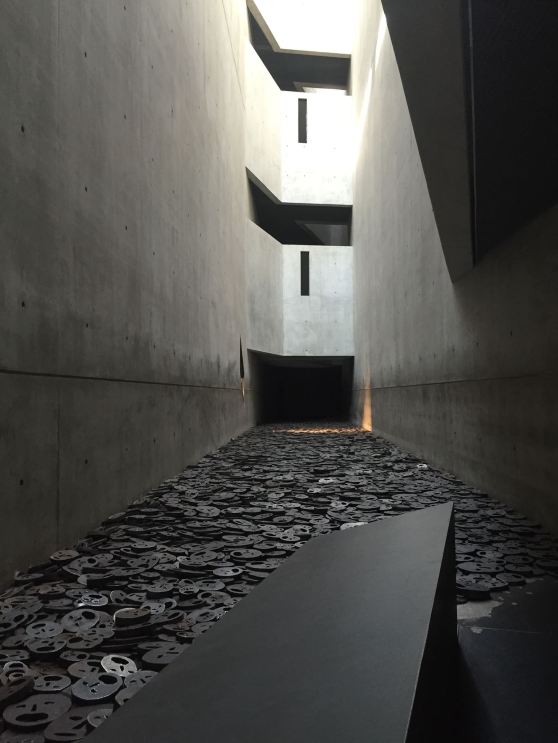
Berlin holds a special place in my heart because of the great historical importance the city has, both good and bad. I was lucky to travel to the Jewish museum in Berlin which was an eye opening experience. The museum itself is a small picture of what life was like for Jewish culture throughout history leading up to the terrible events of World War II. But the truly breath-taking thing about the museum is the symbolism that the large empty cavities and the room of faces have on the unprepared. When you enter a large empty room that is lined with ten thousand metal faces on the floor representing the people who were killed in the Holocaust it has a staggering effect. It made me pray that the conflict in Syria comes to a speedy end so they don’t need to build a museum to it and do a similar thing.

13063465_993839674004055_6796922034197765642_o

In Budapest I spent time exploring a city that has many hidden gems waiting to be uncovered by the adventurous. I happened to be bored one day so I looked up museums in Budapest and the top rated one was a pinball museum. I was shocked that I had not heard about this before so I decided to make the trip across the city and visit it. I was not disappointed. There were over fifty pinball machines from the 1940s to the present. And a majority of them were even playable for free. A truly worthwhile experience to explain my time in Budapest.

12968071_989523357769020_2661057681473092171_o

The last amazing moment I had was in Munich, Germany where I saw the true meaning of being a traveler. I was sitting in an Italian restaurant all by myself when a man and his young son came strolling in. The man ordered in German but spoke to his son with a Southern American accent. As soon as I said hi we spent the rest of the meal talking about our journeys and life in general in the last place I expected. It really shows how the unexpected conversations can sometimes be the most worthwhile if you are with interesting people.

To end this story I think of all of the amazing people who have made my trip possible and the ones who helped make it amazing. It has also made me appreciate the friends I have both in Scotland and back in the United States so much more because its a strange feeling to go three weeks with barley any contact with people you know other than through messages. So thank you to everyone who has helped me and supported me over my travels.

Culture Shock

So everyone talks about culture shock like it is this super scary thing that affects everyone in their own special way. Now, I’m one of those people who believes that all you have to do is accept that things are going to be different and everything will be okay but sometimes that can bite you.

I have spent the last three months in Scotland which both very similar and very different from the area in which I come from. It has more people in a much smaller area and they are use to a different way of life but they share many traits. The biggest one for me is the language that they speak. At first it took a few days to get use to some of the things they said, all the while wondering if they were truly speaking English. But I have quickly picked up the accent and have fallen in love with Scotland and all of its wonders to behold because every time I start to think I have seen it all, something happens. I connected so much more with everything around me and I really felt like I belonged in the highlands. But then everything changed.

I decided to city hop across Europe for my spring break and I quickly came to realize that I took so much for granted in Scotland compared to the rest of the world. I landed in Amsterdam and was dazed by all that the city had to offer but one thing seemed to nag at me the whole time. I just shut it out of my mind because I believed that everything would be great as long as I cam at it with a positive attitude. As I prepared to leave Amsterdam I actually met some people who had lived in Montana for quite some time and it made me realize how much I had waiting for me back home.

As I headed off on my next train journey to the German city of Hamburg I quickly realized what it means when you just can’t understand people. My train was delayed for a few hours after an emergency and when they spoke over the intercom they always spoke in Dutch and then German followed by English. It made me cringe because I could see everyone around me knew what was being spoken but I just couldn’t put all the words together fast enough so I would wait for the English one to find out what to do.

To end the crazy day on my journey to Hamburg I decided to go out for some dinner because I hadn’t eaten all day. The restaurant that I chose was so full that they were seating random groups of people together and I ended up siting with two German guys who never spoke a word to me because I wasn’t able to speak German enough to carry a conversation. It really shocked me how much language can divide me and it gave me a quick insight what people who are felling conflicts around the globe must feel when they come to another country and they can’t understand any of the people around them. It’s not a good feeling and it can quickly demoralize a weary traveler.

Witnessing: Remembering the Holocaust

As one can imagine, this was by far the most painful and hard-to-process subject that I encountered on my trip. The Holocaust has a special kind of lore in America, and is consistently taught as the greatest crime against humanity. It is important to note that this lore is largely shaped by a pro-Israel, anti-USSR sentiment and is largely political. The narrative of the big, bad Third Reich brought to its knees by American liberators is as propagandist as Mein Kampf. It is obviously motivated by different (some would argue moral) intentions, however the level of manipulation is comparable.

I was aware of the political spin on my conception of the Holocaust as we began our trip, and I was struggling to find a way to have a meaningful experience without co-opting the suffering of others for my own political or moral education. I was hypersensitive to the fact that neither I, nor my ancestors, had been victims of the sort of systematic oppression and genocide that the Jews and other people groups murdered by the Nazis had been. While I certainly could empathize with the unimaginable suffering of concentration and death camps, it felt wrong to try and glean any kind of trite message from the deaths of millions. Simply put, I didn’t feel like there should be a lesson from the Holocaust.

This led me to one simple goal as we experienced Dachau and Auschwitz: bear witness to suffering and be open to the emotion the experience would bring. It felt like the most significant thing I could do as an outsider was to allow the sadness and horror to deeply affect me, to simply mourn for the victims.

This is not to say that I didn’t walk away from the experience with any new knowledge. Seeing the absolute intentionality of the Holocaust first-hand drove me to questions about the morality of politics and the circumstances necessary for mass genocide. It forced me to reflect on the reasons I was enthralled with rhetoric and underpinned my quest for a moral code for political communication.

But more importantly than that, I feel very grateful for the opportunity to mourn. The Holocaust was not the first genocide, and it certainly hasn’t been the last. Dachau and Auschwitz not only stand as memorials for 11 million people, they remind us of the millions more since 1945 who have been victims of fear and hatred. They are ugly reminders of the capacity of humanity to do harm to itself and monuments to the necessity of tolerance. The most terrifying part about walking the grounds of Auschwitz is just how “normal” it looked. It could have been a village if it were not for the evil of the men who created it.

I still don’t think there’s a “lesson” to be learned from the Holocaust. The only words of remembrance in Auschwitz read: “At this place where the Nazis assassinated a million and a half men, women, and children, a majority of whom were Jews from diverse European countries, will always be a cry of despair and a warning for humanity.” There’s no nursery rhyme morality that one can glean from the gas chambers, no epitaph on the mass graves. Rather, the Holocaust stands as a terrifying reminder of what we’ve done and, in some cases, what we continue to do.

Berlin (December 31-January 4)

After driving across most of Germany, we finally arrived in the bustling, edgy, unique city of Berlin. We quickly got ready for what we knew would be the New Years celebration of a lifetime. Unlike the tame (lame) American tradition, the Germans go all out and take full advantage of the lack of open container and fireworks laws. It was certainly a memorable experience.

IMG_5632

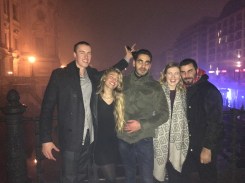
Our new Syrian friends in the haze of what can only be described as a TON of fireworks.

Through the magic of the New Year, we ended up meeting a group of Syrian refugees who had been in Germany for about a year. Through a complex chain of translating from English to Arabic we were able to have a fascinating conversation about their families still in Syria and American responsibility to intervene. I was struck by the similarity of the conversation we were having about appeasement and crimes against humanity in Syria, and the ones that must have been had as the Nazis and later the GDR rose to power.

A theme of our time in Berlin would be exploring the German national identity and the ways in which they have begun to reconcile with the wounds and wrongs of the past. As xenophobic rhetoric reigns in the USA, I was absolutely awed by the German commitment to provide a safe place for those fleeing persecution. It seems that the painful process of remembering the history of totalitarianism and fear in Germany has allowed them to see past nationality to the common humanity in all those seeking a safe place to exist. America has largely chosen to ignore the dark and shameful parts of our history, hoping that the future will abstain us of guilt. However, it seems obvious to me that this has created a cycle that returns the same problems of racism and distrust into the national dialogue frequently.

As we continued our time in Berlin, exploring both the Nazi and Soviet history, I was consistently reminded of the willingness of Germans, and specifically Berliners, to publically explore their past. This was a powerful theme as we would continue into Poland to explore the pain of the Holocaust. Instead of being able to think about these events in black and white dichotomy as is frequent in the American conception of suffering, we were introduced to the power of the German dialogue regarding Nazism.

Munich, Obersalzburg, and Nuremburg (December 28th-31st)

After 18+ hours of traveling in coach, Munich was a welcome sight! After a much needed wheat ale and German sausage, we took in our festive surroundings. Christmas is a weeks long celebration and the hot wine and baked goods were plentiful.

We started the academic portion of the trip with an excursion to Austria to see Obersalzburg which served as Hitler’s mountain fortress for much of the Third Reich. Underneath what seemed to be an idyllic ski resort for top Nazi brass, Hitler had a massive system of bunkers constructed. Although he would end his life in his Berlin bunkers, Obersalzburg was used by Nazi officials until the very end. The museum

IMG_5473

A beautiful Austrian day with the exposed part of the Obersalzburg bunkers.

illuminated the propaganda of Hitler’s personal life that was used to portray him as a likeable god. He was portrayed as serene, quiet, yet in perfect physical and mental health. He was the people’s leader.


We continued our day by lunching at a gorgeous alpine lodge where Hitler himself dined often. It was a little surreal to realize that we were quite literally on the ground that history had happened on. This would be the first of many times where I was struck by the depth of history in the places we visited.

Another notable experience in Munich was visiting Ludwig Maxmillian University, home to the White Rose Resistance movement. In the height of the Third Reich a brave group of university students and one of their professors published several leaflets denouncing the Nazi regime. Among these was Sophie Scholl 21 year old student who would be executed for her part in the resistance. I was captivated by Sophie and the courage it took to face one’s impending death with grace and even beauty. It was a welcome story of bravery and even triumph amidst a narrative of suffering

IMG_5544

The balcony from which Sophie Scholl dropped hundreds of anti-Nazi leaflets. This action would lead to her execution just days later.

and injustice.

As we left Munich (and the best beer I’ve ever had in my life) behind, we continued onto Nuremburg for a quick afternoon stop. Infamous for persecutory laws against German Jews, the site of The Triumph of the Will propaganda film, and eventually the location of the court that would sentence many Nazi elites following the war, Nuremburg was steeped in history. Most significant to our theme of propaganda was the half-finished rally ground building that was to become the primary speaking hall for Hitler and other party elite. The sheer size of the building that remains speaks to the Nazi fascination with all things grand and imposing.

IMG_5600

What remains of the speaking hall building in Nuremberg.

Much of our time on this first leg of our trip was spent exploring the Nazi regime’s goals and history. This would prove to be an interesting foundation for the following emphasis on the victims of the Holocaust and WWII. It also set up a nice foundation for comparison with Soviet controlled Germany.


The Search for Familiarity

It was grey the day I arrived, and it was grey the day I departed. The heavy, low-lying clouds brought me a reassuring sort of comfort, and the refreshing breeze flowing between the apartment complexes and the Straßenbahn tracks of Karlsruhe Nordstadt reminded me to breathe slowly and deeply to keep my emotions at bay. It was pouring rain the first time I lugged my black suitcase with anything but grace and ease over the cobble-stoned sidewalks; and although droplets didn’t fall from the sky’s loose grasp as I walked away from my building for the last time, the gloom in the air was palpable. Perhaps it was the weight of my luggage or the heaviness of my heart that made my feet move like blocks of lead as I boarded onto my last Straßenbahn, but two things were for sure:  A part of me was staying behind here in Karlsruhe, and the person leaving it behind was no longer the same as the individual who had brought it here in the first place.

In my opinion, life is full of juxtapositions. I like to think that there are patterns that flow through everything we do – from the places we visit, to the people we meet, to the activities we participate in along the way; and if we are paying attention closely enough, we are given the opportunity to acknowledge magnificent details that might otherwise go unnoticed. From my time abroad here in Germany, I have been observant of a particular cultural tool that I myself especially used during my transition into a new environment, and it involves this basis of comparison and contrast that we apply to our realities in order to understand the world itself. From grocery shopping in an entirely new environment, to that often awkward introductory conversation with a stranger, there is a dominant characteristic manipulating our choices and interactions, and it is this: we are constantly searching for familiarity.

Naturally, there are many components that influence us over time, but it is the concoction of our mixed experiences and diverse lifestyles that tint our vision of what is good and what is truth. The way that we maintain and continuously build upon our identities has entirely to do with the ways in which we equate minor characteristics in our surroundings with an idea at large. This search for familiarity is a game that we are constantly playing, where the purpose is not necessarily receiving the answers themselves to our gaps of understanding, but instead recognizing the internal and external transformations which occur in the process.

In attempts to develop meaning out of my time abroad, I took a chance at trying to understand this search for familiarity, and here is what I have determined:


As stated in the movie Into the Wild, “Happiness is only real when shared.” A single location can solace an individual, but it is the company of others that instills significance in our interactions with our environment.

 I once wrote in an Instagram post concerning Germany that you know the place where you belong when find the place where you long to be; however, I now believe that belonging is a not as much of a spontaneous impulse as it is a committed choice. It’s easy to love something when seeing it at its best; but still admiring it at its darkest hour is the real sign of appreciation.

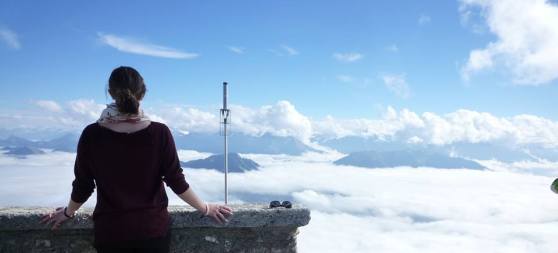
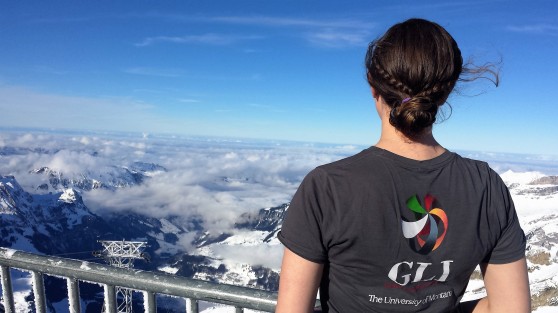
My European journey began and ended with a magnificent trip to the Swiss Alps. As a native Montanan, I find that where there are mountains, there is a perfect canvas for deep reflection, and it has been a big Bucket List dream of mine to visit these famous, beautiful ridges. But as I stood on these high peaks, the most reoccurring thought was that of home. I suppose we can travel the world, achieving goals and going great lengths, but wherever we go, the greatest thing we carry with us is our origins.

 sff blog 320160123_142336

 (Special thanks to GLI for the worldwide support, the educational guidance, and the indispensable stimulating inspiration)

El Fin

By: Ciara Gorman

(Posted September 16th, 2015)

My time in Nicaragua came to an end and it was time to travel home. Saying goodbye to all of the wonderful friends I had made was tough but I was ready to see my family! Little did I know that the first week home would be a huge adjustment. I wasn’t used to running water during the day and certainly wasn’t used to the weather that felt like I was going to freeze. I often looked around throughout that week and realized how much I took advantage of simple things that really are luxuries. I wasn’t used to the paved roads, the urgency everyone around me had or the use of electronics that truly dominates our way of living in the United States. I cannot speak for other countries because I do not live there but I know that most Americans could benefit from a type of service trip in a place that is very different from our way of living. I say this and am hesitant though because third world countries do not exist for others to pity on and give charity to. Never in my life have I seen neighborhoods and communities like the ones I did in Masaya, Nicaragua. The people were so supportive of one another and truly were friends to not only one another but to visitors like myself. From the young children to the elderly ladies that got together at dusk, every person I had the chance to meet and converse with made me feel like an old friend. I think what I was trying to say earlier is that most people in today’s world are so comfortable in their setting that they do not realize the potential that is out there for personal growth and new experiences.

The medical aspect of the trip was incredible as well and I was lucky to be with a group that had similar goals and career interests that I did. I didn’t know a single person on this trip with the exception of looking on Facebook! I loved meeting people from across the country who wanted to learn and make a difference each and every day and am lucky to call many of them my friends today. As much as I felt like I helped our patients, I don’t think they realize how much they helped me in return. This was my first opportunity taking patient histories and performing physical exams with a team. I realized the importance of not only asking the right questions, but also performing a thorough exam so we didn’t miss anything when the doctor came to us. Educating our patients on hygiene, diet and answering their questions was one of our strongest tools as well. The opportunity to see conditions and diseases not typical to the US was unique and my first experience conversing in Spanish with patients was so cool!

The best way to understand a culture is to fully immerse yourself in it and I will repeat that until my last day on Earth. This trip was an experience of a lifetime and I cannot express how grateful I am for the opportunity. Traveling to a country I’ve never been to, speaking a language I wasn’t confident about and eating food I normally would not are things I would highly recommend to anyone. Getting out of my comfort zone was one of the best life decisions I have ever made and the friendships, memories and clinical experiences I gained are only proof of that. I want to thank Vida Volunteer for coordinating our trip and to GLI for helping make my experience possible. Pura Vida!

“Only a life lived in the service of others is worth living.” -Albert Einstein

unnamed-2

unnamed-1

11401385_10152797212177554_2487780513404578417_n

11406923_10205382201129298_3574932360876491385_n

11217955_10153348060733361_2385203811573510895_n

11535859_1143694028980357_3384470627275450947_n

11392979_10102823130914940_4669185197729297409_n

11426716_10102823134128500_3497890503053269115_n

11535884_10153347310418361_7374496027884254348_n

Pacayita!

By: Ciara Gorman

(Posted September 8th, 2015)

Day 7 of our trip was the turning point for me in our clinics. During our clinic orientation, Dr. Pinto had taught us about common illnesses and diseases we would frequently see throughout the next couple weeks and mentioned to us that prevention education was one of our most powerful tools to help people. By now, I felt confident in taking patient history (mostly in Spanish by now!) and performing physical exams. I was not prepared however for the emotional toll seeing some of these patients had on me though. Experiencing some of the living conditions our patients had and the surrounding communities really opened my eyes to why some people were sick! It was a common practice to burn garbage in these areas, but, often times they were open fires in backyards or right next to the homes. We would frequently see children with severe allergy symptoms and respiratory issues in our clinics and I would tell the parents that their smoke from burning garbage was a likely cause.

A common illness we saw was Chikungunya. This was a viral disease passed to humans from mosquitos and resulted in rashes, fever, joint pain that could last anywhere from a couple weeks to several months. It was interesting to see an illness not common in the US frequently in another country and reminded me of the importance of constantly studying and staying on top of illnesses whether they are common to your area or not. I learned the vital importance of a thorough physical exam when a young girl complained of common cold symptoms like a sore throat, fever, and body aches. The minute I asked her to open her mouth so I could look inside I was shocked. She had the most swollen tonsils I had ever seen and we classified them as stage III tonsillar hypertrophy, meaning they were almost completely obstructive to her throat. Thankfully we gave her an immediate referral to the hospital to get them taken out. If we hadn’t looked in her throat, we probably would have diagnosed as a common cold and just prescribed acetaminophen!

Thankfully our long days were also followed up with relaxing evenings exploring the cities we visited. In Masaya, we visited their famous outdoor mercados (markets) and shopped for souvenirs and even found hammocks a couple of us bought! I had my first smoothie with guayaba and pitaya! They were some funky looking fruits but they tasted awesome. All of the fresh fruit we’ve never heard of but got to try everyday was definitely one of my favorite parts of Nicaragua. I never found one I didn’t like!

exchanging money at the Nicaraguan border!

1236175_1136985469652074_4322854895908125878_n

1392017_10102823126309170_6314625082499041783_n

11535908_10102823157242180_4741366086414489563_n

10492528_1143694255647001_4870196319335285085_n

10885466_1143693662313727_8942366399941216074_n

The best smoothie i’ll ever have!

11391258_10206443466910371_3324674623232033921_n

Guayaba!

imgres

Pitaya aka dragonfruit!

dragon-fruit-seeds-DIY-home-graden-pitaya-seeds-fruiting

Carmen del Parque & La Fortuna

By: Ciara Gorman
(from September 3rd, 2015)
We had out second clinic day in the community of Carmen del Parque. I was particularly interesting in learning about both Costa Rica and Nicaragua’s healthcare systems and made it a point to find out more today. Costa Rica has a universal healthcare system and is regarded as some of the best in Latin America. Often times, we saw patients whose family worked in some sect of the government so they had the opportunity for a privatized plan. Many people from other countries try and move solely for the healthcare benefits, referred to as seguro social, and job opportunities. However, it was apparent that if you were from another country besides Costa Rica, you most likely did not have healthcare access and consequently were patients we saw in our trip. This community had cobblestone streets and the houses were colorful with children playing everywhere. Children who had school that day were dressed in white pressed collared shirts and navy bottoms with black shoes. They took such pride in their school attire and made sure to not get dirty by playing with the younger kids before they left!

In the afternoon, we headed back to where our vet team was located and had ice cream for the first time! It was an interesting experience but it was so hot outside that day that no one really noticed the differences in flavor and texture. We played a pickup soccer game with the kids around that neighborhood while we waited for the vets to finish up. This is hands down one of my favorite memories of the trip! I started to juggle with a couple of the kids with my scrubs and stethoscope still on and they just stared at me. For one, I was a girl playing with a soccer ball. Two, my Spanish was still a work in progress at this point so we had a little bit of a language barrier. A couple of the young boys really stood out to me, however. One was named Juan Carlos and we ended up scoring goals and winning the game together. The other guy I called Real Madrid because of the jersey he had on. They both were phenomenal soccer players and were only 12 years old! We left the community a little sad that day but I know one day I will hear about a famous Costa Rican soccer player named Juan Carlos and smile.

We had an off day so we traveled to the city of La Fortuna and checked in to our next hotel. We ended up visiting this beautiful hot springs resort for the afternoon and it was our first chance to really see the country as tourists. What I was shocked by was the hospitality and friendliness every Costa Rican showed us! We stayed at Villas Vistas Arenal overlooking a volcano for the night before our all day bus trip to Nicaragua that following morning.

Thank you Costa Rica for everything you taught me, I will be back for you someday!

11401030_10153347310083361_8700555639164477129_n

11391428_10102823134737280_6513498602210754805_n

A blue-eyed local?

Three times, three times in ONE week, I was mistaken for being Chilean…. by Chileans! Toot toot! Ok I’ll put my horn away.  I may not be able to say much, but damnit I can sure imitate that accent. 🙂

If anyone was wondering.. it’s been confirmed. I’m the proud owner of the biggest feet in Chile (on a female, that is. Although in general, I’m probably close). La mama chilena approached me last week and very forwardly looks at my Chaco-clad feet and says “Uh-uh. Nope. Not acceptable. No more Chacos. We’re going shopping.”  Promptly at 9 a.m. the next day, she hauled me out of bed and off to the mall we went. First store we stepped in, we browsed a bit before I realized I hadn’t seen my size once.  Nor anything within 3 sizes of my size. She marches up to the front desk and asks if they carry a 44, and he says, “of course!” …pointing to the men’s section. “No no no,” she says, “women’s!”  …The response: a headshake….followed by a squinty, not-real-subtle look of disbelief and a quick up-and-down of the tall gringa (me) by her side.  11 stores later, I was laughing and shaking my head while she, ever more determined, starts calling in the whole family, asking where in the country there might be a shoe store that carries my size. “Ay dios mio” she says, “what are we going to do with you!”  Hey– at least in Missoula socks and Chacs are cool.

A few weeks ago I spent a four day weekend in Santiago.  I had a blast.  It started out being picked up at the bus terminal by two wonderful people I didn’t know, just friends of friends, who pulled me into the crazy mess that is the Santiago metro.  Thousands of people, lines in every direction, about 8 different floors of trains… kinda made Valparaiso feel like a deserted forest.  My fearless leaders stuck by me, though, and an hour later we stumbled out into, well, I still have no idea where we were. Another twenty minute walk and we made it to his house, where his mom (everyone lives at home until they’re 30 here….so weird) cooked us dinner and insisted we practice his English.  David actually attends an English institute, and he knows a fair amount of the language but is very shy about speaking it.  It worked out perfectly–I help him with English and he helps me with Spanish. He is ruthless when it comes to correcting my Spanish and I love it.  People are usually too nice to point out errors.  We still keep in touch almost daily, and he’s always quick to help me out with stuff I don’t understand.  The best was when we got into an argument over Spanish grammar– something HE had said, and I brought it to my professor here and proved him wrong. Hehehe. His sweet mother gave me a woolen doll she had made and insisted I come back anytime.  Later, we went to a party where I saw all of my “army of Chilean protectors,” aka the goofy guys I met camping back in February.  What a blast.  And this time, I could understand them. 

I spent the rest of the weekend exploring Santiago and being passed around from friend to friend, seeing all kinds of friendly faces I met when I was traveling.  I went to see La Moneda, the president’s house, that was bombed in 1973, killing Allende during the military coup.  I wandered all the famous hills, parks, museums, tried supposedly the 25th best ice cream in the world (I wasn’t convinced), saw an enormous protest in action and decided, rich with history though Santiago may be, I am so very glad I chose the city that I chose.  I feel more and more like I hit the jackpot living where I do.

Lunch with la mama and her son turned immensely powerful and educational when I brought up that I was going to a showing of a new movie, Allende en su Laberinto (Allende in his labyrinth), a film documenting the last hours of Allende’s life in La Moneda as Pinochet rose to power.  I had been nervous about approaching the subject at home, and it’s something I had been wanting to ask her about since before I even arrived.  It is a touchy subject here, though, and I’ve heard it compared (by Chileans) to asking a German about the Holocaust.  The country is still very much divided.  When I mentioned the film, her son Oscar, who thankfully speaks very clearly, warned me that the film was unlikely to be objective, but rather would paint Allende as the hero. He is well-educated and objective himself, and was able to clearly explain both sides, as in who supported Allende and why, the mistakes he made, and who was in support of his fall.  And the same was said for Pinochet; who benefited from his rise to power, his economic success with Chile, and the horrible social actions he took in the process.  On the other side, my host mom is poorly educated because she couldn’t leave the house for 12 years of her young life under Pinochet, but was able to explain what life was like for her at the time… the things that she saw, the family members who were killed, the friends who were never heard from again, and how she would stand in line once a week for a single kilo of bread for the family, silent and head down while the military stood over them with machine guns, ready to drag off and shoot anyone who stepped out of line.   For 3 hours they talked, each supplementing each other’s thoughts with interjections of their own… it was more than I’ve ever learned in any history class on the subject, and well-worth staying with a family for that alone.

Perhaps the most fun I’ve been up to is playing tour guide for a plethra of buddies who come visit me. I am so glad I traveled first… I am so lucky.  I met so many excellent people on the road, and instead of having to say goodbye, I got to say come see me in the North! Each person who has come here to see Valparaiso and visit me I only knew for a few days at most, and yet the second time around it’s like seeing an old dear friend again. Plus, it has allowed me to do so much exploring of these cities! Visiting the house of Pablo Neruda, free walking tours, hours and hours wandering the steep hills of Valpo, getting lost in street art and friendly characters, finding the best empanadas and the cheapest underground pubs. Beaches, beautiful sand dunes, street performers, artists, ancient rickety elevators, the adorable musicians on the metro who round up the ladies and serenade us with their guitars and their catchy lovesongs, the sweet Rasta man on the corner who sells shawarmas at a discount if you help him with his English….  If someone had told me 6 months ago that I would soon fall in love with a city, I’d never have believed it.