Learning Māori

Māori to New Zealand are like Native Americans to the U.S. they differ however in their languages. The Native Americans have many different languages and more space to move around. Māori only have one language, te reo Māori. Since the relationship between the Māori and Britain has allowed this language to be taught at my uni (university), I thought why not. So I took and completed MAOR 101 – Introduction to te reo Māori.


Like any other introductory language course, it incorporated listening (whakarongo), speaking (kōrero), writing (tuhi), and reading (rīti). For me the hardest part was whakarongo because there are so many little articles and minor difference in sentence structure, it was difficult to discern. To work on this, our instructor would describe a scene and whoever’s picture came out the same, did a good job of listening.


The most challenging assignment was having to write an essay in te reo Māori about my family. It had a minimum of 280 words and could not go over 400. Here is what I turned in.


Ko Koenig te ingoa o tō mātou whānau. (The name of my family is Koenig) Kei Washinton tōku whānau. (My family live in Washington) Ko Rāwiri tōku matua ā ko Julie tōku whaea. (My father’s name is David[Rāwiri] and my mother’s name is Julie) Kei Washington rāua, enagri nō California rāua. (They live in Washington but are from California) Ko William tōku tungāne. (William in my younger brother) Kei Washington ia. (He is in Washington) Ko whaea pai a Julia. (Julie is a good mom) He wahine tino ātaahua tōku whaea. (My mother is very beautiful) Ko whakarīrā whakamahi a Rāwiri. (David is a hard worker) E maha ōna waka. (He has many cars) He roa ko Rāwiri rāua ko William. (David and William are tall) He rima tekau mā rima a Rāwiri ā he rima tekau mā toru a Julie. (David is 55 and Julie is 53) He tekau mā whā a William ā he rua tekau mā tahi ahau. (William is 14 and I am 21) Kāore ōku tuāhine. (I don’t have any sisters) E mau ana māua ko Julie i ngā mōhiti. (Julie and I wear glasses) Kaore ko Rāwiri raua ko Willliam ana I nga mōhiti. (David and William do not wear glasses)


He nēhi tōku whaea. (My mother is a nurse) He kaiaka mīhini tōku matua. (My father is a mechanic) E mahi ana ia mō Ford. (He works for Ford) E haere ana tōku tungāne ki te kura. (My brother goes to school) Ehara ia i tino pai tauira enagri he koi te hinengaro ia. (He is not a good student but he has a sharp mind)

E tunu ana maha tōku whaea ā ko ia tunu tino pai.  (My mother cooks a lot and she makes good food) E aroha ana ia ki te tunu ā e aroha ana ia ki te rīti. (She loves to cook and she loves to read) Me whakatika a William i tāna rūma moe, nā te mea i te nuinga o te wa he porohe tāna ruma. (William should tidy his room because most of the time his room is a mess) He tungāne pai ia, engari i ētahi wā ehara ia i te tama pai. (He is a good brother but sometimes not a good son. Engari e aroha ana mātou ki ia. (But we love him) He tino hoa maua ko William. (William and I are good friends)


E maha mātou mōkai. (We have many pets) E toru mātou ngeru, e rua mātou hurī ā e maha mātou ika. (We have three cats, two dogs and many fish) Kei Washington ngā mōkai. (The pets are in Washington) E rua mātou hurī, engari kaua e hīkoi I ngā hurī. (We have two dogs but we don’t walk the dogs) Me hīkoi rātou I ngā hurī nā te mea kei Aotearoa ahau. (They should walk the dogs because I am in New Zealand) Kotahi tōku mātua ngeru. (My parents have one cat) Kotahi tōku tungāne ngeru ā kotahi tāku ngeru. (My brother has one cat and I have one cat) Ko Cole te ingoa i te ngeru o William a ko Hippie to ingoa i te ngeru o mātua. (Cole is the name of William’s cat and Hippie is the name of my parent’s cat) Ko Starla raua ko Twilla te ingoa i nga huri o matua. (Starla and Twilla are the names of our dogs) Kaore ika nga ingoa. (The fish don’t have names)


Basically it describes who my family is, where they are from and what they do.

I must have done well because my grade back was a B.


Learning the language really helped me understand more of the culture and appreciate the diversity we have in this world. I suggest to those going somewhere new, learn the language!

Milford Sound April 25th 2016

April 25, 2016

First off, my feet stink so badly! I can’t even begin to describe, so I’m going to go wash them real quick.

Now that I feel better let’s begin with how today started and I have a feeling that this entry will take some time to finish. Hopefully I have the patience to do so.

Sleeping was easy, easier than the first night.

Breakfast was quick and walking, a breeze.

I was worried I would miss the bus but turned up there early anyways.

The bus driver was funny and enjoyable. But what I really want to do is write a story about today. How to start is still uncertain but one thing I do know for certain, today was a Mountain Top experience. Milford was beautiful as I thought it would be, however, the ride in and out was the best part.


On the way in, the bus driver stopped many times and gave wonderful commentary. Albeit, some were a little inaccurate but I wasn’t there to correct him, I was there to enjoy myself.


The road into Milford Sound is spectacular and some scenery was even used in the Hobbit films. There was one peak that jutted out from the others and that’s the peak that Peter Jackson used.


How can words describe today? How can words describe any day??


Upon leaving Milford Sound, you witness giants carrying out their day. Some are adorned with mist, others with dew. Their presences in all encompassing. You realize how small you really are, but these giants don’t scrutinize you. Instead they bring comfort. Comfort very similar to another powerful force, one even stronger. God. God’s majesty consumes you beneath these creatures’ feet. Yet you know they won’t step on you. They are the guardians to these waters, these trees, these birds. Their power isn’t controlled by humans. Their power is much more than what mere humans have, however, these giants have come to an understanding with humans. This understanding didn’t come right away but these giants were patience. The humans have this way of thinking that they’re the top of the world, but is it the humans that reach for the sky? Is it the humans that continue to grow? Do the humans have the power to live for thousands, even millions of years? No. It is because of their longevity that the guardians waited. They waited until the day came where humans realized how important they are. So now the humans work hard to aid the mountains; aid the livelihood of the coat that surrounds them, the life they support and the majesty they carry.


While leaving Milford sound, I became a dwarf. But instead of being crushed by these giants, I was cradled. I felt more cherished and loved, than frightened. These mountains contain the power of fear but during those moments, I felt none.


The bus driver made a point to mention how infectious mountains can be to the human species and then when surround by them, you feel spiritually connected to them. I connected to these mountains spiritually but what stands out more is that I connected to them emotionally.


These past two months have been hard, emotionally and spiritually. Moving away from home is not something new for me, but moving to a new country, even for four months, is still a big change. I feel different. I process things differently and I speak differently. I have changed.


Change isn’t something to be afraid of, it’s something to strive for.

“To improve is to change; to be perfect is to change often” Winston Churchill.


Because I have changed I needed to discover who this new person was, so I took advantage of the mid-trimester break and left. Alone.


It is by far, the gutsiest thing I have ever done but I wouldn’t change a thing. I have begun to understand this new person and how she feels. Today, one piece fell into place.


I love giants.

For the love of language

People always ask me why I’m studying a language like Irish. “You mean Gaelic?” they say. “I didn’t even know that was still a thing.” One particular professor asked why I didn’t want to study a “useful” language, like Chinese. Usually when I’m talking to someone like this who just doesn’t understand, I don’t bother wasting my time to explain. I just shrug my shoulders and smile, and they seem to let it go. I haven’t yet perfected my persuasive argument on why studying languages that aren’t “useful” is so important to me. But I’m working on it. It started with Latin. I took “the dead language” in high school because I wanted to be different – I didn’t want to be like everyone else who took Spanish and French. And sure, no one really speaks Latin anymore. Less than 100,000 people speak Irish. But these languages are NOT dead – not so long as there is someone like me around who wants to study them and learn from them. A language is so much more than a set of grammar rules, a lexicon, and an alphabet. It’s a complex compilation of a culture. It holds history, values, and perspectives. If we let a language die, we let those components of a culture die. And with each fewer language, each fewer culture, our world becomes all that more homogeneous. And I don’t want that. I think one of the most beautiful things about humanity is our diversity, and more importantly, our ability to learn from each other. We have to preserve other ideals and ways of life in order to be able to learn from them. And we can preserve those ideals by preserving languages. I love Irish, not because it’s “useful,” but because it holds so much history and sacrifice and love within its words.

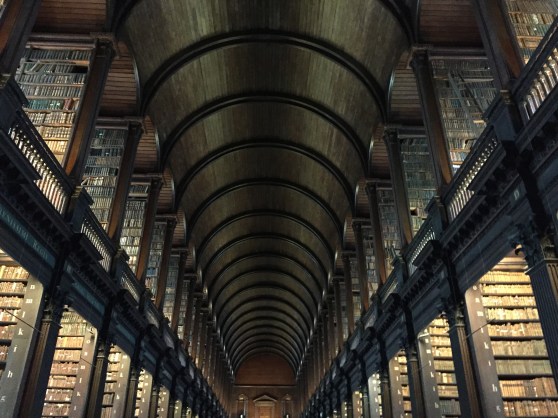
IMG_2254Old Library, Trinity College, Dublin, Republic of Ireland
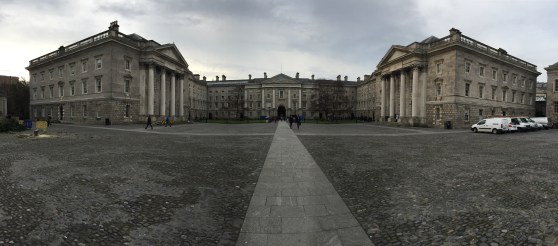
IMG_2249Trinity College, Dublin, Republic of Ireland
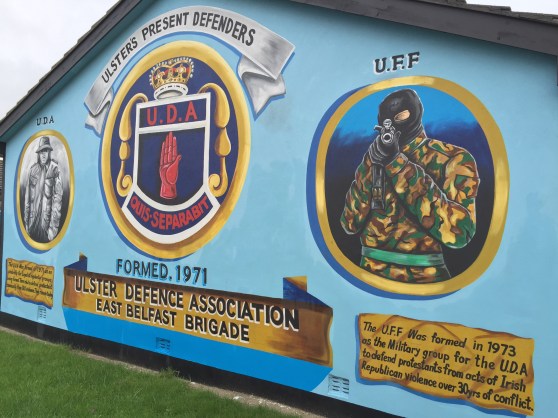
Terror from within

Terrorism. Today, when we say that word, it conjures up all kinds of images and feelings. Growing up, I’ve developed my own connotations of the word. In an unintentionally self-absorbed way, I assumed terrorism was an entirely American thing, and that it all started here with us. But Ireland has made me realize a different story. Merriam-Webster defines terrorism as the use of violent acts to frighten the people in an area as a way of trying to achieve a political goal. If you know anything about Irish history in the last hundred years or so, then you know this definition fits the conflict in Ireland to a T. A few years ago, I would have said that Ireland’s form of terrorism was very different than ours, in the sense that our fear is of a foreign enemy, and Ireland’s of a domestic one. However, I now believe we can somewhat better understand Ireland’s form of terrorism. With our present and ongoing domestic mass shootings and bombings, more and more often in the name of ISIS, we are becoming less afraid of an enemy outside our borders and more terrified of one within. I’m not making any assertions on which form is better, as they are both obviously atrocious and unbearable, I’m just making an observation on what I see as a developing similarity. What is particularly interesting to me, however, is the fact that I can almost empathize with the motivations for Irish terrorism. I get it. Almost. I understand why they were willing to go so far, after so many centuries of being ignored. But I just do not comprehend ISIS’s rationale. I find it impossible to fathom how they really think mass murder will lead to a better world. You could say Ireland is now a better place, but only once terror was primarily discarded. Violence doesn’t create peace – it only creates more violence. How many more times will the world be shown this before we finally pay attention?

IMG_2978Belfast, Northern Ireland

IMG_3513Derry, Northern Ireland

I’m from Montana

During my time in Ireland, I realized that whenever someone asked me where I was from, my instinctive response was “I’m from Montana.” Not once did I ever say that I was from the United States. Once I noticed this, I couldn’t stop thinking about it. I began to understand that this was an expression of my personal identity. I don’t identify myself as an American. I know that I am, but it isn’t how I see myself. I’m first and foremost and always and forever a Montanan. My pride and my affection are for my state more so than for my country. Once I acknowledged this, I started thinking about the Irish identity – one so very different from my own. My Montana pride stems from the state’s beauty and way of life and the simple fact that it’s my home. Irish pride, if I may say so, is a lot more complex – so complex that I don’t believe I can accurately explain it or ever fully understand it. Of course it varies for every person, but it’s rooted in centuries of conflict and poverty and oppression. If you ask any American when they think their history starts, they will most likely say somewhere around 1776. If you ask any Irishman, you’ll get a lot of different answers – but all of them will be a lot longer ago than some measly 200 years. This is one of the things that most fascinates me about the Irish. Their history spans such a greater time period, and all of it remains so central to their modern identity. History is a common topic of conversation in a very different way than it is here. Because I don’t have this immense frame of history, I don’t believe I’ll ever be able to really understand what it is to be Irish. But even as I lack that understanding, I know what it means to be a Montanan, and that’s enough for me.

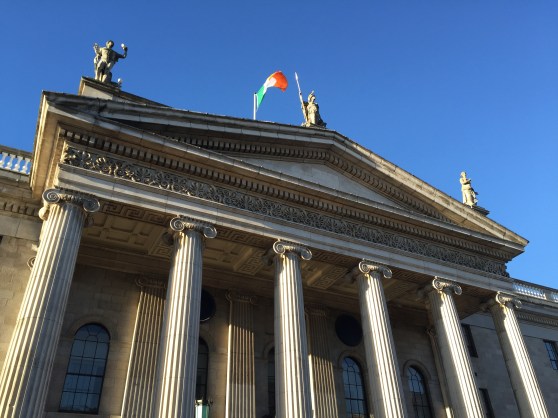
IMG_2332General Post Office, Dublin, Republic of Ireland

IMG_4439St. Finbarr’s Cathedral, Cork, Republic of Ireland

Day Fifteen: January 19, 2016

Today we woke up early (no surprise there) and headed straight for the national park Glendalough. I tried to sleep on the bus, but couldn’t take my eyes off the countryside, for I knew it would be one of my last glimpses of Ireland’s green plains for awhile.

The park itself was lovely, and had some truly beautiful craftsmanship put into it. I was honestly surprised that we skipped over such a magical place in our studies. I don’t recall Bartlett mentioning a Saint Kevin or any National Parks. Adam and I walked around the site, I really wanted to go to the lake, but was feeling pretty weak and lightheaded. So while everyone else ventured off hiking, Adam and I went inside and got some hot soup. It was difficult to tear my eyes away from the misty mountains, and the intricate rock work on the ground. Hopefully, I will be able to return to that park someday and explore more.

As soon as everyone concluded their hiking and had grabbed some lunch, we loaded back on the bus and left for Dublin. I was excited to return to the capital, and see if it looked the same to my Ireland-adjusted eyes as it had to my jet-lagged ones. Of course, it did. The city was just as beautiful as I remembered it.

Laure gave us the night off, but most the group already had plans to go to the Oscar Wilde production at the Gate Theatre. Tonya, Lydia, Adam and I stayed at the Belvedere hotel for a while and relaxed, then we walked to a nice burger joint for dinner before the play. I tried falafel for the first time, and it was delicious.

Attending a local performance of The Importance of Being Earnest was absolutely one of my favorite things that we have done so far. It was very well done, and highly entertaining. I love going to plays, but rarely get the chance, and I cannot remember ever seeing a performance of such high quality. 

Now I’m just back in my room, brainstorming ideas about what to do to make my last day in Ireland special, and writing in my journal. I’ve come to the conclusion that I never want to leave this magical fairyland.
Day Two: January 6, 2016

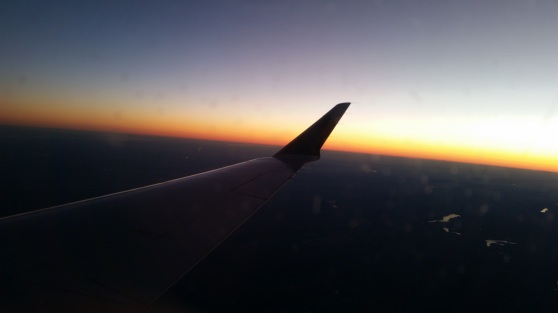
We landed in Ireland at the break of dawn, it was beautiful, but the plane ride was terrible. Tonya (one of my classmates) and I spent most of the flight getting to know each other, because neither of us could get comfortable enough to sleep. It felt like the flight attendants were waking everyone up every ten minutes anyways; to hand out everything from drinks and food to hot towels and sleeping masks. On top of all of that, they kept the cabin lights on most of the night, and the guy in front of me leaned his seat all the way back, until he was – quite literally – in my lap. That alone made it a very long and difficult ride. Tonya, being a rather tiny human being, was kind enough to curl up in a ball and offer me some of her leg room.
After landing, everyone wanted nothing more than to head to the hotel, shower, put on some fresh clothes, and pass out, but Laure (our professor)  and Tom (our tour guide) made sure that we stuck to the schedule and began touring instead. At that point, Adam and I had only slept about five hours since Sunday evening, and it was now Wednesday. You can do the math on that one.

Tired and cranky, Tom took us to the Kilmainham Gaol prison, a place where both de Valera and Charles Stewart Parnell both did time, it was also the location of the outrageous 1916 Easter Rising rebel executions. I walked through the prison, haunted and excited; pausing occasionally to wonder how many great men had stood where I was standing. The size and complexity of the prison amazed me, along with the logic behind the design of it all. It was genius yet disturbing how they planned the place out; making sure that nothing anyone or anything did went unseen by the guards.

This slideshow requires JavaScript.

After the tour of the prison, we drove around Dublin and grabbed lunch at Temple Bar (the happening, pub-filled, area of town). Once we ate, we walked over to Trinity College and visited the Book of Kells. The book itself is strikingly beautiful, but I was much more interested in the grand library upstairs, that’s filled with antique books and artifacts.

Saint Patrick’s Cathedral was our next stop. A very beautiful and holy ground, I am not religious, and certainly not Catholic, but I loved looking at the architecture, sculptures, and stained-glass windows that adorned the place. Catholics really don’t spare any expense when it comes to their house of worship. Sadly, I spent a large deal of our time there waiting in line for the bathroom, which was impressively small by the way.

Following the Cathedral tour, we finally went to the hotel; at that point, everyone was walking around like zombies, except instead of brains we really just wanted to sleep in peace. Of course, we had to check in and eat dinner first though. I was pleasantly surprised by how delicious the dinner the hotel prepared for us was. Not only did they work around everyone’s allergies, but they also prepared an excellent vegetarian meal for me (traditional pasta, vegetable spring rolls, and cheesecake).

Finally, after eating, we were dismissed to go to our rooms, take hot showers, and sleep in actual beds. It was a fantastic first day in Dublin, but I wish I would have been less tires and more alert to enjoy it.

Day One: January 5, 2016

After months of waiting, our journey has finally begun. Now the entire class is jet-lagged, exhausted, and stuck in yet another airport (JFK to be exact). But, I guess that’s just how travelling goes. I cannot even imagine how good it is going to feel to get off of the next plane, and walk out onto foreign soil for the first time. Several of the other students in this class have already travelled the world, but this is a first for me. I am excited, to say the least. Also, I thoroughly regret not getting more than an hour of sleep last night, but in the end, it was probably worth it.

20160105_160507

As usual, the airports have been awful: crowded, noisy, boring, and they all have the same over-priced, mediocre food. I have flown many times in the past, but never for more than ten or twelve hours at a time. This twenty-four plus hour thing is a little much for me. I’m sure it will be worth it in the long-run though. It better be. I am honestly terrified that I put hundreds of hours of work and god knows how much money into a trip I might be miserable on. That’s ridiculous though. I have Adam (my wonderful boyfriend) to keep me company, and am beginning to get to know some of the others in the class, and I am sure that after the first few days I will be more comfortable with everybody. The fact that I was not actually in the fall-semester history class with everyone else (I had to take an independent study instead, due to a schedule conflict), makes me feel outside of the rest of the group, but that will certainly change soon. Either way, I am thrilled to go on this amazing adventure, and see/learn all that I am able to, in such a short amount of time.

Maternity Ward

After the first few days of getting a feel for the hospital operations, I decided to spend most of my time in maternity because of the high number of births that happen every day. One of the nurses estimated that the hospital saw between 3 and 7 births every day–and that, of course, does not count the births that happen at home with Traditional Birth Attendants (TBAs). With so many pregnant women and new mothers, the maternity ward was overflowing.

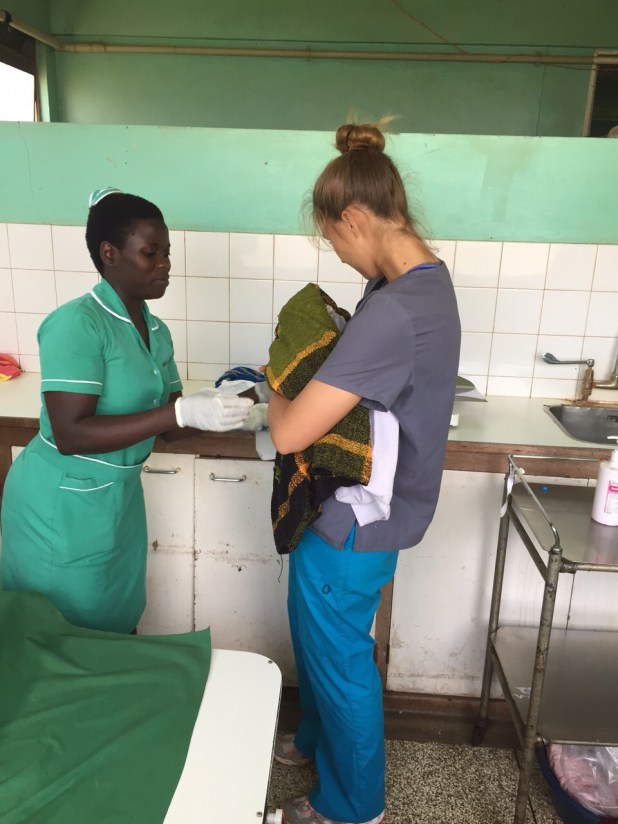
My main duties were giving treatment to new moms. They all got antibiotics for seven days after they gave birth and many also needed malaria medication to reduce the risk of complications during pregnancy, delivery, and breast feeding. I helped mix the medicine, drew it up into syringes, and administered it through cannula ports that were inserted by the trained nurses. (I am definitely not qualified to put in an IV.) I also helped clean wounds after women had to get C-sections, weigh and clean babies after they were born, and bring the newborns and their mothers back to their beds in the ward. I loved seeing the little newborn babies–they looked like aliens, but really adorable aliens.

Birth in Uganda is very different than birth in the US. There are no epidurals and doctors very rarely, if ever, assist in births. That task is left up to the nurses and nursing students. The mothers have to provide their own waterproof sheet to lay on during the delivery as well as all of the bedding for her hospital bed, all of the towels to clean the baby and all of the blankets to swaddle it. Additionally, mothers have to bring sterile gloves and a sterile razor blade for the nurses to use during the delivery. The nurses use the bottom of the gloves to tie the umbilical cord and then use the razor blade to “cut” the cord (its more of a sawing motion rather than a cutting motion).

The mothers are rarely accompanied by anyone and certainly not a husband. There were never any men (besides the male nurses and doctors) anywhere near the labor suites. The women were mostly quiet, occasionally moaning with the contractions, but there were never any screeches or screams that Americans would usually associate with childbirth. The women in the ward ranged from teenagers having their first child to women in their late thirties or even older having their fifth, sixth, or seventh child. In Uganda, the total fertility rate is 6.7 meaning that, in her lifetime, an average woman will have about seven children.

The women I met in the maternity ward were so hardy and strong and inspiring. They cook all of the food for their family, they fetch the water, they clean the house, and they give birth with little help from friends, family, or modern medicine. Like the rest of the hospital, the maternity ward has not changed since the 60s and could really use a face-lift.

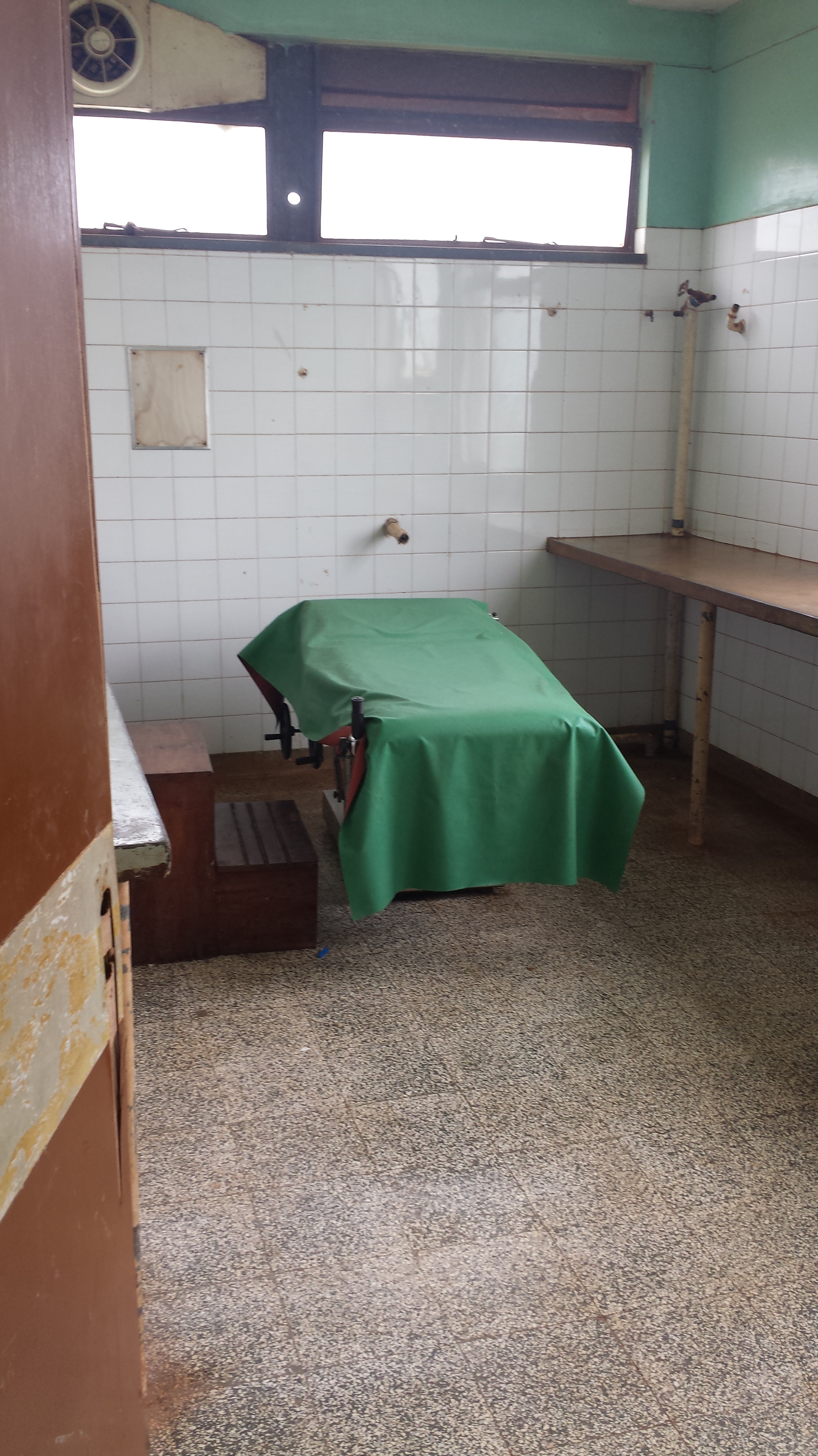
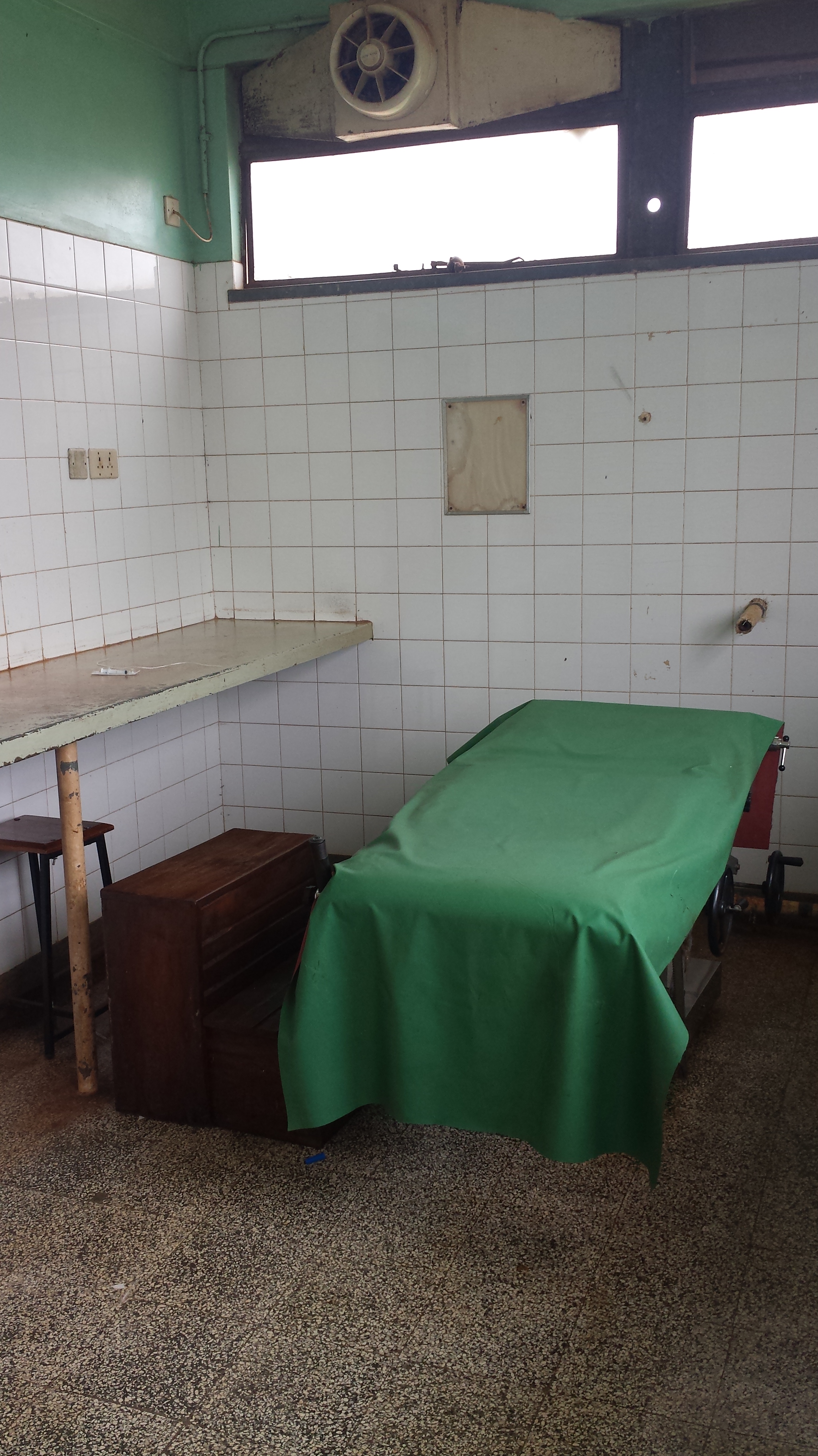
20150616_142344 20150616_142351

These are the rooms that the women give birth in.

Globalization Correlations

The world is getting smaller. At least that’s what some people say. When an airplane can get you from Missoula, MT to Amsterdam, Beijing, Tokyo, Prague, and beyond in less time than it takes to drive to the East Coast, when email and phones make contact and communication instantaneous anywhere in the world, there is truth in that.

Times have changed. It used to take weeks to sail up and down the East Coast of North America, let alone to make the voyage across the Atlantic or the Pacific. Of course that was long ago, before cars were invented. But even when our parents were taking their turns at studying abroad, phone calls were rare and the internet was in its infancy.

How does that relate to my study abroad experience? It relates in the way that globalization (the big ‘it’ word that the GLI is built around) is directly correlated to those developments in transportation and communication. In Ireland, the American influence is a bit more noticeable than in places like Bulgaria or the Czech Republic. However, Irish culture, Bulgarian culture, and Czech culture still are fundamentally unique, with traditions and beliefs that will never fade.

As well they should not. Its hard to put into perspective how much cultures differ until you’re living in one that’s not your own. I know this sounds like a ‘Duh!’ moment, but from someone that has never been outside the United States (excluding Canada), it was a profound revelation.

Thinking about my GLI topic that I chose freshman year, I’ve come to realize that obviously I need to rethink so things. It had something to do with how the arts (specifically theatre) are transmitted and passed from culture to culture, and while that is an interesting and relevant topic for an anthropologist, there are other, more modern, more pressing topics that have to deal with issues in the world right now. Or at least, I can tweak my topic to reflect a more mature understanding of the way the world works.

Has anyone else wanted to change their topic after their Beyond the Classroom experience? I imagine so. These experiences (at least Studying Abroad from my perspective) are profoundly momentous. I don’t know if I’ve referenced this quote before on this blog but Mark Twain’s quote is a good way to finish this my entries in this blog.

“Travel is fatal to prejudice, bigotry, and narrow-mindedness, and many of our people need it sorely on these accounts. Broad, wholesome, charitable views of men and things cannot be acquired by vegetating in one little corner of the earth all one’s lifetime.”