This summer I interned at the Dakota Zoo in Bismarck, ND as a zookeeper. The zoo is a nonprofit organization that works with many other nonprofit conservation organizations around the world. As an intern I gained knowledge of animal husbandry, animal training, enrichment, dietary requirements of animals, general knowledge of behavior, disease, proper animal handling, chemical immobilization and restraint techniques, as well as helped guests understand the importance of wildlife conservation and preservation through teaching them about the Dakota Zoo Conservation Fund and its mission “to support and promote wildlife conservation on a local, national and international level”.
In this photo I am rewarding Ted the grizzly bear with a sweet treat after a good training session! He stands almost 10 feet tall!
The Dakota Zoo houses around 128+ species of animals at their facility. I worked 45 hours a week with every animal in the zoo. It was a very fast paced job where I was almost always on my feet. My GLI theme is natural resources and sustainability and I am also majoring in wildlife biology and minoring in nonprofit administration. This experience furthered my understanding of my global theme and challenge because it gave me face to face interactions with the public and helped me learn how to interact with people and inspire and teach them about conservation and sustainability. I got to give keeper chats on North American river otters all summer and also informally talk to guests about our animals and why we have them. The second way this experience furthered my understanding of my global theme and challenge is that it allowed me to experience a conservation organization first-hand and learn how they practice sustainability to help the environment and how they encourage others to do the same. The zoo tries to “go green” and be sustainable wherever possible, using low voltage fluorescent bulbs and comfortable but energy-conscious temperature settings for public areas of buildings. Office paper is shredded and repurposed as animal bedding, and aluminum cans, cardboard is recycled saving landfill space and energy. Building and fencing materials are also recycled or repurposed whenever practicable and they also re-utilize animal shelters, enclosures and even buildings. The third way this experience furthered my understanding of my global theme and challenge is that it allowed me to not only work with the public and teach them about conservation and sustainability, but it also allowed me to work hands on with some of their conservation projects allowing me to get an all-around experience of what goes into protecting the environment and wildlife.
In this photo I am giving a keeper chat and educating a group of guests on North American river otters! The otter in the photo is named Gary!
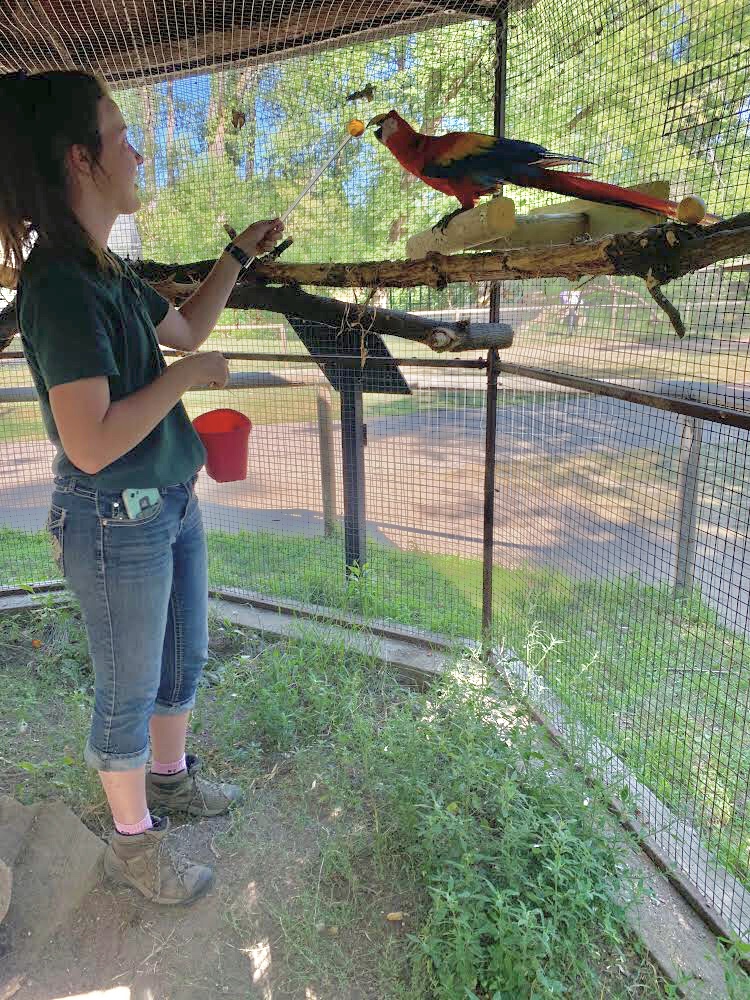
One of the projects they were a part of was a monarch butterfly project where they raised up monarchs from eggs and then released them into the wild. They also raise money for other threatened or endangered species like tigers or black-footed ferrets by hosting events at the zoo and then they send the money they raise to conservation organizations around the world that are working on the forefront of those conservation projects. I got to help organize a small tiger fundraiser this summer and we were able to get about $500 to send to tiger conservation projects happening around the world! Another project I worked on this summer was training the four macaws the zoo has to help eliminate some of the aggressive and territorial behavior they were displaying as well as improve the daily enrichment they were receiving. My project was successful and by the end of the summer the macaws were much less aggressive and much safer to work around! The macaw project gave me some animal behavior/training experience and more experience with reaching out to other organizations to gain more knowledge to help improve the enrichment and training program the zoo had in place. This internship helped broaden my views on world-wide issues affecting wildlife and conservation today and I learned that I can not only work towards fixing local conservation issues but world ones as well even from such a small organization located in North Dakota. This Beyond the Classroom experience was part of the beginning steps to my future in education, wildlife conservation and sustainability.
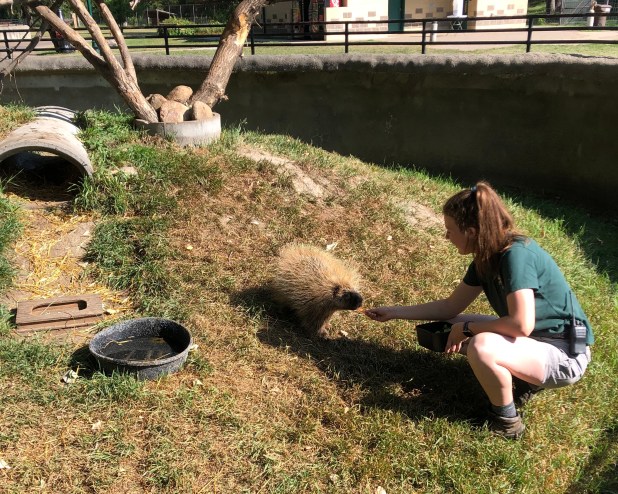
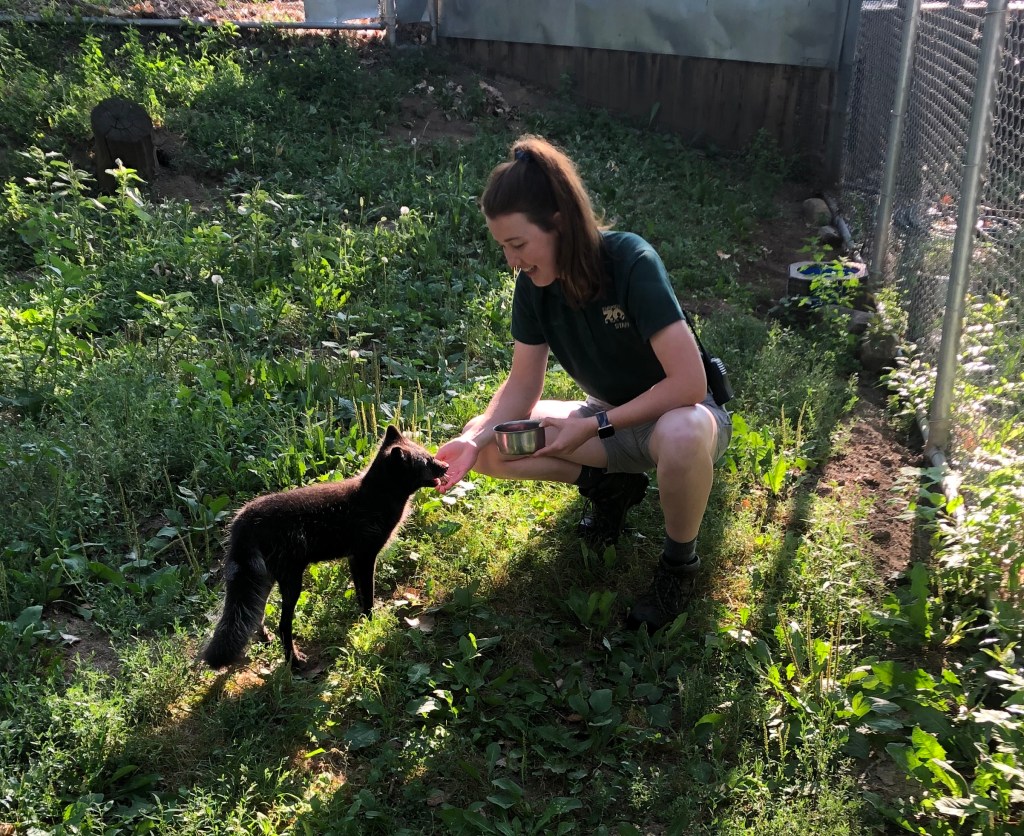
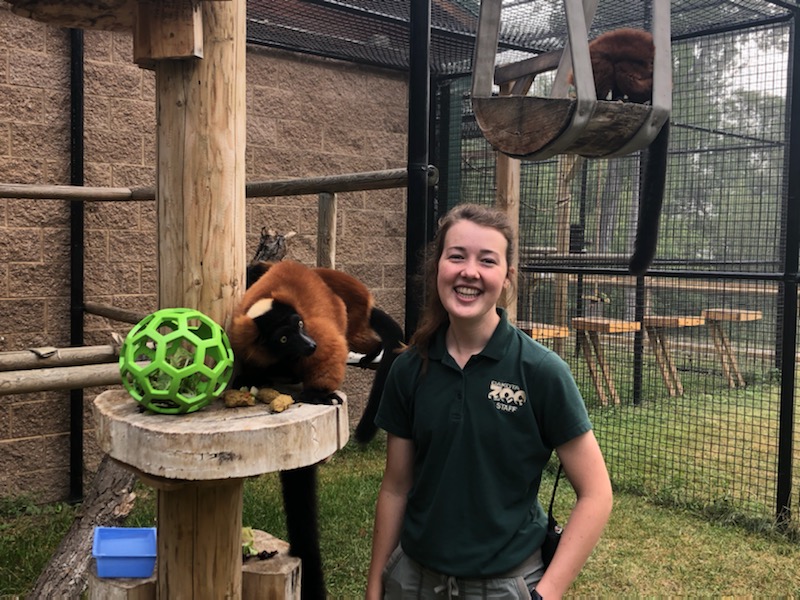
In this photo I am target training Baby the scarlet macaw for the macaw project I worked on during this internship!In this photo I am feeding Selene the arctic fox! She had just completely lost her white winter coat for the summer!These are red-ruffed lemurs I got to work with! I had just finished giving them new enrichment and food for the day!
A Japanese businessman entering through the main gate of Zojoji Temple in Tokyo.
To me, Japan has always seemed to be a place where modern and traditional life overlap. Tiny shrines are tucked neatly between high-rise buildings, and businessmen dressed neatly in suits take shortcuts through the courtyard of a temple on their way to work. Most people wear western clothes on a daily basis, but every once in a while, a woman wearing kimono will walk past. Even the language is a combination, integrating three writing systems into one fascinating, complex tool for communication.
I went to Japan intending to learn about Japan, but what I found was so much more than that. My school was known for its international program, and I was surrounded by foreigners in my classes at school and when I returned home to the share house I stayed at. My roommates were from Singapore, Korea, France, Germany, Canada, Australia, and China, and my classmates exhibited just as much diversity, if not more.
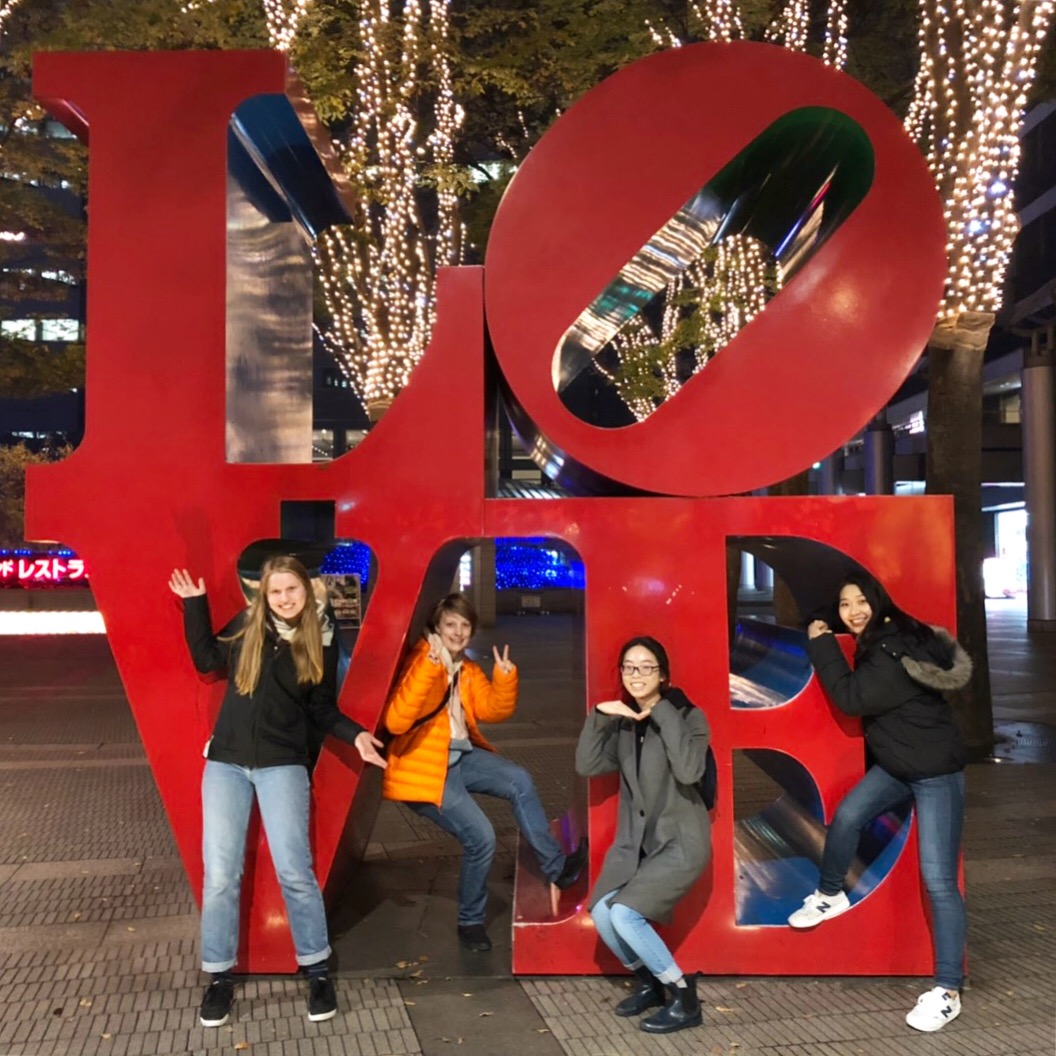
A few of the incredible people I met, posing in front of the somewhat famous “LOVE” statue in Shinjuku.
Living in Japan was a perfect chance to explore my GLI theme of Culture and Politics. As a foreigner, and living with other foreigners from all across the globe, I got a glimpse into what Japan is like from many different perspectives. My experience as an American in Japan was not the same as many of my friends. One day, I overheard a conversation between my classmates from Iraq and Pakistan reflecting on the fear they both had had of being rejected when applying for their student visas to Japan—a fear I had never experienced. My Korean roommate was often harassed due to her ethnicity, at work and in her daily life, despite the fact that she spoke Japanese fluently and had graduated from a Japanese university.
I got the chance to learn about why this subtle (not so subtle) racism exists in Japan. With Japan’s recent history as a colonial power in Asia, Japan portrayed itself as a “liberating power” to free other asian nations from western rule (then place them under Japanese rule). However, with Japan being Asia’s first industrial success story, the idea that Japan was superior or especially exceptional took hold, and remnants of this belief are still seen today. Historical revisionism has been an issue (and not an issue unique to Japan), in which some politicians attempt to sweep the darker parts of Japanese history under the rug. For example, “comfort women” who were taken from Korea and other countries to service Japanese soldiers during the war are sometimes portrayed as “volunteers”– prostitutes who willingly came along, rather than young girls tricked and forced into leaving their homes. The infamous Unit 731 of the Japanese army that practiced experimentation on humans in Manchuria during the war is often not discussed– in fact, many of my Japanese classmates had never heard of these war crimes before.
A street vendor making okonomiyaki at a festival.
One of my main goals in Japan was to practice Japanese, and happily, I found many chances to use the language. I was able to incorporate Japanese into my life far beyond the classroom— buying okonomiyaki (a kind of savory pancake) from the lines of food stalls at a festival, chatting with my seat mates on trains and buses, and reconnecting with a few of my old friends. There are still many situations where I feel uncomfortable using Japanese, and they push me far out of my comfort zone. However, I learned to advocate for myself even when I struggled to communicate. Despite only having an intermediate command over Japanese, I was able to get a job at a climbing gym (via stumbling through a terrifying job interview in Japanese), open a Japanese bank account, and register for national health insurance. By no means were any of these smooth, natural transactions, but they are far more than I could have ever dreamed I was capable of accomplishing in a foreign language.
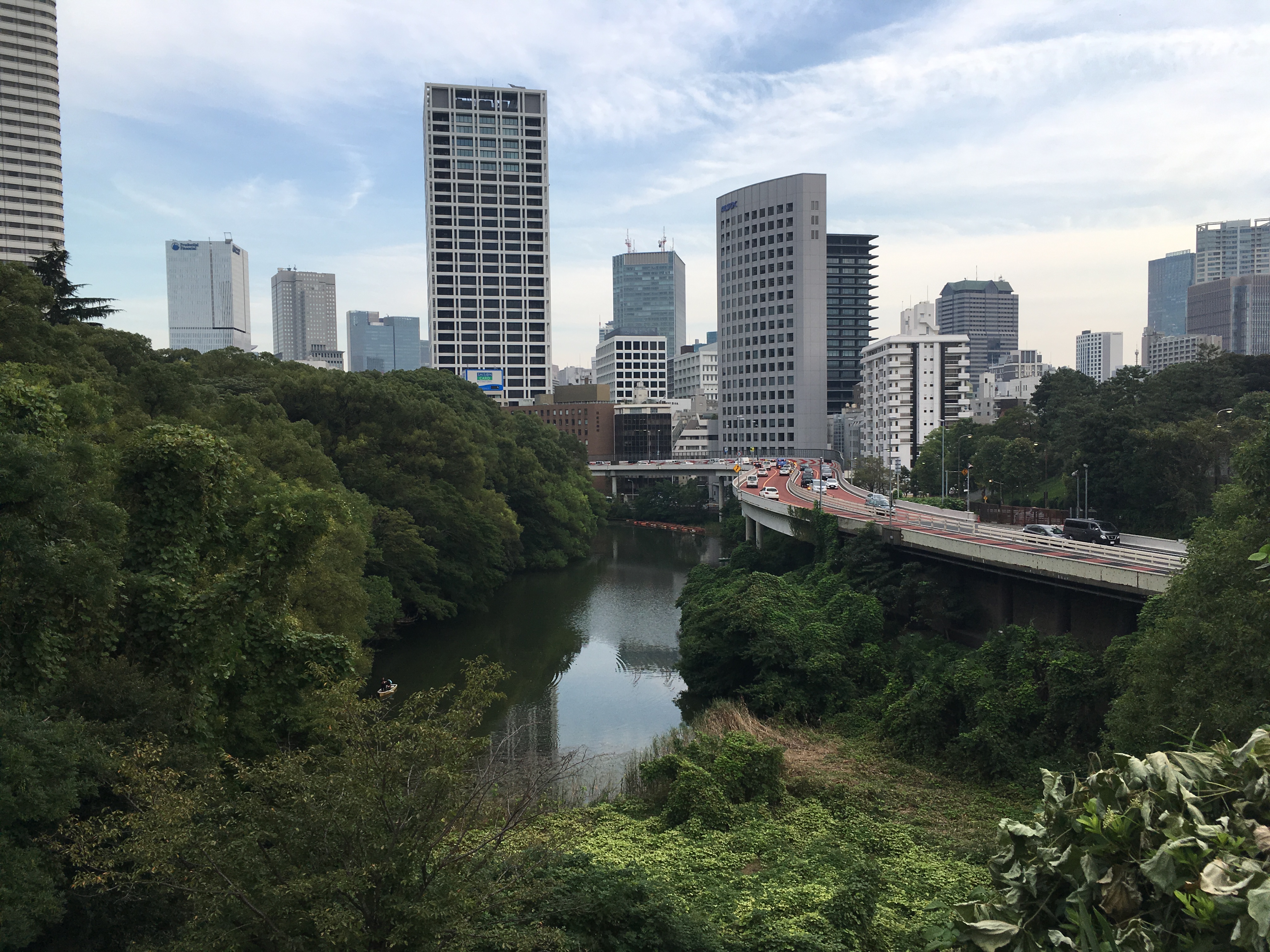
A cityscape near my university in central Tokyo.
Studying in abroad has helped me be more confident, as well as more open-minded. I realize that my perspective is different than the perspectives of so many other people from around the world. However, I have also found that whatever our differences, people are all more similar than not, and I am happy to say that I have friends around the globe. I loved my time abroad, and I know it has helped shape me for the better.
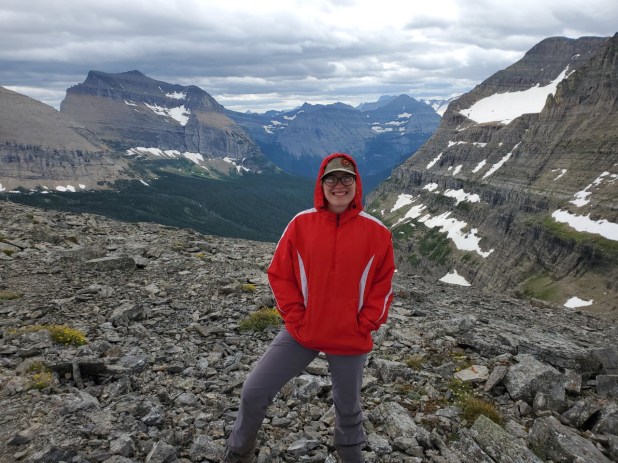
This summer, I completed my Beyond the Classroom Experience with the Glacier Institute, a nonprofit based in Columbia Falls, MT that focuses on outdoor education in and around Glacier National Park. I was hired as an outdoor educator intern for Big Creek Outdoor Education Center, the Glacier Institute’s location that focuses on youth outdoor education. Big Creek served an important purpose in a lot of kids’ lives this summer. For most of them, it was their first time interacting with kids their own age since schools were shut down. Outdoor education also provides a unique opportunity for them to challenge themselves, learn new skills, and develop a connection with the environment that will hopefully foster positive environmental behavior in the future. Aside from leading team building activities, I got to help teach the campers about land stewardship, navigation, fly fishing, and other wilderness skills.
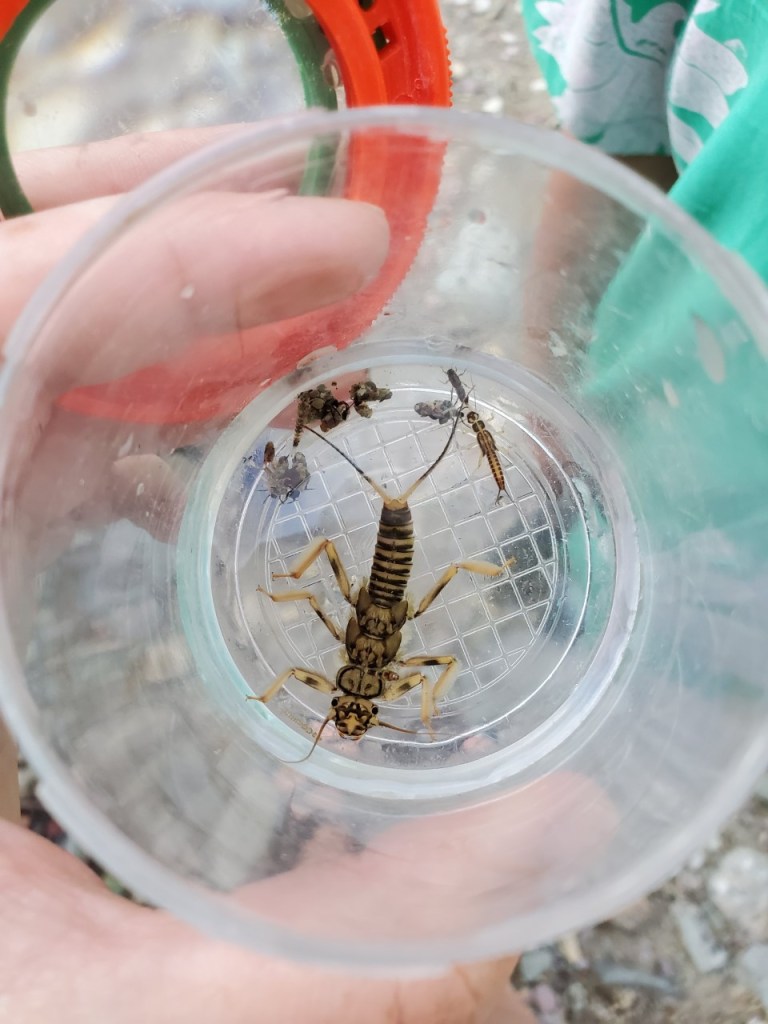
I got to teach lessons about benthic macroinvertebrates and their importance to the environment as a part of our fly fishing classes. Campers were instructed to find as many macroinvertebrates as they could in Big Creek so we could identify them together. I was surprised at how much fun everyone had looking for all the macroinvertebrates, and campers wanted to spend more of their free time looking for these cool bugs!
The global theme I chose was Global and Public Health, with my specific challenge being that I wanted to improve public health by connecting people to their environment in order to make healthy, sustainable lifestyle choices that support not only individual health and wellness, but also community health. The Glacier Institute allowed me to focus specifically on youth, and I was able to spend an entire summer observing how the environment brought kids together after months of isolation from both their peers and their ‘normal’ lifestyles. I quickly realized that outdoor education was only a small part of what we were doing for our campers. Along with many returning campers, we received numerous grateful emails from parents describing how a week at Big Creek gave their kids a break from all of the stress and uncertainty that the pandemic caused in their families. I learned so much about the pandemic through the campers’ eyes, and I feel like I have a totally different understanding of youth in the age of coronavirus.
As a part of our stewardship lesson, campers learned about invasive species like spotted knapweed and why it was important to give back to the landscape that provided them with so many fun adventures. Campers helped pull tons of knapweed in the Flathead National Forest throughout the summer.
One of my goals for the summer was to explore how youth develop a sense of place attachment because positive environmental behavior is often initiated by feeling a strong connection to the world around you. With the campers, this came in the form of hands-on exploration of the natural world as well as learning about stewardship. However, I also wanted to explore my own feelings of place attachment. I know that history and traditions are things that make me feel stronger connections with the world around me, so I decided to create a small side project I called the 2020 Homestead Hunt where I tried tracing the footsteps of the North Fork Valley homesteaders. I pulled from numerous sources in order to find the original property locations of different homesteaders including the National Registry of Historic Places and previous research by archaeologists Douglas MacDonald (Final Inventory and Evaluation Report: North Fork Homestead Archaeological Project, 2009) and Patricia Bick (Homesteading on the North Fork in Glacier National Park, 1986). When Glacier National Park was established in 1910, there were 44 North Fork homestead sites located in the park. It was a bit of a scavenger hunt because most of these sites were not on any map and I had to use multiple research sources to try and pinpoint locations. Some sites still contained historic structures while others had been burned over and overgrown with new vegetation.
Pictured above is an old basement where Johnnie Walsh established his claim. From 1918 to 1925, his property was the location of the Kintla Post Office until it was moved to Polebridge. I am holding the 1986 paperwork from the National Registry of Historic Places that described the general area and helped lead me to the unmarked location.
This homestead was built by Rudolph Matejka in 1908, a twenty-three year old from Nebraska. While the homestead remains off of Glacier National Park maps, it has been restored by the Glacier National Park Volunteer Associates.
Another thing I loved about the Glacier Institute is that they thought it was important for us to explore the park in order to get to know it as well as feel more connected to the place around us. I feel so grateful to all the Glacier Institute staff for showing me around and giving me opportunities to see such breathtaking places.
I had such a memorable experience with the Glacier Institute, and I left feeling touched by my amazing coworkers, campers, and the landscape that became my stomping grounds.
This ancient lone ponderosa pine officially earned a waypoint in my GPS. I found it while on a bushwhacking expedition for three different homestead sites. Along with it’s very tiny ponderosa offspring, it was the only ponderosa left in the area. It’s so old that it would have been around when the homesteaders were first building their homes.
My name is Liam Hauck, I am a marketing major and my global theme is Natural Resources and Sustainability. For my beyond the classroom experience I chose to study abroad at La Trobe University in Melbourne Australia. I was looking forward to learning more about the theme of Natural resources and Sustainability while I was in Australia. Climate change has had a significant impact on Australia. The Great Barrier Reef is continuously being negatively impacted by climate change and I arrived in Melbourne just as the last of the severe bush fires were being put out. So, it seemed like there was a lot to learn from Australia in terms of natural resources and sustainability and how the natural world can challenge a nation’s sustainable practices.
However, it was only about two weeks into my semester abroad that I had to return back home to Seattle to finish my studies online due to COVID shutdowns. Fortunately, I had arrived in Melbourne about a month before my program started and I got to stay with my Uncle who lives in Melbourne. During this time I was able to explore Melbourne, see Elton John perform, and even took a week-long trip down to Queenstown, New Zealand (where I got to skydive)
The majority of the times where I found myself growing as a leader and simply as a person were when I had to continue my studies online back in Seattle. I left Australia on March 26th and finished my semester on June 15th. All of my classes had to be attended live via Zoom, in Australia time. Which meant that most of my classes were at night, with the latest class starting at 9 pm and ending at 11 pm. It was very hard to find the motivation and fortitude to attend these classes and do all the work at late hours. Yet I persevered and worked as hard as I could through those 2 ½ months of late nights and I certainly developed skills that I will take with me into my professional career. While this experience of course was not the one I wanted, it was the crazy one that I got. I am definitely thankful for the time that I had down under.
My name is Noelle Annonen and my Beyond the Classroom Experience was interning in Dublin, Ireland, with a content production company called Maxmedia. This dry description doesn’t do any justice to the experience that I had when I lived in Dublin. Yes, I did gain skills in writing, social media content creation, and even website development. But more than that, I learned about a surprisingly completely different culture from my own. My global theme and challenge is Inequality and Human Rights. While I lived in Ireland, I learned about a country that is still dealing with prolonged historic oppression and religious segregation and violence from the perspective of Irish people.
My experience taught me that even western cultures that I assumed could be similar to my own are actually incredibly different. Superficially, the island of Ireland is more socialistic than the United States. The people I met seemed more connected with each other and their communities than with career and individualistic goals. This difference seemed extraordinary to me, and prompted me to analyse my values and the values of my country. The experience and questions that were raised weighed heavily on my mind as I continued to learn and grow in Ireland. More importantly, I learned that the island of Ireland is divided, by religious differences and a past of violence between the two countries on it; the Republic of Ireland and Northern Ireland. The time period that best illustrates the extent of this conflict is known as the Troubles, and while it occurred in the 1970s and 80s, the unresolved issues are still at play. Within the discussions of the people I encountered, I learned about the love and pain that stems from this division in the lives of people on the island today. The interconnectedness of the culture, as I witnessed it, gives conflict and division an impact that stands the test of time.
The Troubles were ended by what was essentially a call for a cease fire. But while I lived in Dublin, I learned how the religious discrimination and oppression is still felt throughout a society that, only recently, threw off their British overlords and began creating their own country. This experience gave me a fresh drive to better understand conflicts like the one on the island of Ireland and to fight for the rights of people who are discriminated against and oppressed. My end goal is to lead in advocating for and helping create a more equal world and society.
Thanks to COVID-19, my 6 month experience was shaved down to only a 3 month experience. I am left with a strong desire to learn more about the culture and all the intricate details and impacts that the Troubles have and continue to have there. I would like to know how the Good Friday Agreement fell short and what moves are being made to amend past mistakes. More importantly, I keep asking myself, ‘When can I go back to Ireland?’
Where: The University of Jyväskylä in Jyväskylä, Finland
Wait…where: About three hours by train north of Helsinki
Was it cold and dark: Yes
Did you learn any Finnish: A little bit (I am especially good at saying “En puhu suomea” or “I don’t speak Finnish”)
sun setting above apartment buildings at 2:29 PM
Löyly, Avanto, and Sisu.
Sauna culture was something I looked forward to exploring while in Jyväskylä and I was pleased to learn that Kortephoja, my student living complex, boasted a proud five saunas. It is also important to clarify that the correct pronunciation is sow-na, because the Finns know best. Learning about Finnish sauna culture meant embracing löyly, the steam that rises off the rocks in the sauna when water is splashed on them, and avanto, the practice of dipping into a hole in the ice.
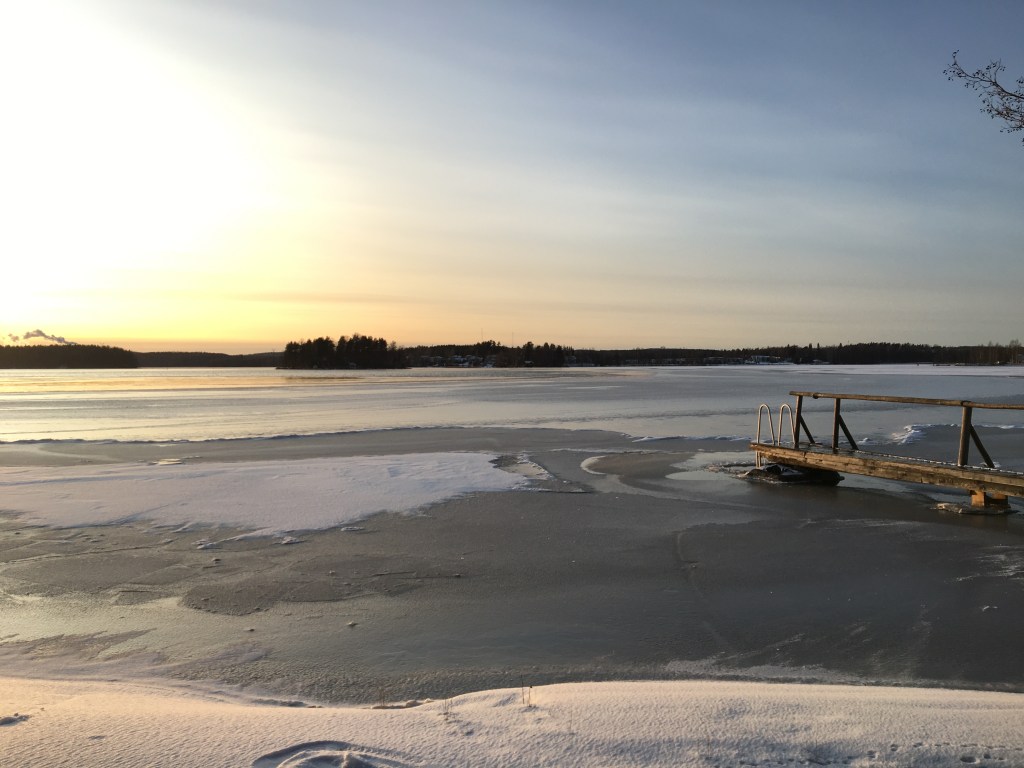
a hole in the ice waiting for a sauna-goer
Taking multiple sauna turns a week meant time for long conversations with friends. More adventurous sauna experiences included running into the Arctic Ocean in Norway while a Finnish bus driver yelled at me to put me head fully under the water; this gets one closer to the Finnish concept of sisu. Sisu is comprised of determination, grit, and resilience and is said to express the Finnish national character. Choosing an exchange experience in college means choosing to embrace sisu (and saunas, if one finds themself in Finland).
Are you the one who needs a violin?
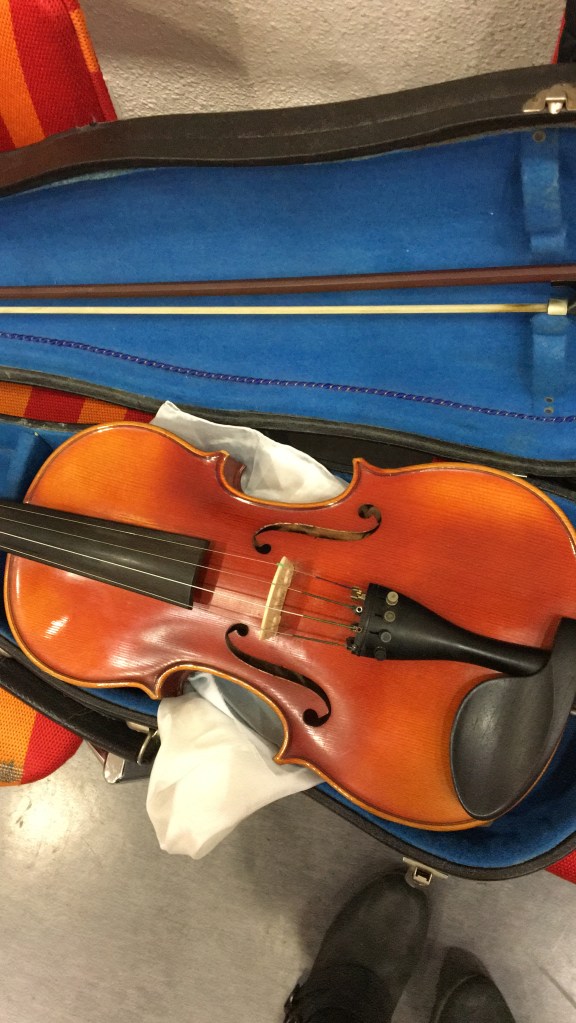
After my first day of classes I plodded through the dark, the sun set at 3:30, without an instrument, my violin was safe at home in Montana, towards the music building, a twenty-minute walk from my apartment. Groups of musicians have a certain buzz about them, and that night was no exception. Timpani drums were tuned, a saxophonist played a scale, and rosin was applied to bows as I quietly stood in the corner and observed. As the symphony tuned, a trombonist emerged beside me and asked, “are you the one who needs a violin?” I was offered her grandfather’s violin for me to borrow. I lovingly nicknamed the violin ‘Pavo’, after violin’s original owner, and slipped into my spot in the second violins.
say hello to Pavo
As the only exchange student in Sinfis, the student symphony, I found it refreshing to be around only Finnish students. Works by Grieg, Mendelssohn, Bizet, and Saint-Saëns were the soundtrack for those three-hour Monday evening practices. The rehearsals were conducted all in Finnish, but I quickly learned “yksi, kaksi, kolme, neljä” (one, two, three, four) as the count to begin as a symphony. My ever-patient stand partner, Rita, spent hours leaning over to me and whispering what measure number we were rehearsing each time the conductor offered a direction. While our final concert was canceled due to the COVID-19 pandemic, those hours spent making music remain some of the ones I am proudest I spent during my exchange.
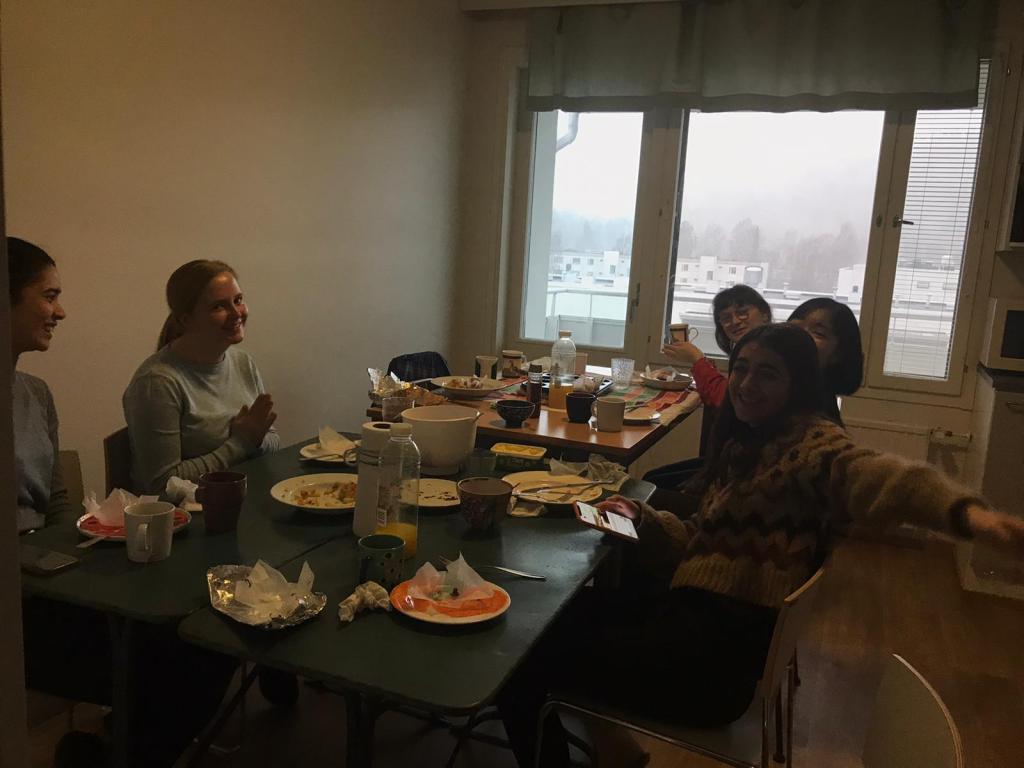
Brunch
Because my roommates and I had the largest apartment, it was decided that we would host brunch. Miriam and I pulled out the desks from our room to make the dining room table longer. Shannon took muffins out from the oven while her ‘brunch’ playlist played out of her phone. Sienna stood ready at the door to hop in the dangerously small elevator and let our friends into our building.
a bounty from some creative exchange students
About once every two weeks this was our ritual. Gathering for a meal with friends from Spain, France, Hong Kong, Madagascar, and Russia meant lots of food, conversation, and laughter. Our earnest interest in building lasting friendships was born out of these meals together and has continued since. In late March when the composition of our study abroad experience was altered due to the global pandemic – this group of friends rallied in an impressive way. When universities called some of us home, others showed up to clean the entire apartment top to bottom while we packed. Our last hodge-podge meal all together was composed of only desserts and food we had purchased in an attempt to use up our food stipend for that month (can’t let good euros go to waste). Though I spent half the amount of months I had planned to with this friend group, we’ve stayed connected: reminding each other of inside jokes, bi-weekly zoom calls, and plans to see each other have kept the spirit of our brunches very alive.
our kitchen before our last meal together
Cultures don’t meet, people do
With a focus on the global theme of culture and politics I tried to construct my schedule at the University of Jyväskylä around these large concepts. As a Communication Studies major I had never previously studied intercultural communication. The University of Jyväskylä specializes in instruction and research in this field. I took multiple courses with an underlying focus on intercultural communication. My main take away from these courses, and my time outside of the classroom in and around Jyväskylä, was an awareness of the simplifications we tend to make when we take about intercultural communication.
One of my most impactful instructors at the University of Jyväskylä took a critical view on commonly held beliefs about intercultural communication and borrowed a subtitle from a book by Hoffman and Verdooren to remind her students that “cultures don’t meet, people do.” This lesson was solidified around a table constructed out of desks, while rehearsing music I understood in a language I did not, and in a cedar plank sauna in the Artic Circle.
My GLI theme is public and global health. I worked with the Open Aid Alliance to achieve this theme. The Open Aid Alliance is based out of Missoula Montana and they are committed to serving the people of Missoula who suffer from substance abuse disorders and/or have STIs. COVID drastically affected my experience, instead of working in an office in Missoula we had to resort to an online environment. Unfortunately because of this I have no photos of my experience. Because of that change I worked out of my hometown of Billings Montana. With working from home I wasn’t put into a new environment in the traditional way. Instead I was introduced to different people and different ways of life by way of webinars and articles. With the various perspectives and lives I was introduced to it changed how I look at the issue of substance abuse and how it is treated as of now. Also it made me look at my own bias and background. This experience taught me not to take things for face value and that you never know what someone is going through. A lot of the webinars and articles I was introduced to challenged the American culture towards people with substance abuse disorders. To be completely honest this experience has changed my perspective not only on my theme and challenge it changed how I look at modern health care. I saw so many people not being treated correctly or not being treated at all. It also introduced me to subgroups of people I wasn’t aware of and their challenges and whether or not they are getting the help they need. With this experience being online I had to be my own boss. I pushed myself everyday to put out the best products I can. I also had to insert myself on various projects. Since I was the first person to do an online internship with the Open Aid Alliance, my drive and motivation was a big component to what made this internship so successful. Some of the questions that came out of my experience were about our current healthcare model. How do we better serve people who need it? How have I not heard of these issues earlier? I realize that this is a complicated issue but we need to make some drastic changes so people can get the help they need. One of my final questions was: How is the United States so far behind?
This experience has changed my life and I am extremely thankful for the opportunity. I would like to thank the GLI program not only for the scholarship that made this possible, but for helping me find an experience that best fit my interests. I would also like to thank Amanda Reese at Open Aid Alliance, she could’ve just cancelled my internship but instead she worked with me to find a way to make it work. And finally I would like to thank Kevin Hood at the University of Montana. He helped me figure out the details that made this internship work. I know that a lot of this internship was self motivated but with out the team of people that helped me navigate this experience it wouldn’t have been possible
If you would like to see some of the projects I did during this internship attached is a blog I created for the experience. Along with some of the projects posted on my blog I would say that the most memorable project was creating an educational tool for high school students to learn about harm reduction.
I wasn’t sure what to expect from living in Granada, Spain. My preconceptions included beautiful beaches right outside the city, a huge palace right next to campus, and live music everywhere. I thought maybe there would be pomegranate trees everywhere, since Granada translates to pomegranate. It turns out, the beaches were farther away than I thought, and the giant palace was about two miles away from the Cartuja campus on the hill. There were no pomegranate trees, but pomegranates were printed on everything and they were sculpted in metal everywhere. Granada ended up throwing me lots of surprises and was not a place that I could have dreamed up.
It had it all. Big city, traffic, hiking, beautiful hills and night lights, a river, art shops, and the picturesque Albaicin, which is full of narrow cobblestone streets and white buildings. It had orange trees, fruit stands, statues, and protests, and an entire district full of beautiful, high-end stores. One area of town was entirely Moroccan. The blend of happenings in the city was amazing.
The Alhambra palace from la Mirador de San Miguel.
My GLI experience abroad took me to this beautiful place. My global theme is Public and Global Health, and as part of my experience I took a class called Antropologia de la Salud, or Anthropology of Health. This class focused on health disparities in both Spain and around the world, between different demographics of people, as well as different types of attention and medicine practices in various cultures. This gave me really good insight on how medical attention systems differ around the world and gave me the opportunity to really delve into health disparities. It also further proved just how much work the American health care system needs, given that it is completely unaffordable and unattainable for so many Americans to even receive care.
In Granada, there are a few different programs that as an exchange student you may enroll in. Two of them are taught in English, are off-campus, and are mostly Americans who want to learn Spanish. The third option is the one I chose, which was to directly enroll into the main University of Granada and take the same classes that the local Spanish students take, alongside them.
What this choice meant for me is that I had to quickly adapt to the language, accent, and slang to succeed. It was incredibly challenging, but it pushed me to listen closely, be a good student, and improve my fluency, which was my reason for choosing Spain in the first place.
I’ve studied Spanish for a long time and am a Spanish minor at UM, but part of the learning curve during this culture immersion was finding out that the dialect in southern Spain is difficult for even native Spanish speakers to understand. I picked up on a lot of differences between the central/southern American Spanish that I had studied and the Andalucian dialect, and learned from my Spanish friends that I apparently “talk like a gangster.”
I’d say that being forced to focus so heavily on my communication is a skill that translates really well into leadership. Not only was the language a focus area for me, but a lack of understanding made me use nonverbal cues a lot more and find alternative ways to express myself or ask for clarification. These are essential leadership skills, because as a leader you have to understand what is happening with your team on a deeper level than simply what is said – you have to read into what is left unsaid. It’s also important to really listen and be able to develop an effective response as a leader, which are two objectives that require more effort when becoming fluent in another language.
A view of Granada.
There were lots of culture differences between Montana and Granada. The biggest adjustment for me was probably the schedule. Spaniards stay out late every night of the week, and often they don’t even leave the house until midnight and then stay out until seven am. For several hours in the afternoon, everything is closed for siesta. Another big difference for me was social, as people here at home are much more willing to have a conversation with a stranger. In Spain, people aren’t as chatty with someone who isn’t part of their group. The culture obviously goes much deeper than these basic functional level differences, and I got the privilege of learning a lot about the history of Spain and how it has affected its people.
I took a History of Modern Spain class that focused on the last three centuries and gave me a lot of insight into the instability and politics that have shaped the country. I learned how big of an impact the recent dictatorship had on the way that present-day Spanish society functions, and especially how it affects women and education. I also learned a lot about Spanish culture from the friends I made there who are from Spain. Some things I was shocked to learn. For example, my friend Lucia explained to me that it’s actually rude to ask somebody what their job is, because the Spanish completely separate their work lives and personal lives, unlike Americans. If you do ask, it could be interpreted as you trying to find out how much money they make to take advantage of them.
Though I had to leave suddenly and early due to COVID-19, by the end of my experience I had picked up on a lot of these cultural nuances, and Granada felt like a second home to me. I was left with more questions though. Since I left so early, I didn’t get to do or see a lot of the things I had planned on. The palace I talked about earlier, the Alhambra, is a huge part of Granada’s history. I had booked tickets for about two weeks after I had to go home. I also only got to travel out of Granada three times: once for a hike, once to Cordoba, and once to Bordeaux, France. I would love to return to travel around the rest of Spain and visit the beaches, the islands, and cities like Sevilla and Barcelona.
I ran into a herd of longhorn cattle blocking the trail on my hike.
So, I bid Granada a “see you later,” and hope that one day I get to return to revisit these unanswered questions and my pomegranate paradise. I’m so grateful that I got this opportunity to explore, learn, and better myself through GLI.
Fries, beer, chocolate, and waffles all quickly became staples in my Belgian diet. As well as the removal of the word ‘French’ before fries because, as I learned, there is an ongoing dispute between France and Belgium about where the fries were invented. Regardless of the dispute, the Belgian fries were delicious and you eat them with this tiny fork, which I love. A small aspect of my weekly routine that I miss.
Traditional Belgian ‘frites’ at an outdoor concert by the Atomium
I spent this past fall studying European peace and security studies in Brussels, Belgium. This specific program, while through my host institution, pooled the expertise of the Belgian military, NATO, the European Union, and the Global Governance Institute in discussing contemporary security challenges from a distinctly Brussels view. These courses were incredibly difficult as the professors were very distinguished practitioners in the field of security studies (a bit intimidating to say the least). The students were also primarily graded based on a midterm and a final, something I was not used to at UM. These courses were perfect for studying my GLI theme of social inequality/human rights and the balance between human rights protection and international security concerns.
Bosnian ćevapi at an outside restaurant in Sarajevo, Bosnia and Herzegovina
In addition to Belgium, I was able to do a fair amount of traveling, and visited 13 countries over the course of 5-ish months. However, one country caught my attention that I wanted to highlight in this post because of the impact it had on me both personally and professionally. Before I proceed, I want to write a trigger warning in this post as I will be talking about a very emotionally difficult subject: genocide. As many of you might know, Model United Nations has been a big portion of my life and something that I enjoy doing. I love stepping into the shoes of other nations and seeing international issues from their point of view. Last year, the UM Model UN team was assigned to represent the Eastern European country, Bosnia and Herzegovina, at the annual New York City conference. After intensely researching the country for well over a year, I decided that I had to visit this place as plane tickets were not too expensive and I had a week off of school in October to travel.
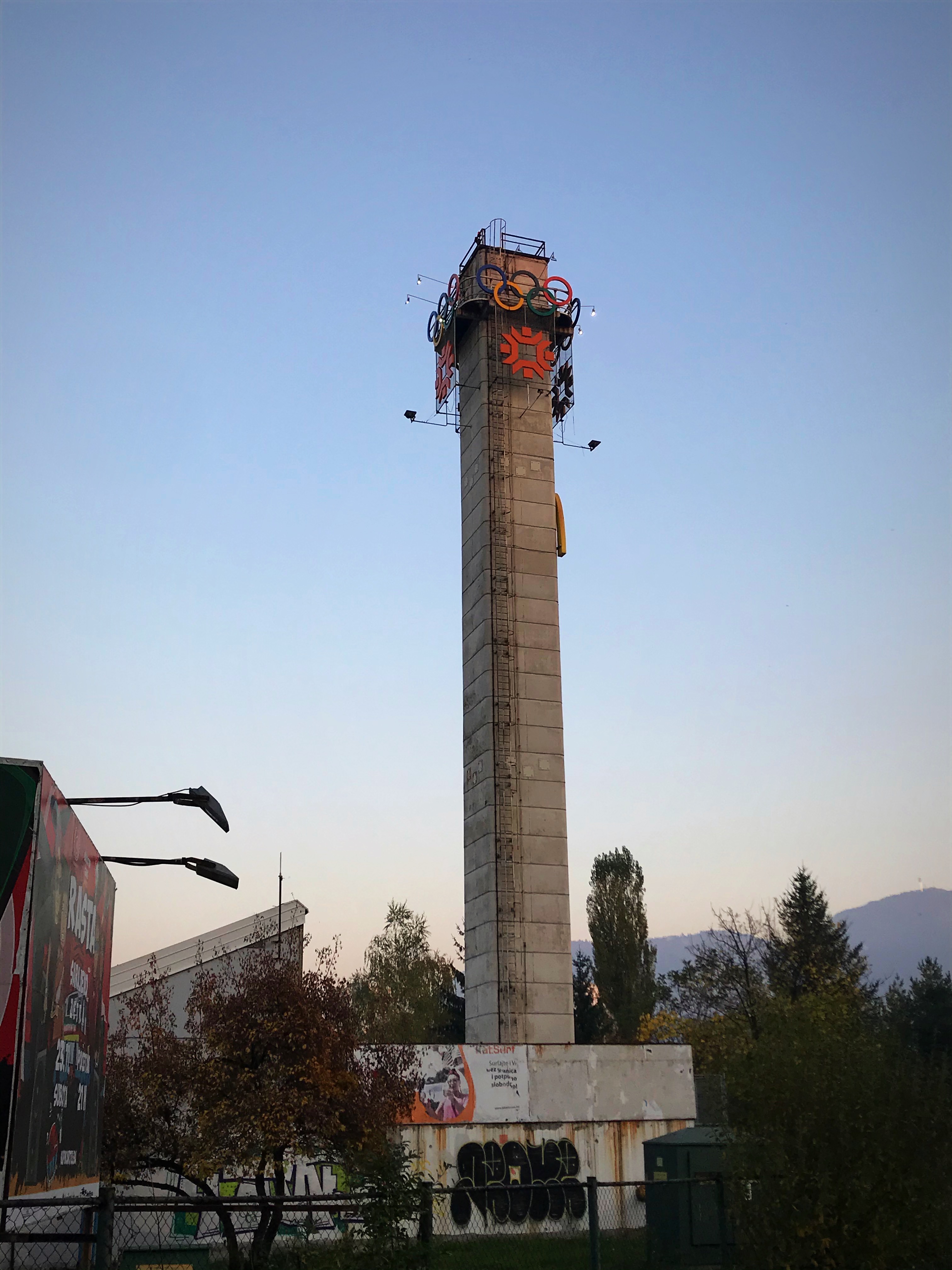
Olympic Tower in Sarajevo Commemorating the 1984 Winter Olympics
I landed in Sarajevo and it was one of the most beautifully complex places I have ever seen. It reminded me of home in Montana, with the mountain ranges and the river flowing through town. It was my first time in a Muslim majority country, and the mosques were so intricately constructed that I could stare at them for hours. Yet, beneath all of this natural and man-made beauty, the scars of the deadliest European conflict since World War II looked fresh and raw. Holes from shrapnel puncture the walls of buildings, graffiti telling stories of the war through art were scattered across town, thousands of white and grey tombstones line the many city graveyards, and 200 ‘red roses of Sarajevo’ mark a spot where at least three people were killed by a mortar shell explosion during the siege of Sarajevo from 1992-1996. The town, which was the host of the 1984 Winter Olympics, looked as if it was a city slowly coming out of a coma.
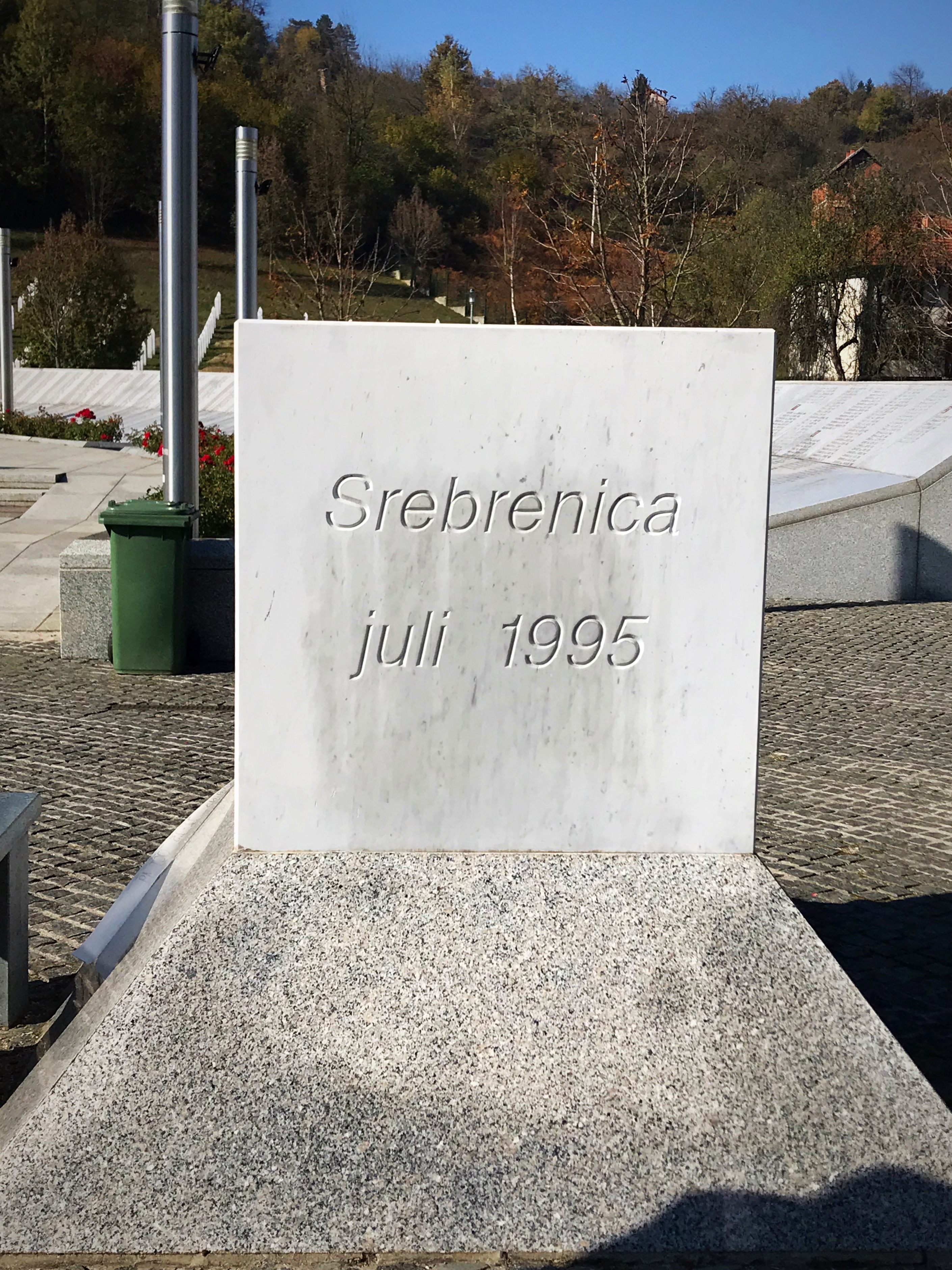
Srebrenica–Potočari Memorial and Cemetery for the Victims of the 1995 Genocide
During my time in Bosnia and Herzegovina, I visited the tiny town of Srebrenica, a place synonymous with a massacre where 8,000 perished. My tour guide was a former soldier who fought for the Bosniak Muslim army during the war when he was my age, and he recounted the war from his perspective. After the tour of the Srebrenica cemetery and memorial, my guide took me to see a woman on the Serbian border who lost many male loved ones during the genocide. She made us traditional Bosnian coffee and snacks, and I was able to have a conversation with her (through my guide as an interpreter) about her life and ways she coped with losing those around her. The woman told me, “for what I have been through, and this country, things are finally okay.” Even though I could see incredible sadness in her eyes, I saw someone who was resilient in the face of unimaginable loss. Courage does not always come from someone who fights with a gun during a war or politicians who command an army, but through individuals who try to pick-up the pieces of their lives even when there may only be a few pieces left.
The historic village of Počitelj in southeast Bosnia and Herzegovina
My trip to Bosnia and Herzegovina was a surreal experience, one that brought me to tears at times, as well as almost to the bathroom to throw-up from the stories. It pains me that the country is still synonymous with war, chaos and destruction. Many of those close to me, at times, strongly urged me to reconsider travel there because the war stories are still etched into people’s memories. But what I found was a country teeming with beautiful landscapes and the warmest people I encountered in all of Europe. Inspired by my time in Bosnia and Herzegovina, and the year I spent researching the nation, I intend to pursue a law degree focused on humanitarian law, an area of study closely related to my GLI theme of social inequality and human rights. I believe my time in Bosnia and Herzegovina has given me a new, powerful perspective on how international organizations, for lack of a better word, fail to protect human rights during times of conflict. And the thing is that it is (and can) happen again. In various roles at UM, I had learned how to discuss uncomfortable issues in a professional matter, and that was a vital skill that I exercised during my excursion to Bosnia and Herzegovina.
Thank you for reading this somber part of my post. I promise Europe for me was more than learning about the dismal record that international organizations have on protecting human rights. As I adjust back, I am still processing all the ways that I am a different person and, to be honest, while I am, it is hard to exactly write in what way. I would be lying if I said that I wasn’t planning my trip back to Brussels to visit my lovely, smart, free-spirited, 82 year old host mom from Germany and her, sometimes terrifying, cat named Blair.
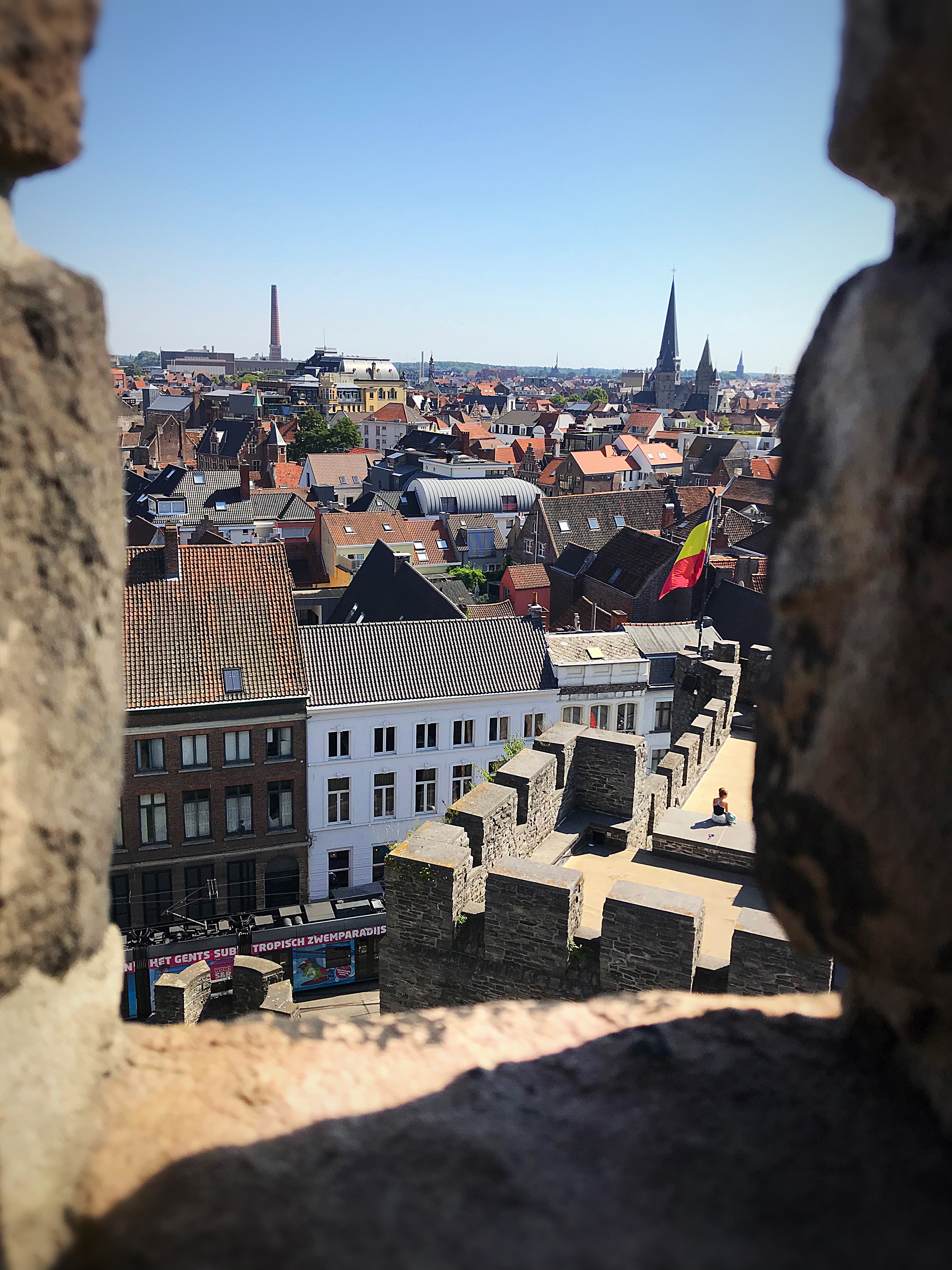
The medieval castle Gravensteen in Ghent, Belgium
If I had to take-away one reflection from my time in Brussels, and Europe at large, it is to learn how to be comfortable with being uncomfortable. You won’t always have all the answers or know exactly what’s going on. You might dress differently or be forced to eat a food you hate because it is the social custom (Brussel sprouts for me). Or you might have to quickly (and discreetly) google translate the words on your menu before you order at a restaurant. I walk away from this experience with a whole new meaning of the phrase ‘c’est la vie,’ and the knowledge that change is possible if we allow ourselves to step into the shoes of other nations.
My semester learning and living on the Colorado Plateau
Cake for breakfast, five espresso shots, Ira Glass’ voice and midday naps.
This is what I craved upon emergence from the backcountry after two months. After tending to these adventitious desires, I gathered my rather satiated self and began to reflect on the events of the past nine weeks.
As fall had settled into my home in the Montana Rockies, I chased the waning summer south to Green River, Utah, where I began my semester with the Missoula-based Wild Rockies Field Institute. The concept of place-based learning was one that intrigued me, but it would soon become apparent how much my trio of mind, body and soul craved exactly what my WRFI experience provided to me.
The desert of the American Southwest was always a dear landscape to me; As a child, my parents, driven by their passion for inhabiting wild places, would tow my younger brother and I south on I-15 to interrupt our high-altitude norm with adventures through deep red rock canyons. When I was presented with the opportunity to study this unique setting through the lens of topics such as land management, geography, geology and indigenous studies, I bought a sun shirt and applied.
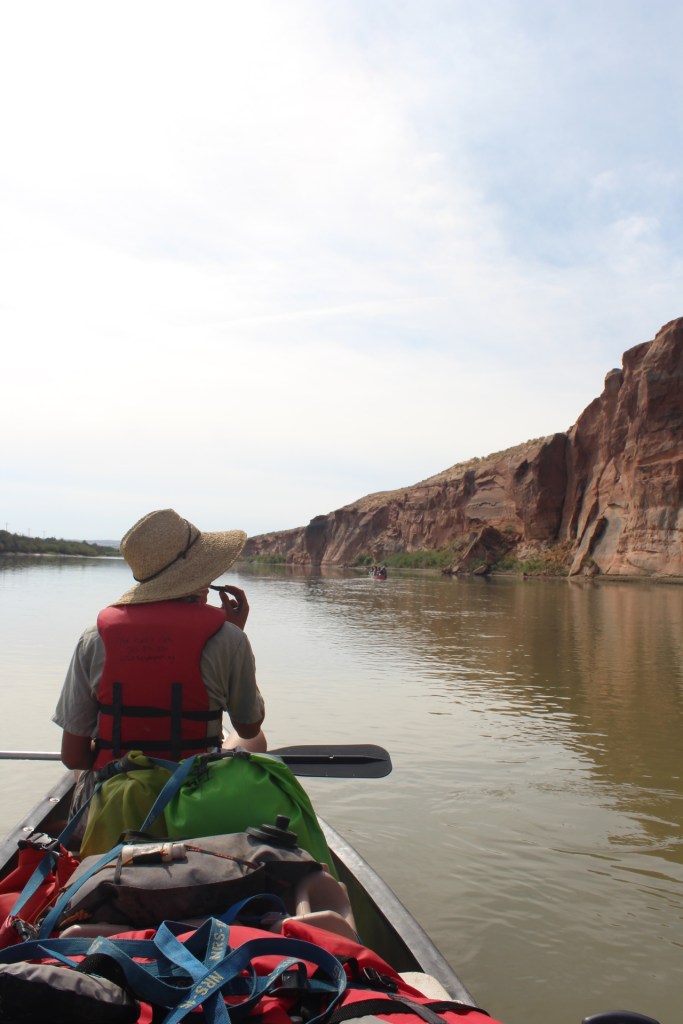
Moving from “classroom” to “classroom” on the Green River. The first section of my WRFI semester was spent in Labyrinth Canyon studying water management, botany and biodiversity among other topics. PHOTO BY BELLA BUTLER
WRFI is unique in many ways, one of which being its setting. The classroom changed on a daily basis, as a component of the semester was traveling and living in the backcountry. This began on the Green River, where I eased into a new way of life cruising down slow late season water in tandem canoes. This was a great way to get to know each of my seven other classmates. After a week on the river, we laced up our boots and set out for a more physically demanding approach.
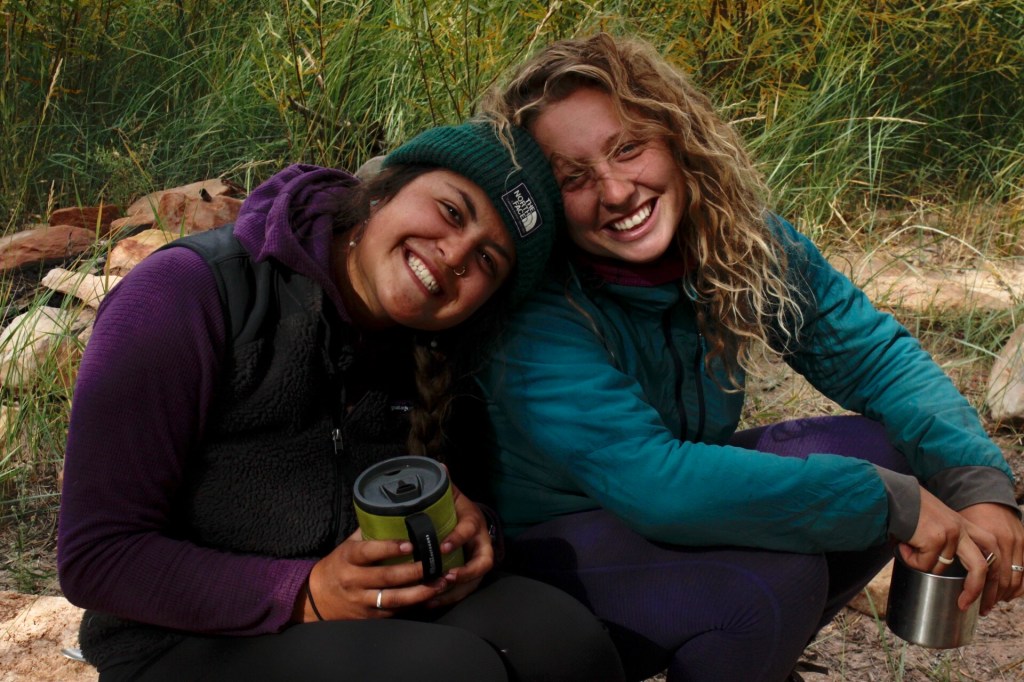
My WFRI peer, Phia (right) and I enjoying instant coffee before a morning class at the boundary of Dark Canyon Wilderness and BLM land. PHOTO BY ELIZA DONAHUE
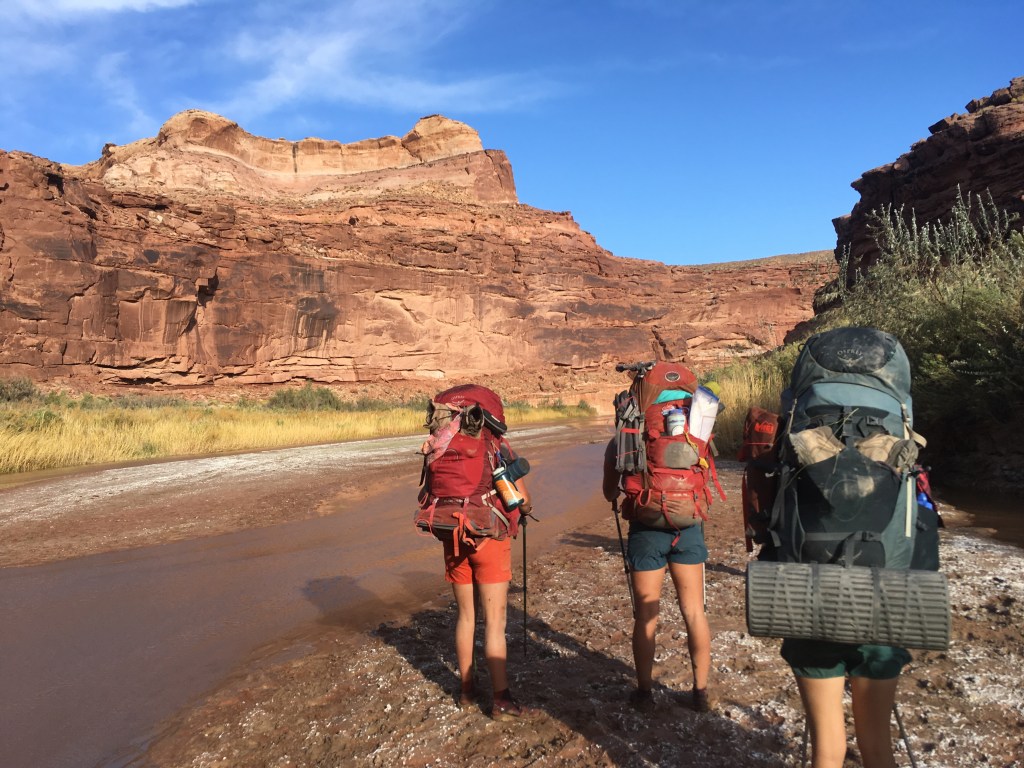
Our first day backpacking, we entered into the Dark Canyon Wilderness, a region formerly encapsulated in the 1.3-million-acre Bears Ears National Monument designated by Obama in 2016 and reduced in size by Trump just shy of a year later. Our packs were 50-plus pounds, and our feet were soft after the plush week on the lazy river. The first stretch was a mere five miles, but our group struggled to find a comfortable rhythm. A few students had never backpacked before, and it took a few tries to adjust packs before they finally joined the rest of us in the conclusion that carrying life on your back is inescapably awkward and sometimes painful. Despite the initial challenges, we fumbled into a reliable groove. By our third day, we moved like a well-oiled machine through our routine of boiling breakfast water, packing, hiking and settling in for the evening at a new camp. Throughout the entire semester, our boots carried us through Dark Canyon, the Dirty Devil River (yes, through the river) and Horseshoe Canyon.
Just as we were not limited to four walls, classes were not limited to a Monday through Friday schedule. Depending on the weather, energy and a number of other factors, our two instructors would gather my peers and I either before or after a day of hiking for a daily discussion-based class informed by reading materials we were individually responsible for covering prior. With a small and enthusiastic group, our discussions were vibrant and constructive.
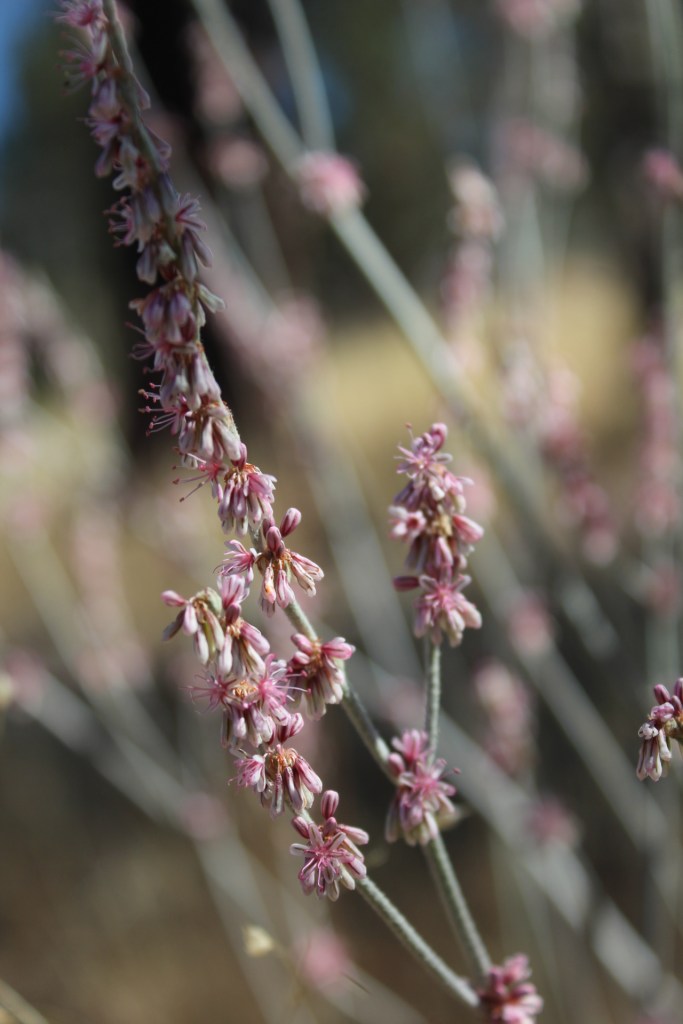
Throughout the course, we discussed the importance of observation. On a solo hike up Cherry Canyon, I practiced my naturalist skills. PHOTO BY BELLA BUTLER
Eliza observes a rare find: a potsherd, possibly a remnant left behind by a group of Ancestral Puebloans. NOTE: This potsherd was left where it was found. PHOTO BY BELLA BUTLER
The beauty of place-based learning is that readings, lessons and classes are immediately applied. One day, after a morning class, we packed up our gear, helped each other hoist packs into position and headed out on the trail. That morning we had discussed the different types of land management and use. Our trail weaved in and out of Wilderness and BLM (Bureau of Land Management) land, and as we hiked, we made verbal note of the clear and present juxtaposition of the less-disturbed Wilderness side of the fence, which was devoid of the cow patties and hoof prints that littered the BLM side. Classes often informally bled throughout the day, and even most nights as we laid in a row of sleeping bag bundles under the stars, debating, lamenting and celebrating the day’s topics.
Lucy (left), Eliza (center) and I observe tafoni, a surreal-esque feature often found in Wingate Sandstone. PHOTO BY EVA CHRIST
.In the middle of the semester, we were privileged to have been hosted by members of the Hopi and Diné (Navajo) tribes in their homes on indigenous land. In Montana, I grew up only a few hours from various indigenous nations and regrettably knew very little about them and the ramifications of a history of genocide and systematic racism that embattle Native Americans on a daily basis. During this time, my peers and I were forced to confront alarming and sickening truths, leaving us with a still shallow awareness of major injustices that occur in our country, many that we even play a role in– and awareness I now seek to deepen in my everyday life.
Exploring slot canyons during a lunch break. My semester with WRFI was academically rigorous, but there was plenty of room for fun and exploration. PHOTO BY PHIA SWART
From these indigenous studies to land degradation to climate change, my brief two months studying with WRFI gifted me a perspective that shed new light on much of the life I’ve already lived but more importantly illuminated the life I hope to live yet.
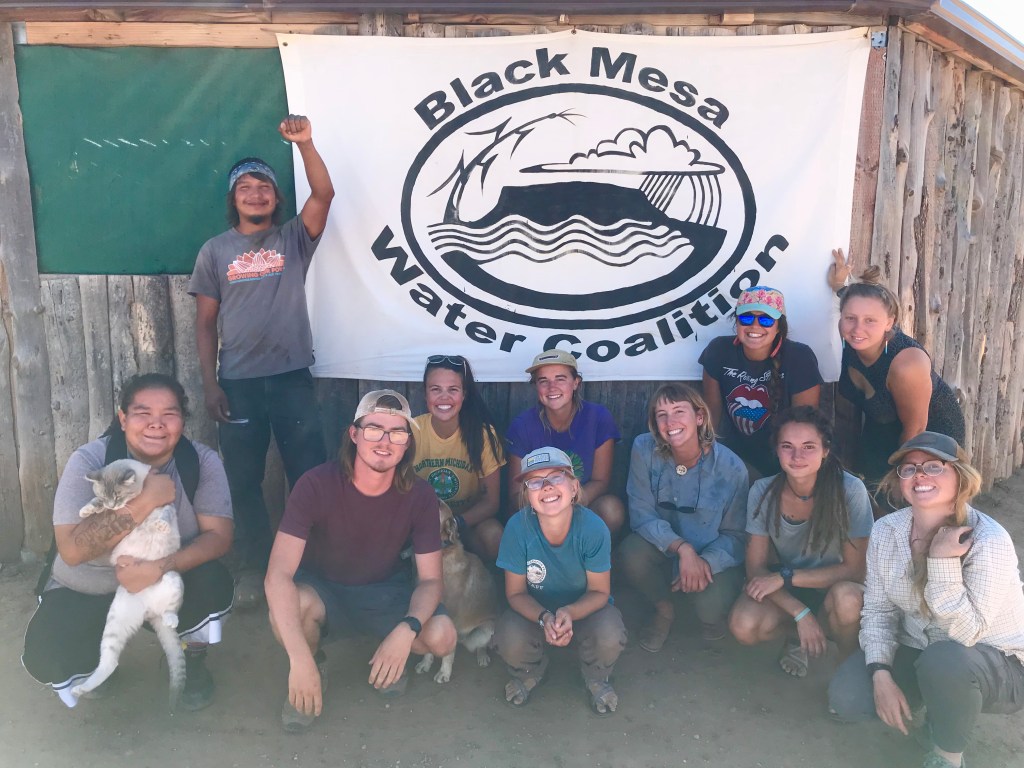
Siena (left), Eliza (right) and I probe for quicksand while traveling through and along the Dirty Devil River, a salty tributary to the Colorado. This particular section was 12 days in the backcountry studying geology, climate change and policy among other things. PHOTO BY EVA CHRISTDuring our frontcountry section, we visited the Black Mesa Water Coalition on the Diné nation. BMWC shared with us their important work on energy and climate justice. Locally, they work to establish sustainable agricultural practices that combine their traditional knowledge with new innovation. PHOTO BY KATIE NELSONA late afternoon scene from the property of Tommy Rock, a Diné man who kindly hosted our group for a few days. We were privileged to have the opportunity to learn from Tommy, who earned a PhD studying uranium water contamination on indigenous land. PHOTO BY BELLA BUTLER, SHARED WITH PERMISSION FROM TOMMY ROCK
On our last day in the backcountry, we emerged from a canyon that had been home for two weeks. As we traversed and climbed the crumbly cliffs and slopes that served as our exit ramp, I frequently looked back over my shoulder, begging myself not to forget any detail of the place I was leaving behind. Finally, we reached the top. Joe, one of our instructors for that section, offered us a parting gift; his last nugget of wisdom to echo off of the stoic red sandstone that had come to feel like a friend. He told us we were about to leave behind a place that had both sheltered and challenged us, that had fostered our growth and forged our bonds for two months. Between the daily pursuits of covering miles, studying and taking care of ourselves and others, there had been little time to look backward or forward– life in the backcountry is inarguably lived in each present moment.
The “real world,” where our smartphones, 24-hour news cycles, friends, family and distractions awaited us, existing in the moment was a hard thing to achieve. We had spent a series of weeks submitting ourselves to a process of growth and self-improvement, and what lay beyond the trailhead threatened all of that. Joe challenged us to consciously consider the people we had become, the people we wanted to continue to be; the characteristics we hoped would live on in us and the ones we preferred to leave behind.
We took a few moments, breathed in a collective breath and called our wandering desert selves back in.
Life post-WRFI is an unpredictable blend of grounding and chaos, and always nostalgia. The takeaways I carried with me out of the canyon country give me clarity in many ways but also remind me to question my surroundings, to be curious and brave and to challenge the status quo when change is in order.
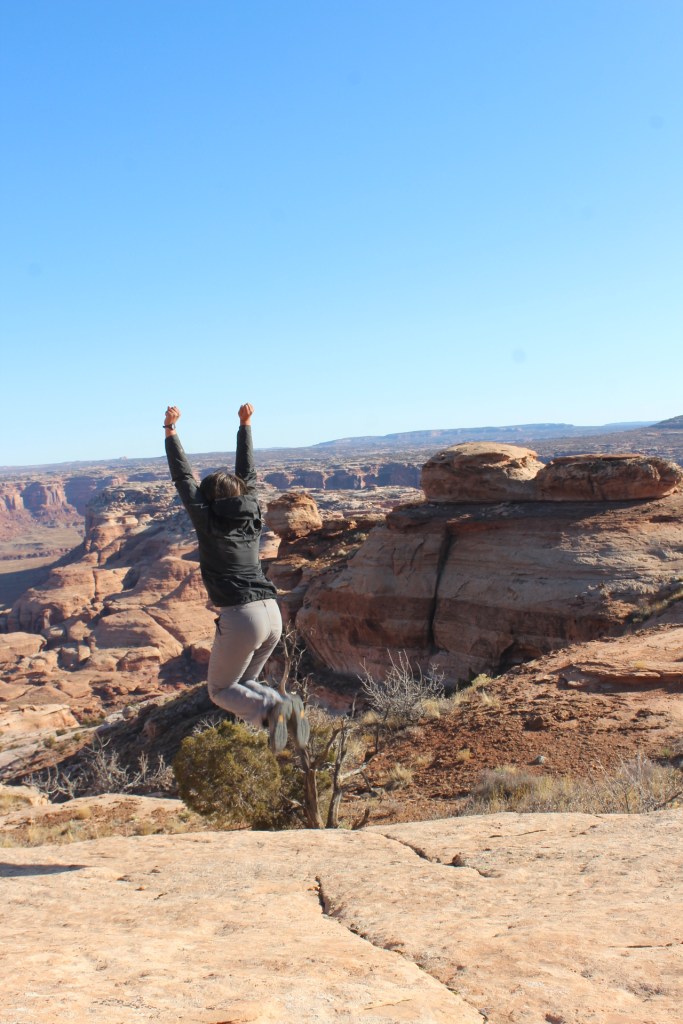
A bittersweet moment at the rim of Horseshoe Canyon, where we celebrated and mourned the end of our time in the backcountry. PHOTO BY SIENA HESTER
Nights nowadays, I close my eyes as the heater hums in the corner of my room and place myself back in the desert, where nights were spent buried in synthetic down and fleece layers. I imagine I can still hear the lullaby rhythm of seven sets of lungs breathing in crisp desert air around me and see the soft light of twinkling stars through my closed eyelids. I picture this until I fall asleep to dreams of red dirt and slickrock, and the truths I found in those places and the courage I cultivated that allows me to share the story with others. I know that one day I will return to this magical landscape, but for now I’ll remain in its trance, abiding by its teachings and honoring its gifts through reciprocity and gratitude.
*To conclude my WRFI semester, I wrote a paper that weaved together concepts from the course with my personal experience. Follow this link to read it.

















 Beyond the Classroom