Healthcare in Ecuador

In 2008, the new constitution of Ecuador declared healthcare must be accessible by all residents. Since this new mandate, Ecuador has invested heavily into public health which has resulted an in increase of the budget of Social Security health care services. There has been significant improvements in healthcare and public health in the last 5 years with this increased budget.  New technology is being purchased in large facilities, increase in staff and changes in age restrictions and individuals with preexisting medical conditions who may now join “voluntary”. More people have been paying into social security with strengthening confidence in healthcare. Full and free medical coverage is being provided under this new health system. Overall, by allowing residents to pay into this new Social security health care program for a monthly fee of approximately $70, accessibility and quality of public health have only grown. I was fortunate to witness many of the positive impacts and obstacles of this new healthcare plan Ecuadorians are paying into.

Volunteering at several different clinical settings in Quito, Ecuador I was able to see many benefits of the new healthcare system. One of the ingenious benefits of this new health care system is that healthcare is completely free for children under the age of 5. This includes the cost of vaccinating children. Immunizations such as diphtheria, tetanus, pertussis, mumps, hepatitis B, etc. are free of charge. By providing these vaccines, Ecuador is able to prevent the resulting life threatening diseases in these children as well as avoiding the issue of parents refusing to vaccinate their children and compromise herd immunity, the overall immunity of the general population, as seen in Disneyworld.

Although immunizations are provided free of charge for children under the age of 5, the parents or the current guardians of the child do not always have the correct paperwork in place, thus the child cannot receive the immunizations. This is very troublesome because not only are parents not taking advantage of a free service being provided to their children, but they are putting others at risk as well.

Another service that is provided free is prenatal care. By increasing prenatal visits there is a corresponding decrease in poor perinatal outcomes.  This is wonderful service as it is probably the most cost effective way in reducing prior and during pregnancy. However, as you move from urban to rural Ecuador, the utilization of this service declines. One of the Doctors I was following explained that this might be due to some rural people’s current mistrust of modern medicine.

There is a higher percentage of individuals in rural Ecuador than urban Ecuador that still practice traditional medicine.  These individuals usually have little understanding of modern medicine and how it works as well as mistrust in the people who administer this type of medicine.  Typically in rural Ecuador, when a pregnant woman, or her family, with these beliefs is giving birth often the birth occurs without complications; however, when the birth does not, usually the family waits until the woman has been in labor for a very long time and complications have become exacerbated. By the time the family brings the woman into the clinic it is almost always too late. The family feels that it is the Doctors or clinics fault for not saving the child and or mother. Thus, continuing the mistrust of certain individuals in modern medicine and the new Social Security health care program and the amenities it has to offer. Although there are great benefits being provided in the new health care program in Ecuador there are still obstacles to be addressed and overcome.

DSCI0095

Hospital San Francisco is a new public Hospital built only 4 years ago.

Africa In My Blood – What I learned

I wanted to make a post especially for summarizing what I learned while I was in Africa. I want to share these things because I think they are important, but they are also my most cherished souvenir. I learned practical things but also some things about myself. If I was to break it up I would have to say that the first two weeks I learned a lot of important things about Africa that I had misconceptions about before. But over the second two weeks I learned more about myself.

I learned a lot about conservation in Africa while I was in Masebe. Issues there are all pretty complicated because of a couple of reasons; both the humans and the wildlife demand a lot of space and don’t necessarily get along very well and a lot of the world has opinions about what should be done regardless of whether the information they have is correct.

IMG_3780-EDIT-FB

A lioness which was in the Moholoholo Rehabilitation Center, one of the places that will come in and remove problem animals from areas where human/wildlife conflicts arise.

Many of the communities that have to deal with the wildlife on a daily basis are very poor and many of them need livestock or land to make a living and feed their families. Conflict arises when the wildlife in the area start interfering with their ability to make a living through those means. For example, if there is a leopard in the area and it has started to kill their livestock, in order to keep their family from starving these people have no choice but to trap or hunt that leopard, whether or not it’s legal. One way they can fix this issue is by putting up fences. In my experience with fences in Montana they are mostly a problem because it creates barriers in migration routes. In Africa this is a problem as well, but there are other benefits to the fences that may outweigh the negatives. Fences in this environment serve many purposes and in most people’s eyes they see them as a good thing. Fences keep the wildlife out of communities, and with all the dangerous wildlife this is a pretty important function, they also help keep people out of wildlife spaces, especially in the case of poachers. The fences are also quite fortified compared to fences I was used to and it’s because they are meant to be more permanent barriers than the fences we have in Montana.

IMG_3532-EDIT-FB

A bull elephant we saw in Kruger National Park

Although the fences can fix issues for communities, such as elephants eating all their crops or lions eating their livestock, they also create issues for a lot of wildlife in the process. How many elephants do you think there are in Kruger right now? 1000? 100? Too few? There are over 20,000 elephants in Kruger National Park today, which is triple the carrying capacity, or how many elephants Kruger can sustainably hold. (http://www.krugerpark.co.za/krugerpark-times-23-elephant-numbers-18006.html). I was shocked to find this out, I was pretty confident that African elephants were having a hard time. The media has falsely advertised the problem of African elephants, there aren’t too few, there are way too many. The real problem is what to do with these animals. Part of the reason that they are so over populated is because they are confined to one space thanks to fences. There are many advocates of tearing down fences to connect national parks all over Africa. There are other projects in place to help control their population like the implementation of contraceptives for female elephants. Then of course there’s the thing no one wants to talk about, culling. The fact of the matter is that culling may be the only way to bide enough time right now to come up with a better solution before the environment is totally altered by the over population, but officials are afraid to make that decision because the media would explode with negativity if they did. People would be irate – how could they kill these animals in cold blood?

Each solution comes with severe pros and cons. I saw the effects of these animals first hand while I was in Kruger. Elephants are destructive, the eat by knocking down trees to get to the fruit and leaves at the top. We drove through some spaces that were nothing but pushed over trees. The trunks were torn and the tree was dead. I don’t envy the person who is in the position to have to make this decision right now. If you take down fences you risk poaching and conflict with people, if you choose contraceptives you are going to have to spend a lot of time and money as it isn’t easy to administer a drug to a four ton animal, and if you choose culling you will have to face an onslaught of angry people who don’t really understand the issue. I don’t know what the right answer is, but it’s something I know I will be thinking about for a long time.

* * *

“Africa In My Blood” is actually the title of a book I read a few years ago. It was an autobiography written in letters about Jane Goodall, one of my biggest idols. In one of the first letters she wrote home after she arrive in Africa for the beginning of her incredible work with chimpanzees she wrote, “…on the whole I am living in the Africa I have always longed for, always felt stirring in my blood.” This quote resonated in me when I read the book, but it held a whole new and deeper meaning for me while I was in Africa myself. I felt a strong calling there that I haven’t felt before, and I am certain I will be back one day. I also learned that I actually do love to travel, given this was my first trip out of the country I wasn’t sure how I would take to it. I learned that I love the sky from caving and I also love the ground from scuba diving (seasickness). I learned that I can be adventurous and I can do lots of amazing things if I just go for it. I also learned how to travel responsibly and that it’s important to look into the organizations you travel with if you want to make a positive impact in a new place. I inadvertently made a good decision with ISV, they are very environmentally conscious and all of the activities we did, especially those that involved interacting with animals, were done with the utmost respect for the culture and the environment.

This trip was just incredibly enriching and it both filled and fueled a need to see the world and do good in every aspect of my life. I can’t wait to go on my next trip where ever that may be and I know I will carry the lessons I learned from this trip with me for the rest of my life.

Africa In My Blood – The School and Adventure

As part of the volunteer work we had the opportunity to visit a local school and help with environmental education there. We taught the kids about different animals, the circle of life, water, pollution, poaching and the food chain overIMG_2506 the course of six days. The kids were kind of shy at first but by the end they were more comfortable with us and they seemed really excited to see us when we came. The lesson would be in two parts with a snack break in the middle when we could play games with them and take photos (they loved to have their picture taken). By the time of the last lesson they waited for us outside the classroom to give us hugs while we straightened up the classroom. It felt really good to have a direct impact on these kids, and even if they forget all of the details of the lessons at the very least most of them will have a positive memory associated with the themes. Norman (the leader of this part of the project) seemed really happy with how the lessons went and had a positive outlook that we made a difference in at least a few of their lives. This work was admittedly the work I looked forward to the least, but in a lot of ways it was the most rewarding and I enjoyed it a lot.

That was the first two weeks. We left Masebe emotionally having made pretty IMG_3100-EDITclose relationships with the people who had been mentoring us for the last two weeks to head on out adventure tour which was the second part of the month long trip with ISV. The adventure tour promised to be incredible, and it definitely lived up to that promise. We first went to a place called Glen Afric which was a great starting point. We got to meet some of their resident animals including leopards, lions, a hyena, zebra, ostrich, hippos, tigers and cheetahs. Then the next day we got to meet three of the elephants that live in the area; there was a mother named Three, and two teenagers named Hannah and Margie, one of which she adopted. We got to touch them and hug them. It was such a powerful experience I can’t really put it into words. That day we also got to visit a market and a cultural village where I tried ostrich and crocodile. Glen Afric was also a really neat place in part because at night you could hear their lions and hyena while you were in bed. Overall it was a pretty magical start to our tour.

IMG_3622-EDIT-FBThe next place we went to was just outside of Kruger National Park. Kruger is one of the biggest national parks in Africa with 7,500 square miles of area. We spent a whole day in Kruger and saw a ton of wildlife. I felt like we were pretty lucky too, we saw four of the big five (lions, water buffalo, elephant, rhinoceros, but not leopard), four individual cheetahs, one of the rarest birds a southern ground hornbill, a carcass frenzy and a ton more. This was one of the parts of the trip that I was looking forward to the most and it totally lived up to my expectations. It was a really incredible day.

After Kruger we went to the base of the Magaliesburg mountains in the
Drakensburg escarpment. There we got to try out kloofing (the South African name for cliff jumping). This was a ton of fun and such an adrenaline rush. Fortunately I don’t have a fear of heights, but this was one of the more challenging activities for those who did have a fear of heights. We had to climb up some loose rocks, stand on top of waterfalls (and under some) and navigate some pretty rickety ladders. The highest jump we did was 11 meters which turns out to be about 36 feet. It was a long, long way to fall. Long enough that you could contemplate just when you would actually hit the water. It was a blast though and we all had a lot of fun. There we also visited a wildlife rehabilitation center called Moholoholo. We got to touch a baby honey badger and feed vultures there. We also learned about how important it is that the people have some kind of relationship with their environment.

Our penultimate stop was in Swaziland (new country!). We visited a candle making factory where we got to see some beautiful candles made by hand. We also got to go horseback riding, mountain bike riding, visit and orphanage and go caving. The orphanage was also next to a cultural village and we got to meet the chief (who was a woman). We got to do a little bit of Swazi cultural dance and singing before we went over to hand out food we donated to the orphans. It was a really humbling experience. These kids were so happy but they were so excited to have apples, oranges and bananas. We all left there feeling like we could all do with a whole lot less and give a whole lot more. Caving was one of the harder activities for me. It was really fun and I felt really proud of myself for doing it all even though it was a challenge. I also got to hold a spider that only lives in that one cave in the whole world. As hard as it was it was a lot of fun and we all made it through by encouraging one another and keeping a positive attitude.

Our last stop was in Ponta do Ouro, Mozambique, and we could not ask for a more perfect ending to a perfect trip. As soon as we got to the border between South Africa and Mozambique we switched vehicles from our gigantic bus to smaller cars that would navigate the sand roads that we took to Ponta do Ouro, a tiny little beach town right on the coast. All of the roads were just sand in the area of Mozambique that we were in. In Ponta do Ouro (tip of gold) we left our shoes in the room and spent the whole time on the beach doing things like learning to surf, swimming with wild dolphins, and scuba diving. Our group had one of the most incredible dolphin encounters of the year if not in the history of ISV. We were within arm’s reach of three dolphins, one of which was a baby, and they were amid a foraging lesson with a struggling little puffer fish (which was alive for most of the time we were there). We got to be with them for almost an hour, and at some point another dolphin showed up and we even saw a black tip shark (which was probably not 5 meters away from me). Of all of the activities caving and scuba diving were the most difficult for me. Scuba diving was hard mentally because I was really worried I was going to get water in my mask and just breathing underwater was hard to get used to. I had to keep telling myself that I was okay and I could breath. It was really beautiful though and I was really glad that I stuck it out. The whole trip was really special and Mozambique was an exceptional end to our trip.

Africa In My Blood – Arrival and Volunteering

I left Missoula in the afternoon, which gave me a whole day to feel anxious as I began the biggest adventure of my life. The first striking thing I experienced was the feeling of being totally alone in a new place. I felt empowered by this when I arrived in Salt Lake City. My first flight was short and there weren’t many people on it, but my second flight from Salt Lake to New York was much more crowded and uncomfortable. Once I got to New York I met most of the group that I would be spending the next month with while we waited for the really long flight across the Atlantic. While I was sitting there starting to get to know everyone I felt even more excited as I was just one more flight away from a place I had dreamed of my whole life; Africa!

Once we arrived in Johannesburg we found the rest of our group and our project leader, Leti. Leti was from International Student Volunteers (ISV, the organization I travelled with) and was there to guide us through our service project portion of our trip. (ISV was fantastic, I highly recommend them for an educational, culturally rich, and safe way to travel and make a positive impact in another country. Here’s a link to their website: http://www.isvolunteers.org/). After a somewhat lengthy bus ride (however it was much more comfortable than the plane) we arrived to our accommodations, Telekishi Cultural Village, where we stayed for the duration of our volunteer project. We had a tour of camp and learned about what was expected of us for the next two weeks (cooking, cleaning, and stuff of that sort).

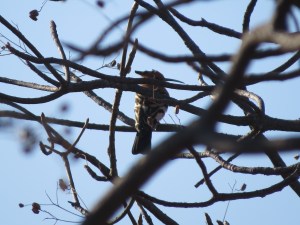
An African Hoepoe, a bird we heard and saw on the reserve while doing bird point counts.

This is the leave of a thorny tree called sickle bush or Dichrostachys cinerea, we had to measure these for the habitat assessments.

The first day was an orientation which involved some bush survival and a run down on the type of data we would be collecting as our volunteer work. We were working with a group called Wilderness and Ecological Investments (WEI) and we would be doing bird point counts and habitat assessments in the Masebe Nature Reserve. The purpose of these projects was to assess the health of different areas in the reserve to help make management decisions with regard to where they keep the wildlife. The bird point counts help by giving an idea about what species are living where in the reserve and how many birds there are. Birds are great bio-indicators of the health of an ecosystem so this helps with determining if the space is being over used. It’s also useful in finding out migratory habits of some of the birds that use the reserve during the year. The habitat assessments were basically a measure of how much vegetation there was. If those measurements are compared from year to year it is possible to find out how much the area is being used by the wildlife.

I really enjoyed the work we were doing in Masebe. I was so pleased that we got to do that project because it is really what I want to do with my life and I can relate it directly to experience I have gained at home in Montana. For instance, earlier this summer I was working on a different bird project concerning Lewis’s woodpeckers, so it was a lot of fun for me to learn some new birds while I was on project. I also learned a ton of  tree species. I found the application of the information we were collecting to be interesting as well. Although it was cold in the morning (I know, I went to Africa and was cold, how about that?) I thought it was well worth it because we saw a lot of wildlife (zebra, wildebeest, impala, baboons, monkeys, even giraffe). We also helped with some other projects, like community outreach and invasive removal. It felt great to make such a positive impact in such a short amount of time. I will cherish every moment of this part of the trip for the rest of my life. I gained valuable experience that will be useful later on in my career as well.

In addition to data collection we helped out with some other project around the reserve as well including invasive species removal, thinning of other problem plants, and game drives. We specifically pulled an invasive called lantana which had originally overtaken a little marshy area. Thanks to removal efforts though it is much more under control now and the area is regaining its health. The other problem plant we thinned was the sickle bush (pictured above). It has some really long thorns and when it grows on the sides of roads it can pop tires, so we just cut some of the tree away from the road. There was also a community outreach aspect which I will talk about in another post.

Papa San Francisco in La Paz, Bolivia

The 8 of July 2015 was declared a national holiday in anticipation for the arrival of the Pope to La Paz, Bolivia. That about 80% of Bolivia’s population is Catholic, hospitals, schools and many businesses were closed so employees would have the opportunity of seeing the Papa, the Spanish word for Pope. Papa San Francisco was flying into to La Paz where he would spend four hours before leaving for Santa Cruz, the next city in his tour in South America. After arriving from Guayaquil, Ecuador it was planned that the Papa would be given a welcoming ceremony, later give a short sermon and then make his way down Avenida Mariscal Santa Cruz, a main street that runs through the city of La Paz. This is the same street that I would see the Papa for a whole three seconds after waiting for over 5 hours, just like many others surrounding me and pushing their way closer towards the street to have a better view.

Prior to the arrival of the Papa many billboards and posters strewn throughout the city greeted the Papa saying: Beinvenidos (welcome) Papa San Francisco, with a picture of the Papa smiling and waving beneath. The Papa himself is from Argentina, the first Pope that was elected from Latin America. As this was his first return trip to South America, and Bolivia one of three countries he would visit, the people of Bolivia were fervent for his appearance.

My roommate, Sara and I left our home stay after lunch and made our way down to the Plaza, ironically named Plaza San Francisco, where we waited among thousands of others for the arrival of the Papa. Shortly after leaving the house we became engrossed in swarms of people waiting for the Papa. People set out chairs claiming their space just like people in America might for Fourth of July parades. I have never been in such massive numbers before. No matter what side street we turned down or where we walked, there were people everywhere.

Many people were selling food, umbrellas Papa memorbelia such as flags and pins. I bought a pin with the Papa smiling on the front for one Boliviano, equivalent to about 15 cents. The Papa was supposed to arrive to the plaza around 4pm, but the sun began to set as we waited for the Papa in our little spot. The Papa was already 2 hours behind schedule. There was a news reporter not far from us saying the Papa was experiencing problems with the altitude. Many tourists before traveling to La Paz will read that the city is at an elevation of about 12,000 feet. When traveling to a high altitude such as La Paz many people experience symptoms as a result of altitude sickness. People around us began to wonder if we would even see the Papa because he only had one lung which would only seem to exacerbate the effects of the altitude, before he had to disembark to his next stop, Santa Cruz a city at much lower elevation in Bolivia.

My legs were killing me, we had left our homestay at about 2pm and now the sun was setting. I’m not sure how other people’s legs felt standing on cement for hours, but I was amazed by people’s desire to see the Papa. Little children, elderly women, people with casts or in wheelchairs all waited. Despite individual’s physical state it seemed all of La Paz, all 1 million inhabitants had flocked to this very street to see the Papa. When seven o’clock rolled around we heard word that the Papa was feeling better and he was making his way down Avienda and would be passing by shortly.

When the Papa drove by he was standing in the back of the car with a big oval shaped glass structure encompassing him (referred to as the popemobile). He smiled. He waved. Just like the posters we saw in town. We saw the Papa for about three seconds before he zoomed by. People were cheering, some crying. Many people holding electronic devices up trying to record the moment in which he would pass. People were joyful but also slightly surprised how quickly he passed.

The following day at work and classes, the only question that seemed to be asked was, “Did you see the Papa?” People talked about how crowded it was, how quickly it all happened, more interestingly was how people started calling him the “the Pope of the Poor.” How he had touched the head of women’s child and healed the infant. How the Papa promoted this and talked about that in his sermon, particularly about the “steps” Bolivia had taken to include the poor in the political and economic life of the country.

papa


Cuy as Medicine

Traditional medicine is still commonly practiced by many people in rural Ecuador. Traditional medicine is administered by a shaman, typically a woman who has been taught the skills by her mother and her mother before her. Each passing the skills on through the generations. Patients do not have money, they can pay in many other forms such as food products, labor, or other gifts.

During the third week of June, two other students from my program Emily and Cody joined me in a visit to Jambi Huasi, a traditional medicine clinic in Otavalo, Ecuador. We only spent one day in the traditional clinic as our other days were spent in nontraditional medicine settings.  Although I did not understand what was said during the visits with patients because the shaman spoke in Quechua, the indigenous language to this area, I was able to witness a very unique and special ceremony which a large percentage of local people deem meaningful in their history, culture, and still in modern day.

The morning we arrived to Jambi Huasi we were introduced to the shaman that would be working there for the day. There was already a father with his son outside the room waiting to be seen. He was brought into the room and explained that his son had been sick for a little over a week and was displaying symptoms such as a body aches, coughing, and was sleeping more than usual.

After the father finished explaining his son’s symptoms, he handed the shaman two eggs. The shaman placed the uncracked eggs in a bowl and picked several rocks from a lovely collection of rocks she had on the table in the corner. She leaned over the bowl and spoke words in way that appeared as if she was blessing them. She then put oil on the rocks and eggs and the boys head and began rubbing first the rocks then the eggs on the boys head, arms, legs, and torso to absorb the bad energy. She then placed the bowl on the floor and held the boy over the bowl and was shaking the boy as if she was trying to shake the bad spirits out of him, all the while chanting at the same time.

After she finished with the eggs she cracked them in the bowl. The way in which the yolk cracked would be interpreted by the shaman. She would then know the sickness the individual had and if the eggs and rocks had worked at absorbing the bad energy. During this whole process the shaman is speaking in Quechua, rending the body of bad spirits and or energy.

After the boy and his father left we were excused for lunch and told that after we returned we would be able to see a Cuy ceremony. Cuy is the Spanish word for Guinea pig, an important and sacred animal to indigenous people of Ecuador and many other South American countries.

Returning after lunch, we were led into a different room this time, but similar to the first. The shaman already had Guinea pig selected. We were told that the Guinea pig had to be of the same sex as the patient being seen. The patient that afternoon was a young woman who told us prior to the ceremony she was in the middle of treatment for parasites.

The shaman first began by saying a few words in Quechua. Then proceeded to take the live Guinea pig and rub it over the woman’s body, arms, legs and torso. The shaman continued this process until the Cuy was no longer moving and squealing. The shaman than sat down over a bowl she had prepared earlier. With experienced hands she made one vertical and two horizontal incisions on the anterior side of the Cuy.

She quickly skinned the Cuy and began examining organs such as the liver, kidneys, heart, intestines and stomach. If there was anything wrong with the organs of the Cuy that would indicate the problem of the individual. After the Shaman finished examining the Cuy. We all noticed the intestines of Cuy moving in the bowl beneath. This Cuy had parasites.  The Shaman had inferred that because this Cuy had parasites the woman in the room with us must also have parasites, which in this case she did.

DSCI0208

Balancing Coding with Summer

Going into this project of building the Android Physical Therapy fitness app, I did not know how difficult it would be to balance an independently driven project with the hectic nature of summer. The progress has undeniably been slow but yet steady. Not only am I learning about Android programming, but I am learning more about myself. Previously, I have struggled with working on coding projects and assignments in a structured and sensible way. I struggle with procrastination and then as the deadline approached, I would finally feel the surge of motivation. At that time, I can be extremely productive in a short amount of time. Previously, working on coding in a compressed fashion, helped me generate the most cohesive program.

Making this app has made it clear to me that that is not the best way to complete a project in a job setting. With this research/internship, I have had to set my own deadlines and goals throughout the summer. At first my sights were too high and I had to moderate my expectations of myself. In a very real sense, I am learning as I progress throughout the project. Working as a programmer is incredibly different from doing programming assignments. Several days a week, I set aside time to work on the app throughout the day. I have had to allot time and give equal share to research, learning through informative videos and reading, and correspondence with the client in addition to actually coding the app. I still have so much to learn about the Android programming environment, and every time I use it, I learn new shortcuts and ways to improve style and accessibility. There has been a much steeper learning curve than I anticipated, and I am incredibly grateful for my Java programming background and experience with XML.

I am pleased with the current progress on the app. Even though I have to learn how to implement new aspects or to use computer jargon-“methods and controls”, you only have to learn how to do it once and then can reuse that knowledge over and over again. Hopefully, as the semester begins, I will be able to meet with the Physical Therapy professor who is the client more regularly. The summer has been a difficult time for coordinated communication, but I am sure that will be remedied in September. I believe we are on track for the prototype presentation in the spring of 2016.

Lisa H. Morgan

What Crisis? Greece July 2015

July 12, 2015

When I told other travelers in Poland and Hungary that I was going to Greece next, they whistled and said good luck. My Mom texted and asked if I was sure I wanted to go, did I think it was dangerous? After messaging a couple of friends who were in Greece, I decided to continue with my trip.

Today, amid news of an agreement being made in Brussels, I encountered a political rally on the steps of the Athen’s Parliament building. Syntagma square was full of people of all ages, waving flags and banners, and calling for the Greek government to reject the deal with the EU, leave the EU, and revert to its old currency, the drachma. I spoke with many young and old people, all agreeing that it was best for the country. Speakers around the square blared a speech in Greek. My older brother, Alex, witnessed a similar rally in Athens in 2012, when he was studying abroad. His ended in tear gas being thrown. This one, luckily, did not.

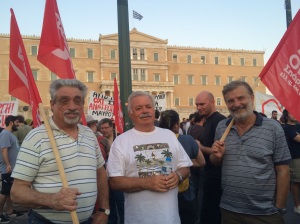
imageimage

All public transport was free in Athens today and will be tomorrow because of the situation, and people were qued up at ATMs all day. The banks are still closed. I’ve been talking to people on the street and friends and there seems to be a lot of confusion, mostly because of the lack of a trustworthy news source. The receptionist at my hotel even told me she hopes America will step in if need be.

As a tourist, I remained in a happy little bubble, enjoying Greece and it’s charms. I saw the news on the TV while taking advantage of the empty hotels and restaurants. It makes me sad, because I have come to love Greece in the six days I have been here. Reverting back to the drachma seems to be the way to go to me, but I still don’t know if it is the correct path.

For more about my trip, read on.

The Maid of Honor made her way from man to man, wiping each of their brows. She skipped the bride, because she was being cooled by the waving fans of her mother and sister. Both the bride and groom’s families were present at the alter of the Greek Orthodox ceremony in Patras, Greece.

image

I had arrived to Patras that morning to visit my friend Elena, a friend from my Salzburg exchange, after “sleeping” in the Athen’s airport Mcdonalds. An experience in itself. The previous four days had been spent on the island Crete, a suggestion from my friend Lefti. A great suggestion as I didn’t want to leave.Crete is quite a big island, and I would have had plenty more to do.

My base was Chania, a beautiful Greek town cradling an old Venetian harbor. My first day was given to exploring the town with European charm and Central American construction.

imageThe next day I explored Lafelonisi, an truly amazing beach with pink sand and aqua blue water. A beach my beach loving Mother would kill to see.image

That evening I met up with another friend made in Salzburg, Tonia, and her friends for drinks and
chatting. The third day I made my way down the 18 km Samaria Gorge, then spent the afternoon floating in the ocean.

image

image

For my final day on Crete I hiked to Balos Beach, another wonder. Never have I
been asked out that many times in four days, Greek boys y’all are dimes.

But back to Patras. Greek hospitality was immediately evident as soon as Elena and her mother picked me up at the train station at 9:00 a.m. We were taken to Elena’s aunt’s apartment in the city center. Most Greeks live in flats in concrete apartment blocks because land is precious. With one bedroom, a bathroom, kitchen and adjoining living room, it was small by US standards, but warmly decorated and all the space one needs. Elena made me a traditional breakfast of hard boiled eggs, Greek coffee, and crusty bread with honey made by her grandfather.

We then hopped on a bus to Elena’s mother’s childhood village and the beach there. We spent a memorable afternoon floating in the ocean, hiking sand dunes, and even stumbled upon a naked beach.
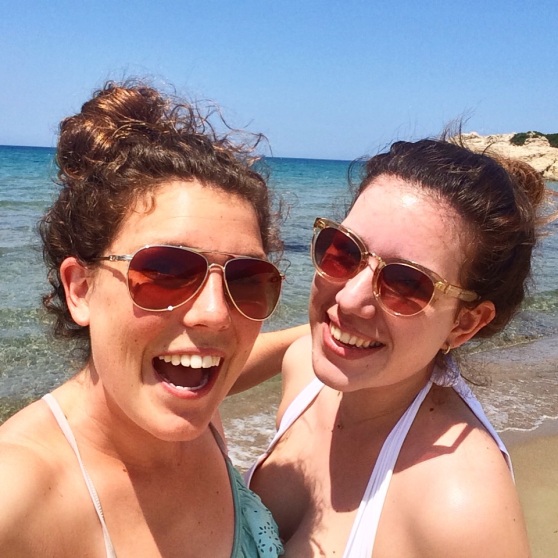
image

While we floated in the water, Elena told me about the crisis her country found itself in and the difficulty her people were facing ,especially young people. She is studying to become a teacher, just like her parents. In one year she will complete her studies and if she doesn’t find a job she will go to Germany or Austria because she speaks German. Something that would make her sad, as she dearly loves Greece and once one leaves it is hard to come back.

She also worries about becoming a foreigner in her own country. Greece has been conquered many times throughout history because of its strategic place between Europe and Asia. If the country reverts to its old currency things will become cheaper, inviting foreign investment. Investment that would be good for the economy, but not if the investors don’t respect the Greek way of life. A way of life already being challenged by its lose of young people to other countries, and English. Elena’s mother gets mad when Elena texts her in Latin letters. More and more young people forgo learning to spell in Greek letters and rely on using the Latin letters to type in Greek.

The country has open borders and serves as shelter to many refugees, refugees the government can’t afford to take care of. This is just one example of the many debts Greece has taken on, the government accepted a loan from the EU to support this influx of people, then the very corrupt government spent it bettering its members and left bread crumbs for the people. People who have been diligently paying their taxes.

When I visited, July 12, 2015, Greece had just defaulted on a major loan and was deep in crisis. People were waiting to find out if they would continue to be on the euro and in the EU or if they would go back to drachmas, their old currency. The streets were humming with talk of the crisis, Elena translated for me. Everyone I talked with seemed to be optimistic though, a Greek tendency, according to Elena.

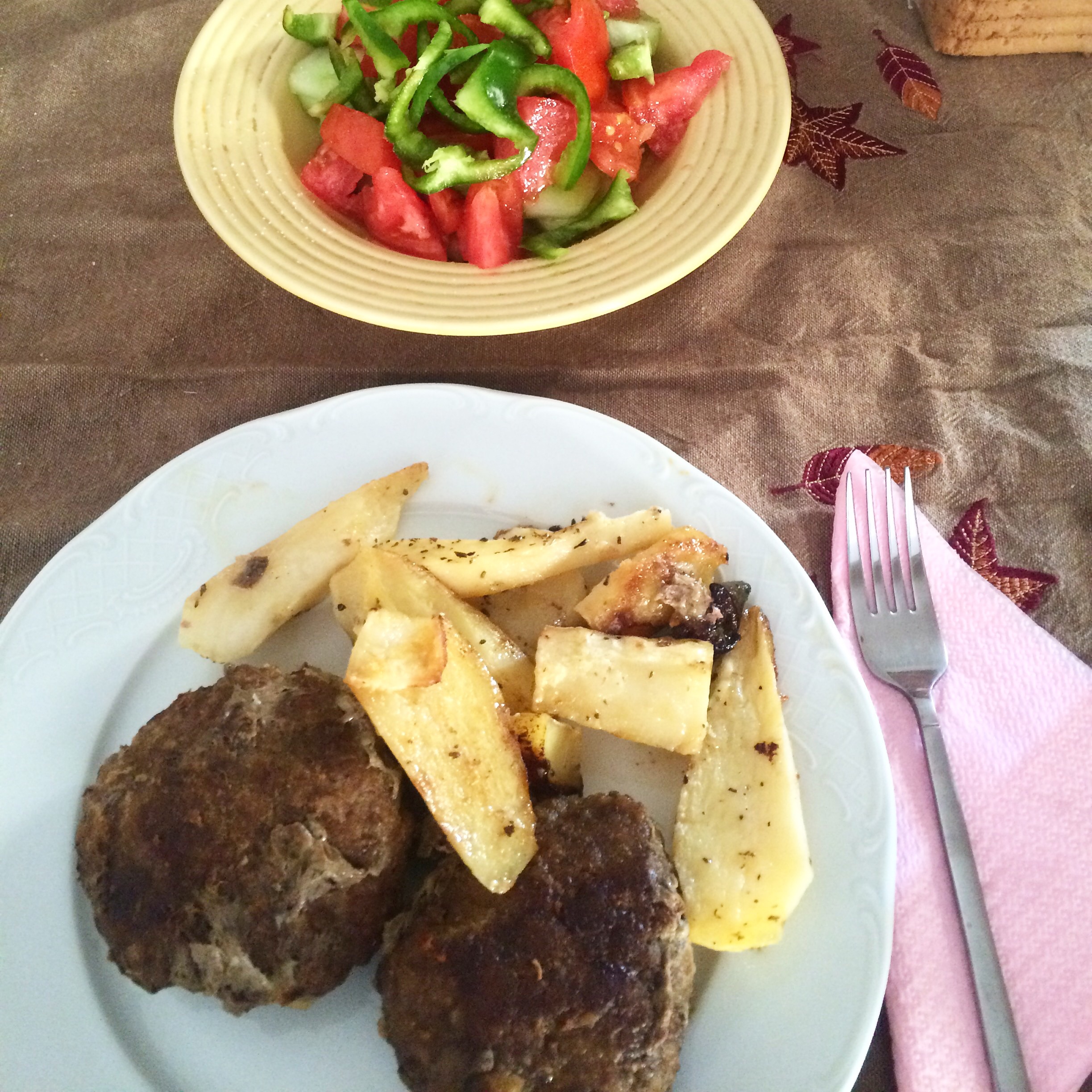
After the beach, we made our way back to Patras for lunch (at 5:30 pm!) of beef patties, potatoes, and Greek salad made from tomatoes grown by Elena’s father, who has always grown all of their produce.

image

We prepared for the wedding then. Elena borrowed a dress from her older sister, saying as she zipped it up that if her sister saw, she would be dead in the morning. I guess little sisters are the same everywhere, stealing their older sister’s clothes. I’m sure Elaine, my sister, has been having a party in my closet.

The wedding took place at 7:30 p.m., after it had cooled down. Everyone waited outside for the bride to arrive then followed her, the groom, and their families Inside. I enjoyed the ceremony immensely, even though I couldn’t understand a word. The ceremony seemed to be a call and answer session, with the priest saying something, then a group of men singing something back. The audience stood instead of sat and were never still, always shifting, talking, and moving. A sharp contrast to American seated and silent wedding ceremonies.image

Other than the connected halo/ring crowns placed on the bride and groom’s heads and the rice throwing at the end, the wedding was nothing like My Big Fat Greek Wedding.

image

After the ceremony, Elena and I skipped out on the reception and headed to the city center for a tour of the harbor, another beautiful Greek Orthodox Church, and to meet her friend, Rafaella, who did her Erasmus in Krakow, Poland. The three of us made our way to one of the many outdoor cafés to split a meat plate and bottle of wine for dinner at 11:00 p.m. This is a typical Greek night out. Instead of going to bars and clubs, Greek students prefer a busy sreet side cafe, talking, and shared food and drinks.

At 12:30 a.m. we went to an ice cream parlor on Patras main square. A square still crowded with people of every age, and it was a Sunday night. The hot weather demands that people live by its changes, waking early to beat the heat, retiring indoors or to the ocean in the scorching afternoon, then venturing out again at 8:00 or 9:00 p.m. when it has cooled down. The use of air conditioning is seldom, as it is expensive and wasteful.

As a tourist and owner of a foreign bank account, the currency restriction of 60.00 euro per day did not affect me, but it did Elena. We walked by the ATM at 1:00 a.m., only to find a line of about 15 people waiting to take out money.image

Elena broke a tooth on a wedding favor. She said she will wait for the currency restriction to lift to fix it. A restriction that people are saying could last 10-18 more months. The next morning we woke up at 8:30 for a quick breakfast, then what Elena called, “fast walking” for 40 minutes to the bus station. The whole time we walked she kept making sure I had all my things, and giving me directions for the bus in Athens. It felt good to be mothered, and by one if the sweetest girls I know.

Thanks for a great visit honey bunch, hope to see you in America soon!

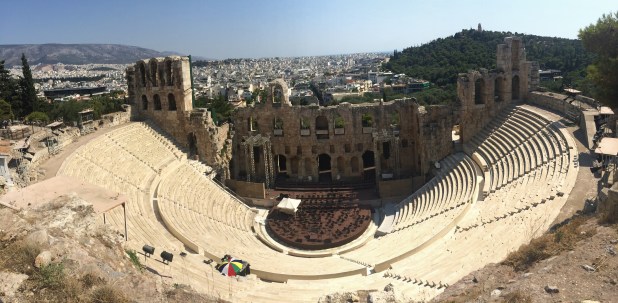
A three hour bus ride brought me to Athens, where I checked out the parliament building, Acropolis museum, and the actual Acropolis. Pretty awesome! Then it was back to the airport for a 1:40 a.m.  red eye flight to Lisbon, Portugal.

image

Greece was just great. I will definitely be coming back. Fingers crossed that my family sails around the Greek islands sometime soon and I can come back to visit friends. Chins up Grecians, your country’s natural beauty and people’s tender dispositions are a treasure.

Next stop Portugal!

July 8, 2015 Chania, Greece

July 9, 2015 Lafonisi Crete, Greece

July 10, 2015 Samaria Gorge and Ag Rioli, Crete, Greece

July 11, 2015 Balos Beach, Crete, Greece

July 12, 2015 Patras, Greece

July 13, 2015 Athens, Greece

Solo in Italy

I arrived at Sojin’s (one of my best friends from the USA) Milan apartment block before she did. Night was coming on and as I tried to match Sojin’s previously sent picture to the buildings around me, I heard voices coming from the street gate. Upon closer observation I realized it was Sojin and her roommate searching for their keys after their journey home from Florence. It was a bit ironic that I let them into their gate. We headed up to their apartment chattering away.

Sojin and I in front of the Milan Duomo, the Italian word for cathedral.

Sojin and I in front of the Milan Duomo, the Italian word for cathedral.

The next morning, after a visit to Soj’s school, we had paninis and then shopped all afternoon. It was so great to walk around in the Italian sunshine, giggling with Soji, eating gelato, and marvelling at the stylish Italians that were everywhere. Milan is not your sandstone Italy with piazzas and jolly, big bellied Italian chefs around every corner. It is a big city, with a more modern and industrial feel. I enjoyed being there, it is different face of Italy.

The next day we had some cannolis, then went to meet the five year old Lupa for his english tutoring session. This consisted of Soj, Lupa, and I running around Lupa’s very nicely decorated flat with matchbox cars and puppets yelling in English. Soj does this every week, and Lupa’s very pregnant mother seemed to enjoy the two hour respite from her busy boy. I was pretty excited to see yet another example of Italian living, this time in the city. Lupa and his three siblings shared a one and a half story flat with their well to do parents.

IMG_1594

That night we went to Apperitivo, where one buys a drink and with it gains access to a buffet full of noodles, veggies, and pizza. Pretty good dinner if you ask me.

The next morning I awoke at five, hugged Soji goodbye and scrambled into a taxi to the train station. Four hours later I arrived to my hostel in Biassa, Italy. A town fifteen minutes from the coastal Cinque Terre.

The Cinque Terre are five brightly painted fishing villages that cling to the coast of Italy. My family visited them when I was younger, but other than a brief flashback of a beach, I don’t remember the trip.

IMG_1706

Cinque Terre was by far my favorite place in Italy. I started in Moterrossa, the northern most village and hiked along the coast to Vernanzza, my favorite of the five villages. In the villages, I wandered the small streets, poking into artist’s shops and caught glimpses of locals. I ate more gelato and enjoyed the sunset over the ocean then headed back to my hostel around 9:30.

Monterossa

Monterossa

Back at my hostel, the chef prepared the most amazing pasta dish for dinner. and for a good price. While eating, I met two girls from California, both teaching english in Madrid, Spain. We talked about the U.S. and what we missed. One was adamant that she never wanted to go home, they just do it better in Spain, according to her. The other agreed with me, that although the US has many problems, it is still great to be an American. No matter how shiny a country appears, there are always things to be reckoned with underneath.

Bright and early the next morning I hiked from Rio Maggiore to Manarola, coming across many farmers tending to their terraces of grapes and olives. I wondered Manarola, then caught a train to Corniglia, the only village that isn’t right on the water. After exploring Corniglia, I spent the afternoon on Monterosso’s beach, using stones to write words in the sand.The beach was deserted save me and a group of local teenagers. They came over to look at my stone words and one boy and I got to talking.

IMG_1650

Monterossa is home to 1,000 people, this boy being one of them. He trains to La Spezia everyday for school and when I asked him how he likes all the tourists, he just smiled and said, “you get used to it”.

The next day I hiked four hours to Porto Nouva, another town on the coast, then made one last trip to the Cinque Terre to enjoy the sunset.

Florence was my next stop. It rained alot. Pretty much the whole time. As an epicenter of Renaissance architecture and art, I roamed the streets buying leathers goods, and marveling at the statues littered throughout the city. Michelangelo’s David was beautiful and I saw works of art by Boticelli and Leonardo Da Vinci.

FullSizeRenderIMG_1839

Pretty amazing culture wise, but by this point in my trip I was getting tired, it was cold and wet, and I missed being with my family on Easter Sunday. My mood would lift at my next stop, Roma!

IMG_1794

Missoula, Ireland

After living in Ireland for so long, it has gotten easier to forget how far away from Montana I really am and Dublin has felt like home to me for a while now. I think a large factor in that is the similarities Ireland shares with Montana. Everyone only shares one degree of separation with any given stranger they might meet while grocery shopping and several small towns hold small populations of tight-knit communities. This is particularly apparent when you start traversing the country with someone as popular (or at least well-known) as Michael Healy-Rae.

It may be this “small town similarity” that forces politics to go about the election game in such a different way than what we are use to being subjected to in the United States. Rather than candidates making their presence known on TV, the radio, and social media, they literally and almost exclusively rely on going door to door and personally asking people for votes. Simple, effective, and honest. I am going to miss this.

My relatives have been asking me if this internship has helped me decide what I would like to do with the rest of my life and my answer is always “no”. Irish politics are incomparable to what we do in the states and I could not decide my future career off of the work I have done here in Ireland, despite the similarities between Montana and Ireland. I did however, learn a tremendous amount about leadership from my time here in Ireland and how to be a proper politician. I also learned that I do not have the patience to listen to people complain about their neighbors to me all day so at least we can rule city council woman out of the picture.

Ireland taught me more than I could have imagined in the two months I was here and I am very thankful to have had this opportunity. I will be back some day.