
Hey guys! My name is Kaelin Thompson and for my beyond the classroom experience I have been working at the Cooper Lab on camps. The Cooper lab is a super amazing research lab that studies a wide variety of issues, in particular the bacteria known as Wolbachia. In the lab I follow a post-doctoral student where I learn many different skills. Currently I am working with fruit flies and how Wolbachia is impacting their reproduction. I attached a typical day of my life to this blog as well as a few photos so that you are all able to see how absolutely amazing this experience has been!
In the lab today, I was able to learn how to begin the PCR process. The first step of PCR is known as the genome extraction. This process includes collecting your DNA, which in this case includes live flies. The fly selection starts by putting them to sleep with a small amount of CO2, and then in our case separating 21 flies into 7 different tubes. The tubes are then placed on ice where 50ul of a squish buffer is added to each tube per fly resulting in 150ul per tube. The flies are then hand crushed with a small stick for 2-3 minutes, until they are almost completely mixed with the squish buffer. This step can be slightly challenging as the flies may fly out if they haven’t been properly placed to sleep.
After being squished, the tubes are placed in a heat bath for 45 minutes at 65 degrees Celsius before raising the temperature to 94 degrees for another four minutes. After the heating process the tubes are placed in a centrifuge where the fly debris sinks to the bottom forming a pellet. The top of the liquid in the tube holds extracted DNA, making it easy for removal while the pellet holds the remaining bodies of the flies. I thought this process was super cool, however I will not lie and say crushing the flies didn’t gross me out a bit. Next a mixture of primers, water, squish buffer and DNA was all mixed together in order to prepare for extraction. The amount of each group was dependent on the quantity of flies and whether or not they were positive for Wolbachia, which we knew from the beginning.
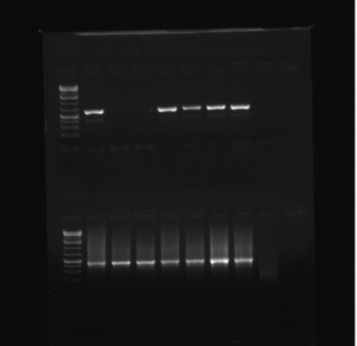
After being separated and marked, the mixtures were then placed in a PCR machine which thankfully is able to perform a heating and cooling process that would take an eternity by hand. After hours the samples were amplified inside of the machine. The third step in a PCR sequence consisted of creating a gel and then loading it with DNA fragments which have been amplified in order to be visible. Once the DNA was loaded, you are able to hook up the gel inside of a gel box to a charger which allowed for electrical currents to flow through the gel so that we were able to see which DNA fragments amplified. In this case, we were testing DNA from 21 different flies. After running in the gel electrical box for 20 minutes, I took the gel out and went to an area where a light is able to shine on the gel. For the flies that had Wolbachia, a small white bar would shine back at us; those without would not shine. Results of a gel can be seen below.
Overall, this experience has truely been the best and I am more than grateful I got to work in the Cooper Lab.

 Beyond the Classroom