Maternity Ward

After the first few days of getting a feel for the hospital operations, I decided to spend most of my time in maternity because of the high number of births that happen every day. One of the nurses estimated that the hospital saw between 3 and 7 births every day–and that, of course, does not count the births that happen at home with Traditional Birth Attendants (TBAs). With so many pregnant women and new mothers, the maternity ward was overflowing.

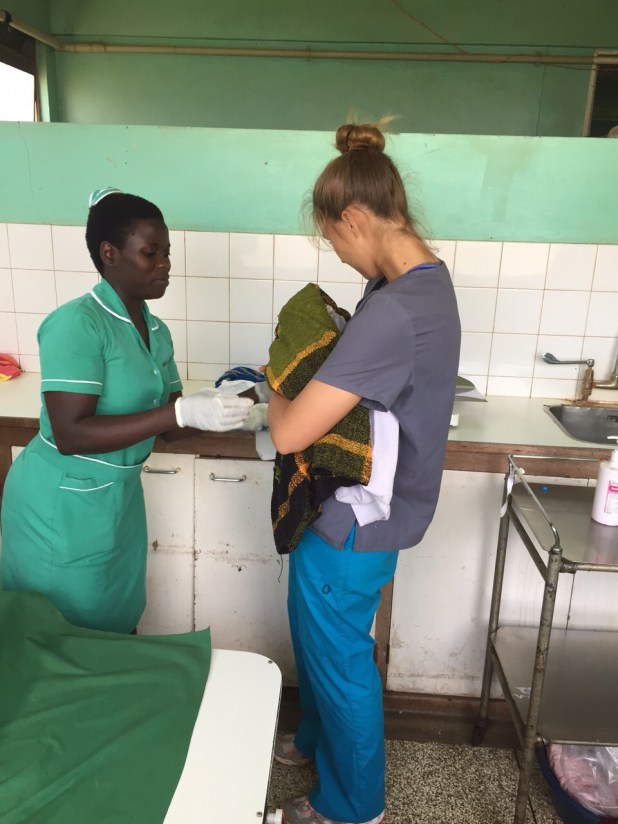
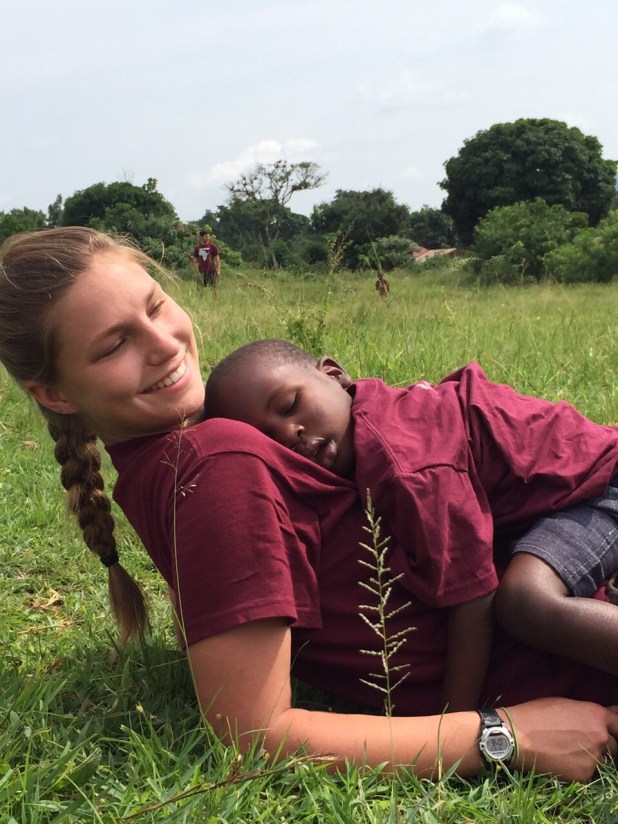
My main duties were giving treatment to new moms. They all got antibiotics for seven days after they gave birth and many also needed malaria medication to reduce the risk of complications during pregnancy, delivery, and breast feeding. I helped mix the medicine, drew it up into syringes, and administered it through cannula ports that were inserted by the trained nurses. (I am definitely not qualified to put in an IV.) I also helped clean wounds after women had to get C-sections, weigh and clean babies after they were born, and bring the newborns and their mothers back to their beds in the ward. I loved seeing the little newborn babies–they looked like aliens, but really adorable aliens.

Birth in Uganda is very different than birth in the US. There are no epidurals and doctors very rarely, if ever, assist in births. That task is left up to the nurses and nursing students. The mothers have to provide their own waterproof sheet to lay on during the delivery as well as all of the bedding for her hospital bed, all of the towels to clean the baby and all of the blankets to swaddle it. Additionally, mothers have to bring sterile gloves and a sterile razor blade for the nurses to use during the delivery. The nurses use the bottom of the gloves to tie the umbilical cord and then use the razor blade to “cut” the cord (its more of a sawing motion rather than a cutting motion).

The mothers are rarely accompanied by anyone and certainly not a husband. There were never any men (besides the male nurses and doctors) anywhere near the labor suites. The women were mostly quiet, occasionally moaning with the contractions, but there were never any screeches or screams that Americans would usually associate with childbirth. The women in the ward ranged from teenagers having their first child to women in their late thirties or even older having their fifth, sixth, or seventh child. In Uganda, the total fertility rate is 6.7 meaning that, in her lifetime, an average woman will have about seven children.

The women I met in the maternity ward were so hardy and strong and inspiring. They cook all of the food for their family, they fetch the water, they clean the house, and they give birth with little help from friends, family, or modern medicine. Like the rest of the hospital, the maternity ward has not changed since the 60s and could really use a face-lift.

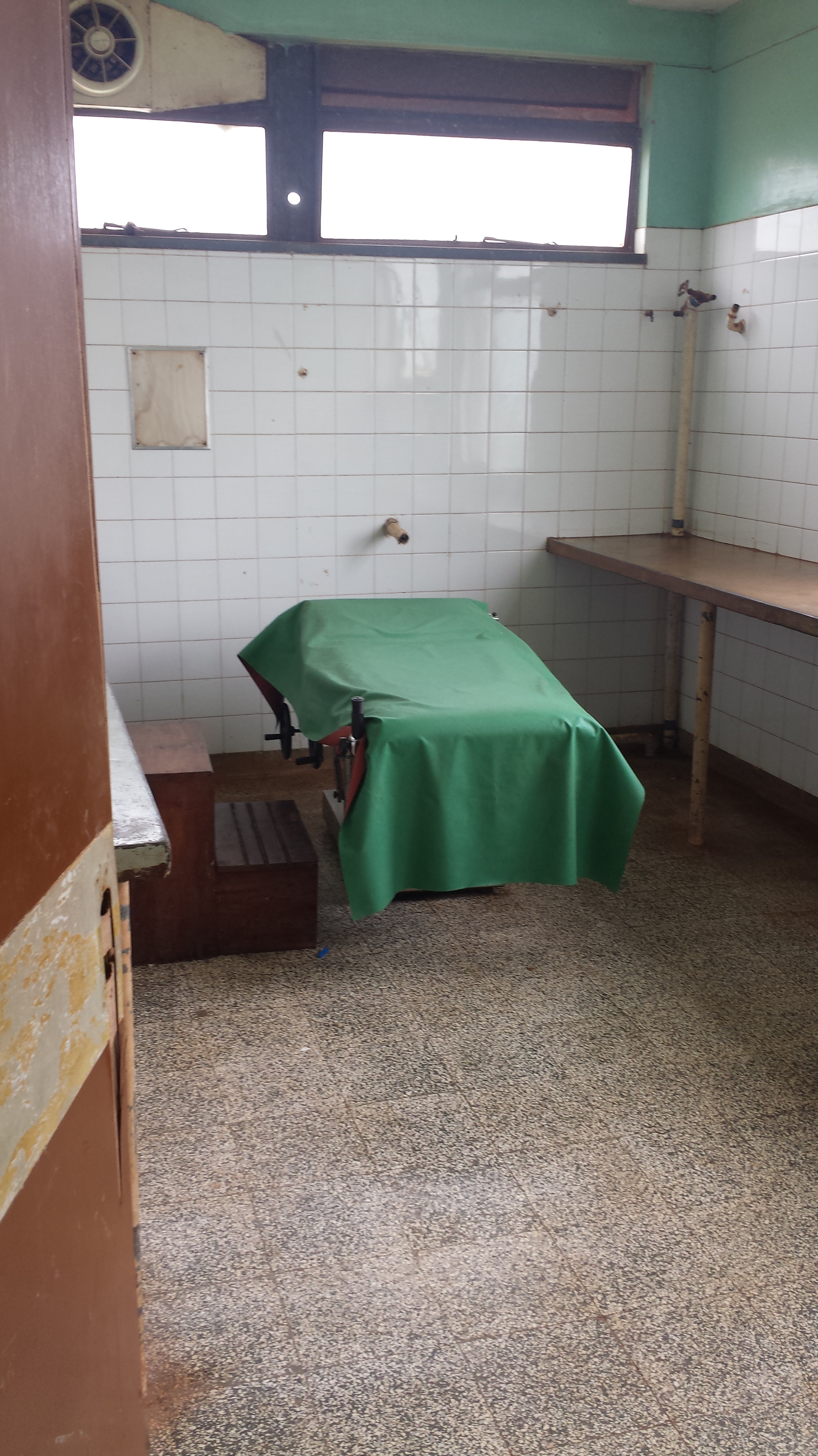
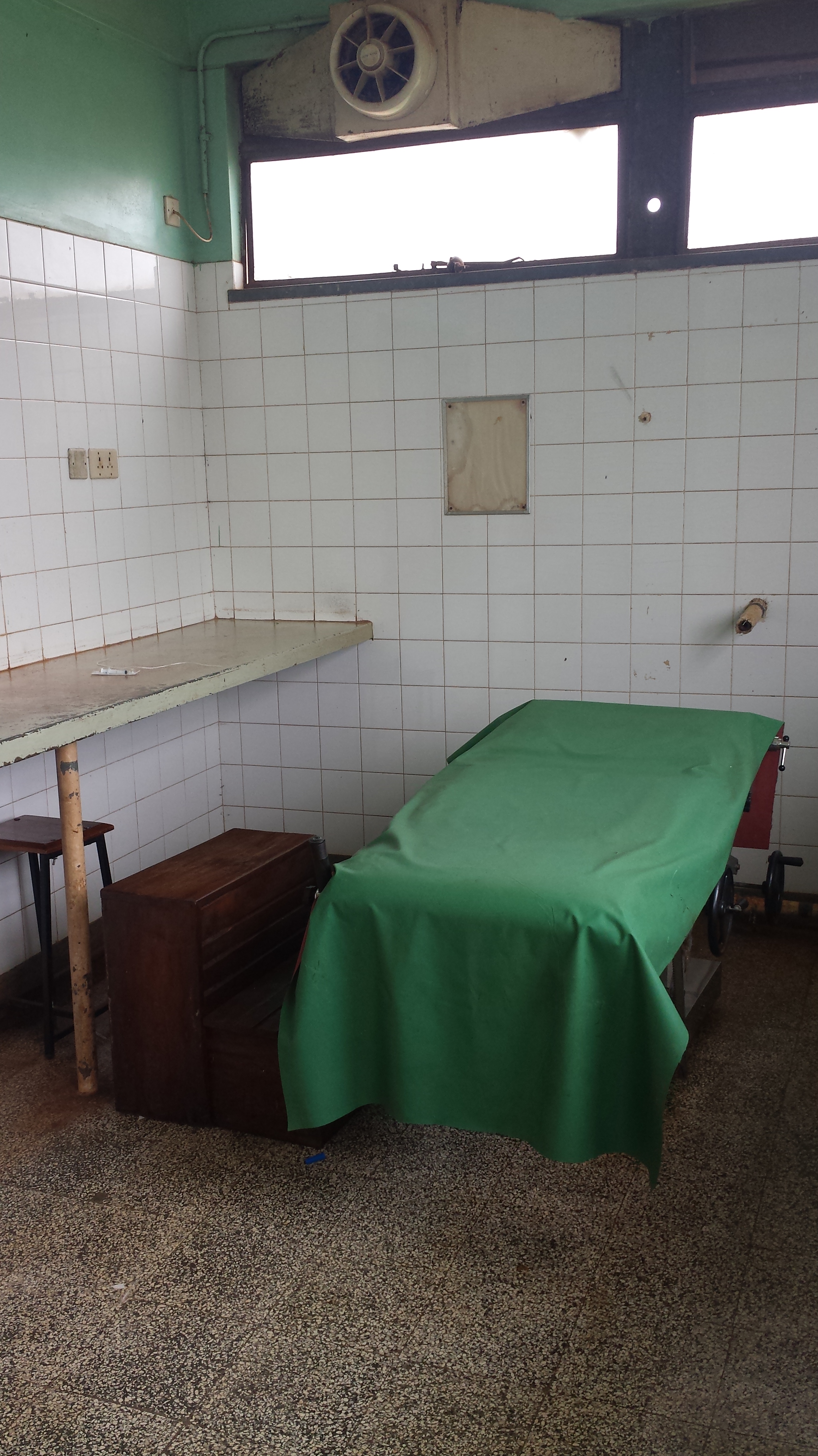
20150616_142344 20150616_142351

These are the rooms that the women give birth in.

Globalization Correlations

The world is getting smaller. At least that’s what some people say. When an airplane can get you from Missoula, MT to Amsterdam, Beijing, Tokyo, Prague, and beyond in less time than it takes to drive to the East Coast, when email and phones make contact and communication instantaneous anywhere in the world, there is truth in that.

Times have changed. It used to take weeks to sail up and down the East Coast of North America, let alone to make the voyage across the Atlantic or the Pacific. Of course that was long ago, before cars were invented. But even when our parents were taking their turns at studying abroad, phone calls were rare and the internet was in its infancy.

How does that relate to my study abroad experience? It relates in the way that globalization (the big ‘it’ word that the GLI is built around) is directly correlated to those developments in transportation and communication. In Ireland, the American influence is a bit more noticeable than in places like Bulgaria or the Czech Republic. However, Irish culture, Bulgarian culture, and Czech culture still are fundamentally unique, with traditions and beliefs that will never fade.

As well they should not. Its hard to put into perspective how much cultures differ until you’re living in one that’s not your own. I know this sounds like a ‘Duh!’ moment, but from someone that has never been outside the United States (excluding Canada), it was a profound revelation.

Thinking about my GLI topic that I chose freshman year, I’ve come to realize that obviously I need to rethink so things. It had something to do with how the arts (specifically theatre) are transmitted and passed from culture to culture, and while that is an interesting and relevant topic for an anthropologist, there are other, more modern, more pressing topics that have to deal with issues in the world right now. Or at least, I can tweak my topic to reflect a more mature understanding of the way the world works.

Has anyone else wanted to change their topic after their Beyond the Classroom experience? I imagine so. These experiences (at least Studying Abroad from my perspective) are profoundly momentous. I don’t know if I’ve referenced this quote before on this blog but Mark Twain’s quote is a good way to finish this my entries in this blog.

“Travel is fatal to prejudice, bigotry, and narrow-mindedness, and many of our people need it sorely on these accounts. Broad, wholesome, charitable views of men and things cannot be acquired by vegetating in one little corner of the earth all one’s lifetime.”

Balancing Coding with Summer

Going into this project of building the Android Physical Therapy fitness app, I did not know how difficult it would be to balance an independently driven project with the hectic nature of summer. The progress has undeniably been slow but yet steady. Not only am I learning about Android programming, but I am learning more about myself. Previously, I have struggled with working on coding projects and assignments in a structured and sensible way. I struggle with procrastination and then as the deadline approached, I would finally feel the surge of motivation. At that time, I can be extremely productive in a short amount of time. Previously, working on coding in a compressed fashion, helped me generate the most cohesive program.

Making this app has made it clear to me that that is not the best way to complete a project in a job setting. With this research/internship, I have had to set my own deadlines and goals throughout the summer. At first my sights were too high and I had to moderate my expectations of myself. In a very real sense, I am learning as I progress throughout the project. Working as a programmer is incredibly different from doing programming assignments. Several days a week, I set aside time to work on the app throughout the day. I have had to allot time and give equal share to research, learning through informative videos and reading, and correspondence with the client in addition to actually coding the app. I still have so much to learn about the Android programming environment, and every time I use it, I learn new shortcuts and ways to improve style and accessibility. There has been a much steeper learning curve than I anticipated, and I am incredibly grateful for my Java programming background and experience with XML.

I am pleased with the current progress on the app. Even though I have to learn how to implement new aspects or to use computer jargon-“methods and controls”, you only have to learn how to do it once and then can reuse that knowledge over and over again. Hopefully, as the semester begins, I will be able to meet with the Physical Therapy professor who is the client more regularly. The summer has been a difficult time for coordinated communication, but I am sure that will be remedied in September. I believe we are on track for the prototype presentation in the spring of 2016.

Lisa H. Morgan

What Crisis? Greece July 2015

July 12, 2015

When I told other travelers in Poland and Hungary that I was going to Greece next, they whistled and said good luck. My Mom texted and asked if I was sure I wanted to go, did I think it was dangerous? After messaging a couple of friends who were in Greece, I decided to continue with my trip.

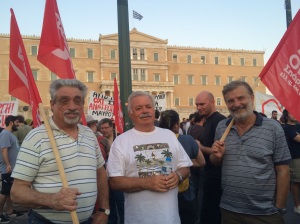
Today, amid news of an agreement being made in Brussels, I encountered a political rally on the steps of the Athen’s Parliament building. Syntagma square was full of people of all ages, waving flags and banners, and calling for the Greek government to reject the deal with the EU, leave the EU, and revert to its old currency, the drachma. I spoke with many young and old people, all agreeing that it was best for the country. Speakers around the square blared a speech in Greek. My older brother, Alex, witnessed a similar rally in Athens in 2012, when he was studying abroad. His ended in tear gas being thrown. This one, luckily, did not.

imageimage

All public transport was free in Athens today and will be tomorrow because of the situation, and people were qued up at ATMs all day. The banks are still closed. I’ve been talking to people on the street and friends and there seems to be a lot of confusion, mostly because of the lack of a trustworthy news source. The receptionist at my hotel even told me she hopes America will step in if need be.

As a tourist, I remained in a happy little bubble, enjoying Greece and it’s charms. I saw the news on the TV while taking advantage of the empty hotels and restaurants. It makes me sad, because I have come to love Greece in the six days I have been here. Reverting back to the drachma seems to be the way to go to me, but I still don’t know if it is the correct path.

For more about my trip, read on.

The Maid of Honor made her way from man to man, wiping each of their brows. She skipped the bride, because she was being cooled by the waving fans of her mother and sister. Both the bride and groom’s families were present at the alter of the Greek Orthodox ceremony in Patras, Greece.

image

I had arrived to Patras that morning to visit my friend Elena, a friend from my Salzburg exchange, after “sleeping” in the Athen’s airport Mcdonalds. An experience in itself. The previous four days had been spent on the island Crete, a suggestion from my friend Lefti. A great suggestion as I didn’t want to leave.Crete is quite a big island, and I would have had plenty more to do.

My base was Chania, a beautiful Greek town cradling an old Venetian harbor. My first day was given to exploring the town with European charm and Central American construction.

imageThe next day I explored Lafelonisi, an truly amazing beach with pink sand and aqua blue water. A beach my beach loving Mother would kill to see.image

That evening I met up with another friend made in Salzburg, Tonia, and her friends for drinks and
chatting. The third day I made my way down the 18 km Samaria Gorge, then spent the afternoon floating in the ocean.

image

image

For my final day on Crete I hiked to Balos Beach, another wonder. Never have I
been asked out that many times in four days, Greek boys y’all are dimes.

But back to Patras. Greek hospitality was immediately evident as soon as Elena and her mother picked me up at the train station at 9:00 a.m. We were taken to Elena’s aunt’s apartment in the city center. Most Greeks live in flats in concrete apartment blocks because land is precious. With one bedroom, a bathroom, kitchen and adjoining living room, it was small by US standards, but warmly decorated and all the space one needs. Elena made me a traditional breakfast of hard boiled eggs, Greek coffee, and crusty bread with honey made by her grandfather.

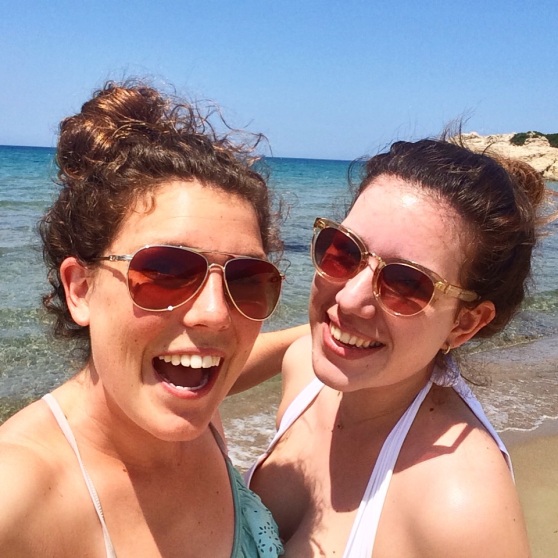
We then hopped on a bus to Elena’s mother’s childhood village and the beach there. We spent a memorable afternoon floating in the ocean, hiking sand dunes, and even stumbled upon a naked beach.
image

While we floated in the water, Elena told me about the crisis her country found itself in and the difficulty her people were facing ,especially young people. She is studying to become a teacher, just like her parents. In one year she will complete her studies and if she doesn’t find a job she will go to Germany or Austria because she speaks German. Something that would make her sad, as she dearly loves Greece and once one leaves it is hard to come back.

She also worries about becoming a foreigner in her own country. Greece has been conquered many times throughout history because of its strategic place between Europe and Asia. If the country reverts to its old currency things will become cheaper, inviting foreign investment. Investment that would be good for the economy, but not if the investors don’t respect the Greek way of life. A way of life already being challenged by its lose of young people to other countries, and English. Elena’s mother gets mad when Elena texts her in Latin letters. More and more young people forgo learning to spell in Greek letters and rely on using the Latin letters to type in Greek.

The country has open borders and serves as shelter to many refugees, refugees the government can’t afford to take care of. This is just one example of the many debts Greece has taken on, the government accepted a loan from the EU to support this influx of people, then the very corrupt government spent it bettering its members and left bread crumbs for the people. People who have been diligently paying their taxes.

When I visited, July 12, 2015, Greece had just defaulted on a major loan and was deep in crisis. People were waiting to find out if they would continue to be on the euro and in the EU or if they would go back to drachmas, their old currency. The streets were humming with talk of the crisis, Elena translated for me. Everyone I talked with seemed to be optimistic though, a Greek tendency, according to Elena.

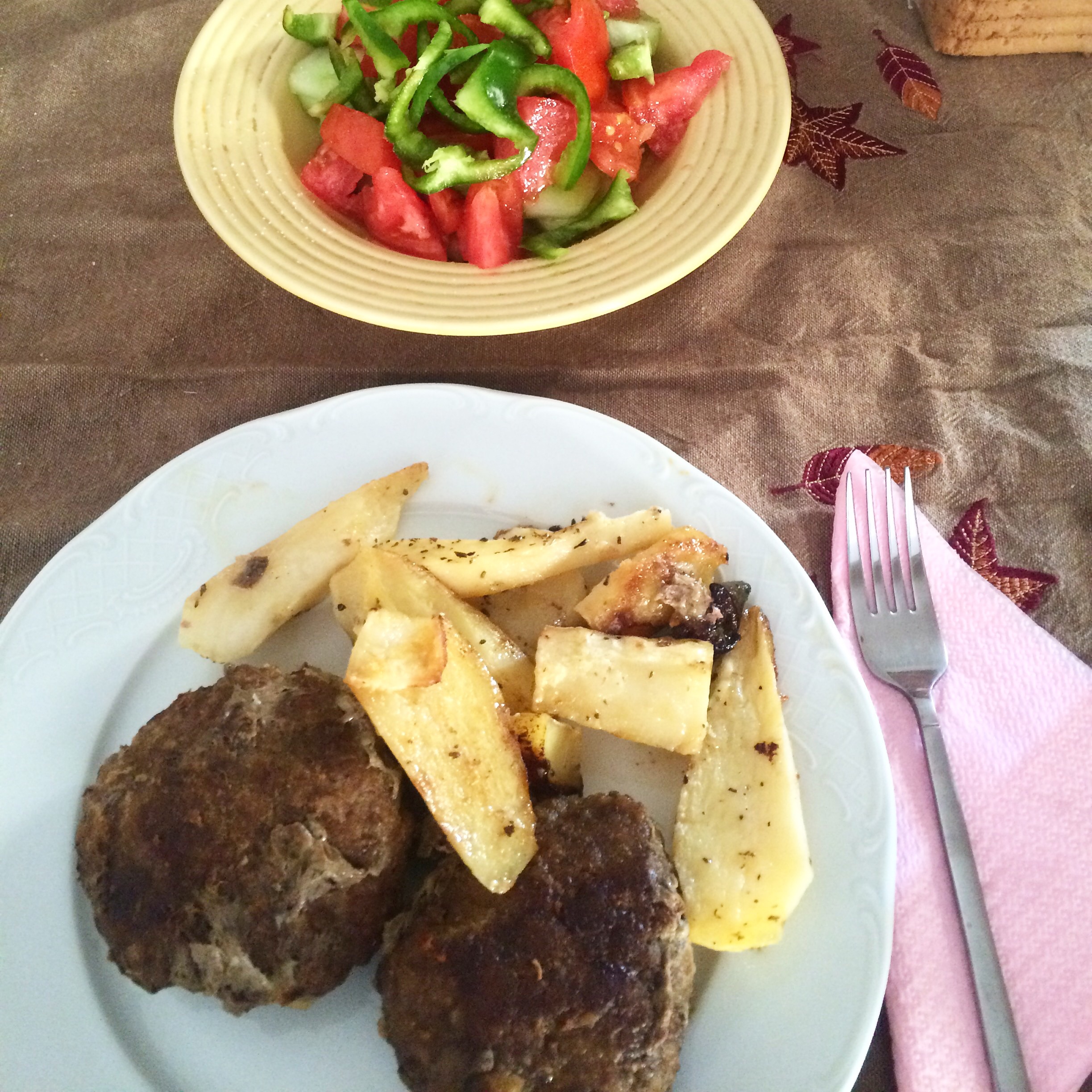
After the beach, we made our way back to Patras for lunch (at 5:30 pm!) of beef patties, potatoes, and Greek salad made from tomatoes grown by Elena’s father, who has always grown all of their produce.

image

We prepared for the wedding then. Elena borrowed a dress from her older sister, saying as she zipped it up that if her sister saw, she would be dead in the morning. I guess little sisters are the same everywhere, stealing their older sister’s clothes. I’m sure Elaine, my sister, has been having a party in my closet.

The wedding took place at 7:30 p.m., after it had cooled down. Everyone waited outside for the bride to arrive then followed her, the groom, and their families Inside. I enjoyed the ceremony immensely, even though I couldn’t understand a word. The ceremony seemed to be a call and answer session, with the priest saying something, then a group of men singing something back. The audience stood instead of sat and were never still, always shifting, talking, and moving. A sharp contrast to American seated and silent wedding ceremonies.image

Other than the connected halo/ring crowns placed on the bride and groom’s heads and the rice throwing at the end, the wedding was nothing like My Big Fat Greek Wedding.

image

After the ceremony, Elena and I skipped out on the reception and headed to the city center for a tour of the harbor, another beautiful Greek Orthodox Church, and to meet her friend, Rafaella, who did her Erasmus in Krakow, Poland. The three of us made our way to one of the many outdoor cafés to split a meat plate and bottle of wine for dinner at 11:00 p.m. This is a typical Greek night out. Instead of going to bars and clubs, Greek students prefer a busy sreet side cafe, talking, and shared food and drinks.

At 12:30 a.m. we went to an ice cream parlor on Patras main square. A square still crowded with people of every age, and it was a Sunday night. The hot weather demands that people live by its changes, waking early to beat the heat, retiring indoors or to the ocean in the scorching afternoon, then venturing out again at 8:00 or 9:00 p.m. when it has cooled down. The use of air conditioning is seldom, as it is expensive and wasteful.

As a tourist and owner of a foreign bank account, the currency restriction of 60.00 euro per day did not affect me, but it did Elena. We walked by the ATM at 1:00 a.m., only to find a line of about 15 people waiting to take out money.image

Elena broke a tooth on a wedding favor. She said she will wait for the currency restriction to lift to fix it. A restriction that people are saying could last 10-18 more months. The next morning we woke up at 8:30 for a quick breakfast, then what Elena called, “fast walking” for 40 minutes to the bus station. The whole time we walked she kept making sure I had all my things, and giving me directions for the bus in Athens. It felt good to be mothered, and by one if the sweetest girls I know.

Thanks for a great visit honey bunch, hope to see you in America soon!

A three hour bus ride brought me to Athens, where I checked out the parliament building, Acropolis museum, and the actual Acropolis. Pretty awesome! Then it was back to the airport for a 1:40 a.m.  red eye flight to Lisbon, Portugal.

image

Greece was just great. I will definitely be coming back. Fingers crossed that my family sails around the Greek islands sometime soon and I can come back to visit friends. Chins up Grecians, your country’s natural beauty and people’s tender dispositions are a treasure.

Next stop Portugal!

July 8, 2015 Chania, Greece

July 9, 2015 Lafonisi Crete, Greece

July 10, 2015 Samaria Gorge and Ag Rioli, Crete, Greece

July 11, 2015 Balos Beach, Crete, Greece

July 12, 2015 Patras, Greece

July 13, 2015 Athens, Greece

Solo in Italy

I arrived at Sojin’s (one of my best friends from the USA) Milan apartment block before she did. Night was coming on and as I tried to match Sojin’s previously sent picture to the buildings around me, I heard voices coming from the street gate. Upon closer observation I realized it was Sojin and her roommate searching for their keys after their journey home from Florence. It was a bit ironic that I let them into their gate. We headed up to their apartment chattering away.

Sojin and I in front of the Milan Duomo, the Italian word for cathedral.

Sojin and I in front of the Milan Duomo, the Italian word for cathedral.

The next morning, after a visit to Soj’s school, we had paninis and then shopped all afternoon. It was so great to walk around in the Italian sunshine, giggling with Soji, eating gelato, and marvelling at the stylish Italians that were everywhere. Milan is not your sandstone Italy with piazzas and jolly, big bellied Italian chefs around every corner. It is a big city, with a more modern and industrial feel. I enjoyed being there, it is different face of Italy.

The next day we had some cannolis, then went to meet the five year old Lupa for his english tutoring session. This consisted of Soj, Lupa, and I running around Lupa’s very nicely decorated flat with matchbox cars and puppets yelling in English. Soj does this every week, and Lupa’s very pregnant mother seemed to enjoy the two hour respite from her busy boy. I was pretty excited to see yet another example of Italian living, this time in the city. Lupa and his three siblings shared a one and a half story flat with their well to do parents.

IMG_1594

That night we went to Apperitivo, where one buys a drink and with it gains access to a buffet full of noodles, veggies, and pizza. Pretty good dinner if you ask me.

The next morning I awoke at five, hugged Soji goodbye and scrambled into a taxi to the train station. Four hours later I arrived to my hostel in Biassa, Italy. A town fifteen minutes from the coastal Cinque Terre.

The Cinque Terre are five brightly painted fishing villages that cling to the coast of Italy. My family visited them when I was younger, but other than a brief flashback of a beach, I don’t remember the trip.

IMG_1706

Cinque Terre was by far my favorite place in Italy. I started in Moterrossa, the northern most village and hiked along the coast to Vernanzza, my favorite of the five villages. In the villages, I wandered the small streets, poking into artist’s shops and caught glimpses of locals. I ate more gelato and enjoyed the sunset over the ocean then headed back to my hostel around 9:30.

Monterossa

Monterossa

Back at my hostel, the chef prepared the most amazing pasta dish for dinner. and for a good price. While eating, I met two girls from California, both teaching english in Madrid, Spain. We talked about the U.S. and what we missed. One was adamant that she never wanted to go home, they just do it better in Spain, according to her. The other agreed with me, that although the US has many problems, it is still great to be an American. No matter how shiny a country appears, there are always things to be reckoned with underneath.

Bright and early the next morning I hiked from Rio Maggiore to Manarola, coming across many farmers tending to their terraces of grapes and olives. I wondered Manarola, then caught a train to Corniglia, the only village that isn’t right on the water. After exploring Corniglia, I spent the afternoon on Monterosso’s beach, using stones to write words in the sand.The beach was deserted save me and a group of local teenagers. They came over to look at my stone words and one boy and I got to talking.

IMG_1650

Monterossa is home to 1,000 people, this boy being one of them. He trains to La Spezia everyday for school and when I asked him how he likes all the tourists, he just smiled and said, “you get used to it”.

The next day I hiked four hours to Porto Nouva, another town on the coast, then made one last trip to the Cinque Terre to enjoy the sunset.

Florence was my next stop. It rained alot. Pretty much the whole time. As an epicenter of Renaissance architecture and art, I roamed the streets buying leathers goods, and marveling at the statues littered throughout the city. Michelangelo’s David was beautiful and I saw works of art by Boticelli and Leonardo Da Vinci.

FullSizeRenderIMG_1839

Pretty amazing culture wise, but by this point in my trip I was getting tired, it was cold and wet, and I missed being with my family on Easter Sunday. My mood would lift at my next stop, Roma!

IMG_1794

Missoula, Ireland

After living in Ireland for so long, it has gotten easier to forget how far away from Montana I really am and Dublin has felt like home to me for a while now. I think a large factor in that is the similarities Ireland shares with Montana. Everyone only shares one degree of separation with any given stranger they might meet while grocery shopping and several small towns hold small populations of tight-knit communities. This is particularly apparent when you start traversing the country with someone as popular (or at least well-known) as Michael Healy-Rae.

It may be this “small town similarity” that forces politics to go about the election game in such a different way than what we are use to being subjected to in the United States. Rather than candidates making their presence known on TV, the radio, and social media, they literally and almost exclusively rely on going door to door and personally asking people for votes. Simple, effective, and honest. I am going to miss this.

My relatives have been asking me if this internship has helped me decide what I would like to do with the rest of my life and my answer is always “no”. Irish politics are incomparable to what we do in the states and I could not decide my future career off of the work I have done here in Ireland, despite the similarities between Montana and Ireland. I did however, learn a tremendous amount about leadership from my time here in Ireland and how to be a proper politician. I also learned that I do not have the patience to listen to people complain about their neighbors to me all day so at least we can rule city council woman out of the picture.

Ireland taught me more than I could have imagined in the two months I was here and I am very thankful to have had this opportunity. I will be back some day.

First Impressions

After spending quite a lot of time getting ready to travel across the world to Uganda, it was surreal to actually be in the Entebbe airport waiting to be picked up by Bazil, our in-country coordinator. Like we were warned, Bazil ran on “Uganda time” meaning that he was about an hour and a half late to the airport but I didn’t care because I was about to start the greatest adventure of my life.

We drove several hours to Gombe, the place where I would be volunteering and living for the next four weeks, on bright red dirt roads through beautiful green jungle. I was very excited to start volunteering in the hospital because it truly seemed like an area where I could actually make a difference.

It took a while before we all got settled in, the creaky metal beds and pit latrines were a far cry from what many of us were accustomed to in the US, but eventually we got used to life without amenities. It was actually very calming to not have to worry about texting people back or talking to them on the phone–to be totally disconnected form technology was the best vacation I could have asked for.

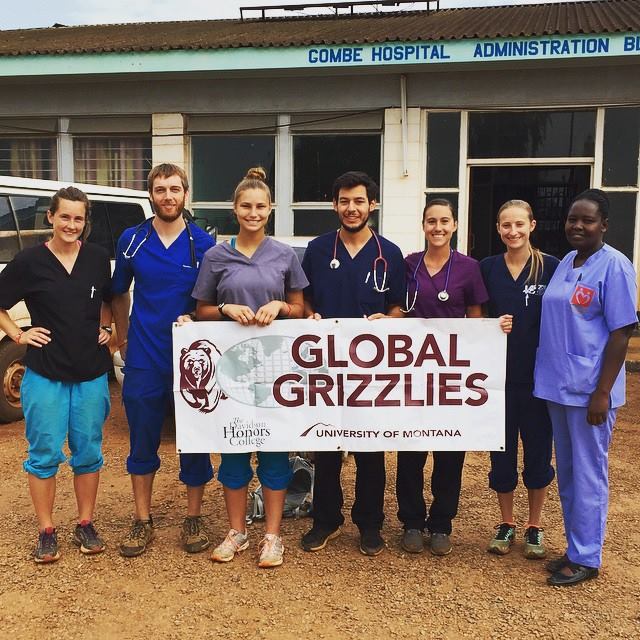
Every morning we all would walk the 3+ kilometers into town to the hospital. It was built in 1969 and nothing about it has changed since then except for some of the technology in the lab and the 20 year old solar panels on the roof. The walls, both inside and out, were stained with red dirt and the eaves were full of birds’ nests–it was definitely not one of the pristine and sterile hospitals that we would be used to in the States. But that fact did not mean that the hospital was not providing vital services to all of the people in and around the village. Yes it was not state of the art, but that hospital was incredibly important to the community and provided women with a safe place to give birth and gave men, women, and children somewhere to recover from severe injuries and diseases. And I was chomping at the bit in order to be apart of it–to learn, observe, and assist in the daily goings-on of the Gombe Hospital.

I wanted to be as much help as possible so I decided to assist in an area that I actually know about–HIV testing and counseling. In Missoula I volunteer for the Open Aid Alliance which provides HIV and Hep C testing and counseling to at risk individuals, so I felt confident that I would be able to successfully perform HIV tests in Gombe. At first I was a little nervous because of the high prevalence of HIV (7.3% of the population), but in all of the testing I did, I did not see a single reactive case. I was very pleased to not have a positive individual not because I was concerned about my safety (I was wearing gloves and correctly disposed of all sharps) but because I hope that the increased testing and counseling will help bring the epidemic under control. I felt very fulfilled to be able to test in Gombe Hospital because I could tell that I was actually making a difference. And, in fact, the testing methods between Uganda and the US are almost exactly the same which made it very easy to transition. I know that the work I am doing will not greatly affect Uganda in the long run, but I would hope that by testing and educating individuals I can make a small difference in Gombe.

I am excited to see what the next few weeks will bring!

11018341_1020680781275942_8943948962621220744_n

The Chilean Education Experience

Putting six months of your life into one blog entry is a tough task to do. Although words don’t do justice to the feelings of being in the moment and experiencing everything first hand, I will try my best to describe certain experiences traveling, studying, and living abroad in the “organized chaos” that is Chile.

The school portion of my study abroad has been spread thin. Having class 3 days a week, hardly understanding professors for the first couple months, and having all classes cancelled for 3 weeks due to student strikes have all contributed to a strange learning environment. My sparse school schedule has allowed me to seek education by a different means. Education can come in many forms, and for me, the most valuable educational experiences have not occurred in classrooms.

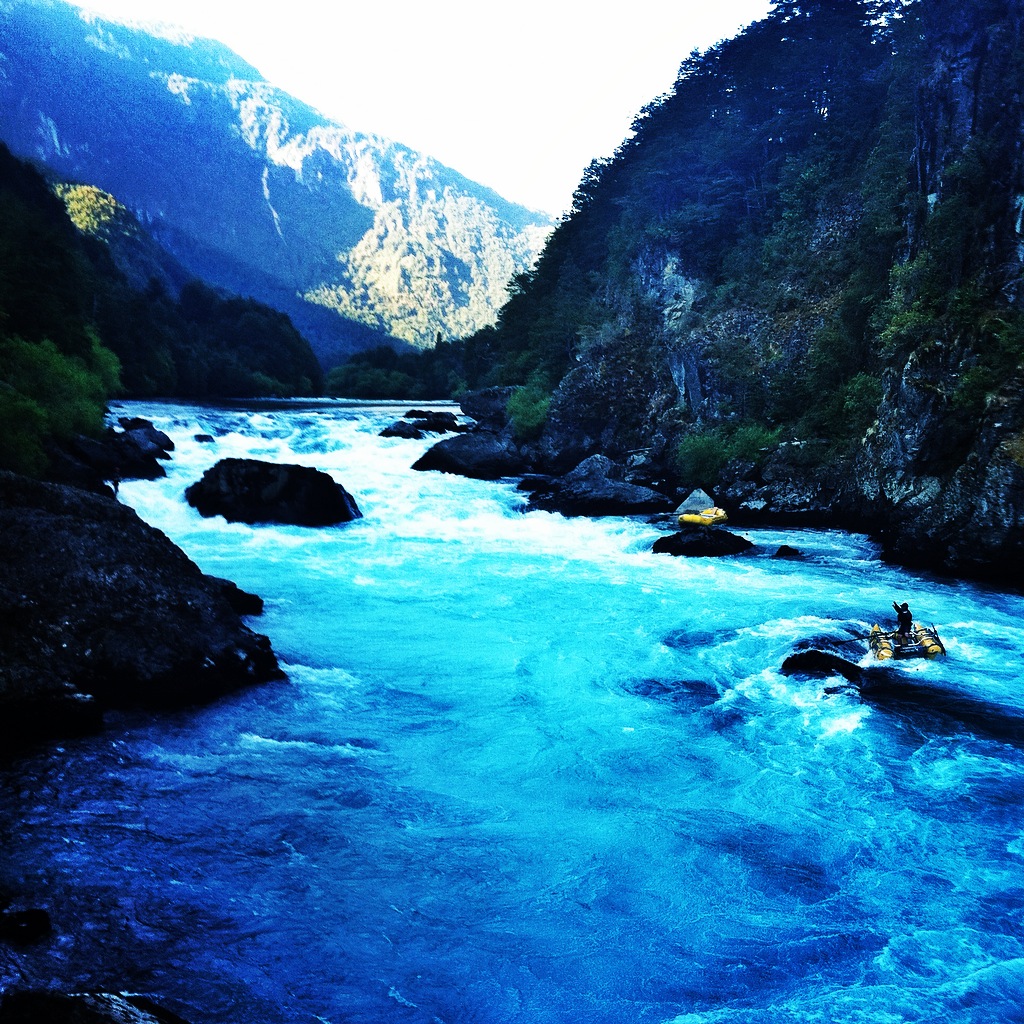
By far the most educational and rewarding memories I have made in my time abroad have come from traveling. Hitchhiking around Patagonia for 2 months with the hordes of other travelers, rafting the class V Futaleaufú River, and road tripping with the roomies have been some of the most memorable experiences in my time here. Although all of these adventures required planning and traveling great distances from my current home, Concepcion, sometimes the best trips and memories come from impromptu Wednesday evening or Saturday morning explorations close to home.

To some (okay most), Concepcion wouldn’t be considered an attractive city. However, just minutes away from the center of the city lies some of the most pristine coastline that central Chile has to offer, free of trash and the ever-present “flaites” (Chilean teens that listen to reggaeton at obnoxiously loud levels and leave their empty beer cans/bottles behind when they are done). As this is my first time living in a large city, it is sometimes easy to feel trapped due to lack of car and bicycle. This is where those weekend excursions or spontaneous weekday getaways come in handy for me. Breaking the daily routine of school and “studying” is the key for me to keep that excitement factor up in living in such a strange and unfamiliar environment. Although I am technically here to study and go to school, I have learned substantially more outside of school, through conversing with locals in broken Chilean Spanish than I have in any classroom.

Upon arrival in Chile, I felt completely out of place in my new living situation. Finally, after six months, I consider Chile home, if only for another 5 months. Although inconvenient at times, I find comfort in the organized chaos of this unique country and the habits that its citizens practice. I shudder to think about returning to Missoula and having to change my internal clock from Chilean time (at least 30 minutes late to everything), to U.S. time.

10968050_10155089045810034_346288365_n

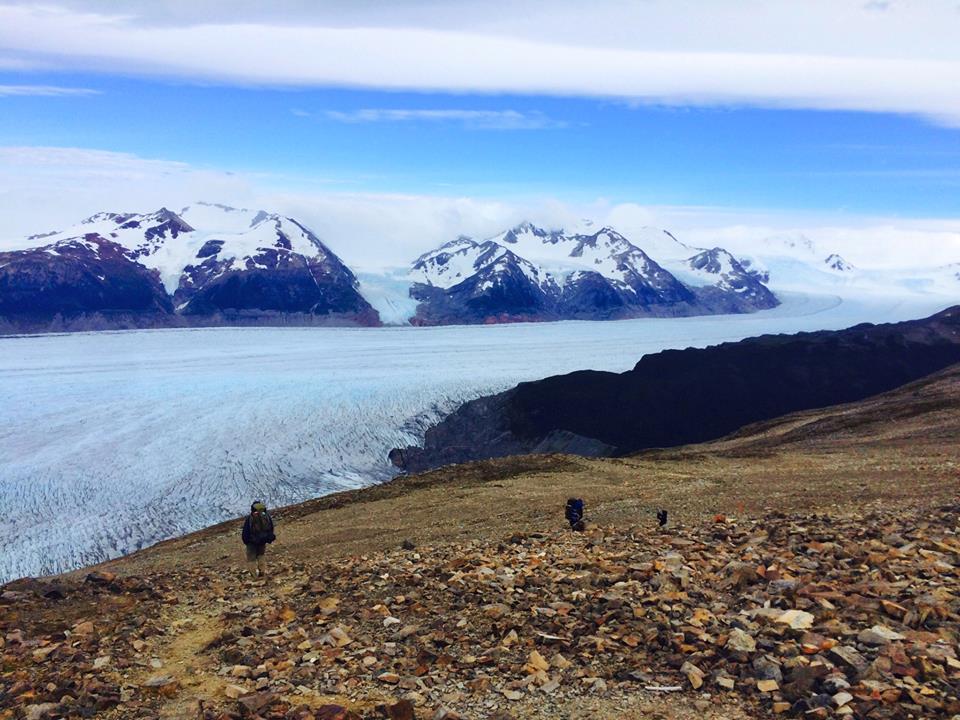
Glacier Grey in Torres del Paine, Patagonia

IMG_1103

Safety boat waiting below class V rapid “Throne Room” on the Futaleufú River in northern Patagonia.

Messenger of the People

Before coming to Dublin, I had only done a minimal amount of research on Michael Healy-Rae. I knew he was an independent representative from County Kerry and I found a lot of pictures of his late father, Jackie Healy-Rae. My second day at work I learned that he was the only member of the Dáil to vote “no” on the same sex referendum in Ireland that was passed two weeks before my arrival and he is a pro-life activist. While he does not go around preaching these values and arguing with people who have different beliefs, my time canvassing with him and Timothy O, Chief of Staff if you will, down in County Kerry proved to be one of the more difficult things I have done. My patience and anger management was tested unlike any other trial I had yet to meet and I learned a lot from the experience.

It is easy to forget that Michael is one of the most conservative TD’s in Ireland and that we hold very different views simply because he is outstandingly charismatic. In this way it has been extremely easy and pleasant to work with him. His office mostly deals with local constituent issues, as I mentioned in my first blog entry, and therefore I have not had much of a chance to see him rally behind national issues. However, while canvassing in Kerry I was able to see how conservative the county is and heard more people’s opinions on national issues, particularly the referendum.

55% of Kerry residents voted yes for the same sex referendum and 45% voted no. Michael has always prided himself in being an honest TD and refuses to be swayed by popular beliefs. Back on my second day of work when we were discussing the referendum, he told me that it was not that he cared if someone is gay, he voted no because he was not in favor of formalizing that union to include marriage. Although this is not my opinion, I was at least relieved to hear he is somewhat open-minded and acknowledges that it is okay for people to be gay, something that a lot of people still do not accept.

While we were canvassing, his “no” vote was referenced more often than I expected, usually with praise, by many of the residents in County Kerry. I knew Kerry was conservative so this did not surprise me. What made me reflect on the responsibility of a TD or Senator or any representative was when he explained that he was the only TD to vote no because the others were afraid to vote against the popular support of the referendum in their respective counties; he was the only TD to not only vote no but to also go against the consensus of his county (“it would have been against my personal beliefs”).

I understand not supporting something that you simply do not believe in and I commend people, especially politicians, who stand up against companies, policies, wars, that they fundamentally think are wrong. On the other hand, if the majority of the constituency who chose you to fix your nation believes that same sex marriage should be legalized, is it not your duty to vote yes? Granted, the final voting margin was slim and the yes’s only barely surpassed the no’s in the grand scheme of things but the majority of his constituents were in favor either way you slice it.

On our last night canvassing in Kerry before coming back to Dublin Michael asked if I knew what “TD” actually stood for. I embarrassingly admitted that I actually did not. “Teachta Dála” he responded “it means ‘Messenger of the people'”.

The Machine

Michael Healy-Rae’s phone never stops ringing. It is quite literally a part of him; if he is not calling someone then someone is calling him. More often than not, these calls are from people in his constituency, Kerry County, asking him for help. Here, a TD working in the Dáil in Dublin, Ireland, being called about matters four hours away; pot holes that need filling, fences that need building, hedges that need trimming, works 20-hours days. These problems keep him from sleeping and often cause him to skip meals. He is quite literally a machine. I do not want to discredit the needs of the Kerry people, they also call asking for medical and legal help and sometimes seek business advice. As Michael explained to me on my first day of work, “imagine what it would be like if 100,000 people had your personal cell phone number in their phones. That is my life”.

He is arguably one of the most outgoing and charismatic people I have ever met in my life and I would bet that most of the people he has met in his lifetime would agree with me. However, there are those few fellows who I come across around Ireland and, after I explain why a Montanan wound up in Ireland, they say that what Michael is doing is down right corrupt. “Favors for votes!” they say. “That’s all he does”.

I won’t go through extensive detail about the Healy-Rae family except to say that he belongs to a bloodline of prominent and charismatic politicians, his late father being the most outstanding of them all. It is known that he and his brothers get jobs done, which is why everyone in Kerry calls them day and night. When I heard people regarding him as a “corrupt politician” I was personally offended. I did not understand how someone could accuse a man who is genuinely and sincerely devoted to helping people corrupt.

In the United States, we elect officials to help us. We want them to fix all of our problems and whoever promises to carry out this impossible task is who we vote for. The difference is that, in America, if I wanted to expand my driveway and did not know the proper form to fill out to do so, my governor, representative, senator, whomever, wouldn’t care one bit about my insignificant parking problem, that is assuming I could even contact this person directly to begin with. In this way, Irish politics astound me. Although I have observed Michael the most, I think it is generally fair to say that most TDs are genuinely concerned with the well-being of their constituents and so personally involved in all of their lives that dealing with seemingly insignificant matters is extremely important to them. I truly admire this and think we lack this in America. Can we classify this as “vote-buying” when this is what the people of his constituency elected Michael Healy-Rae to do? Isn’t his job to help them? Either way it is very refreshing to watch a politician find a tangible solution to a problem.