The Last Supper


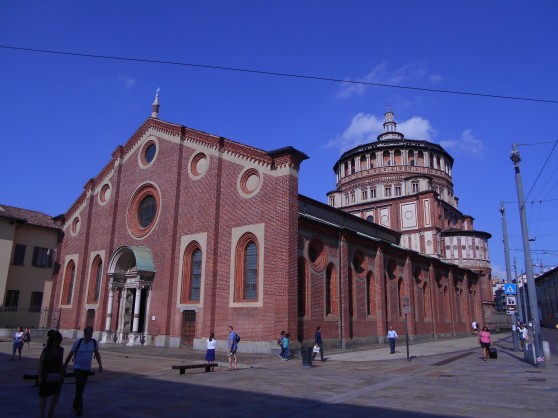
The story of the Leonardo de Vinci’s, The Last Supper, begins at a simple, yet elegant Santa Maria delle Grazie, nestled within the winding streets of Milan. This UNESCO site was erected as a Dominican convent in 1469. The priests of the Dominican Order preferred to live in communities outside the church. So, they uniquely constructed Santa Maria delle Grazie within the constricting center of Milan, despite the lack of space for lavish gardens. Originally, its architecture was modest and simple.

DSCN0177.JPG

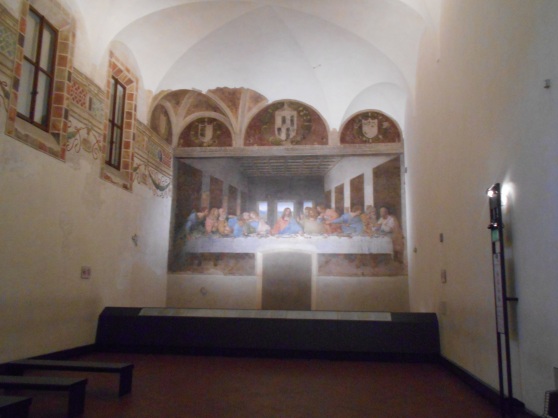
Soon after its completion, the Duke of Milan, Ludovico Maria Sforza, choose the Santa Maria delle Grazie to be the Sforza family burial site. He ordered the cloister and apse to be rebuilt with a suitable splendor. Today, you can distinctly see both the modest and the extravagant architecture. The rebuilding of the church was bothersome for the priests, so the Duke commissioned Leonardo de Vinci to paint The Last Supper as a gift. It was painted in the refectory of the church. This was a place where only the priests entered to eat meals. In this way, the painting was a private tribute for the priests.

DSCN0190.JPG

Leonardo de Vinci choose to paint The Last Supper in a fashion uncommon to wall murals. Fresco Style was the typical method, which required wetting and preparing small pieces of the wall to paint over. The sections dried quickly and permanently. It was not possible to paint layers or redo the sections. De Vinci wished to meditate for lengthy periods while painting. He also wanted the ability to slightly change the picture during the process. Therefore, he chose to paint on the dry, unprepared wall. After the four leisurely years he took to complete The Last Supper, he realized his mistake. He had painted on the outside wall of the church’s kitchen. The humidity and heat from the kitchen caused the paint to flake and deteriorate. At the same time, the Duke of Milan died, ending his family lineage. Without his patron, Leonardo could not restore his painting. In addition, the Santa Maria delle Grazie could never be used as the Sforza family burial site.

DSCN0179.JPG

The priests struggled to preserve their painting. They allowed artists to copy the painting. However, the copies were renditions and didn’t capture the message Leonardo had depicted. They also allowed artists to darken the fading colors of the original painting. However, over time the facial expressions in the picture slightly changed, again altering its message. For example, Leonardo depicted The Supper as the moment before Jesus states that someone will betray him. In the original painting, Jesus’s mouth is opened just slightly as he is about to speak. Over time, artists began to extensively open Jesus’s mouth, which takes away the special moment that Leonard had depicted. Additionally, many of the copies of The Last Supper have Judas, in the front of the table, as he is the traitor. However, De Vinci painted the moment before Judas was realized as the betrayer; therefore he painted Judas behind the table with the other apostles.

The survivability of The Last Supper was further threatened during WWII when a bomb landed in the courtyard of the Santa Maria delle Grazie. It landed nearly 80 feet from The Last Supper. Miraculously, the mural survived. Today, the museum is built with the only surviving pieces of the wall still around the Last Supper.

0903719e11b8380db9b7c0135fa39c45.jpg

In the late 1970s, a major restoration of The Last Supper brought out the original painting. Using new technology, scientists removed the layers of paint that had covered Leonardo De Vinci’s work. This process took over 20 years to complete. Today, you can see the original message that he had depicted.

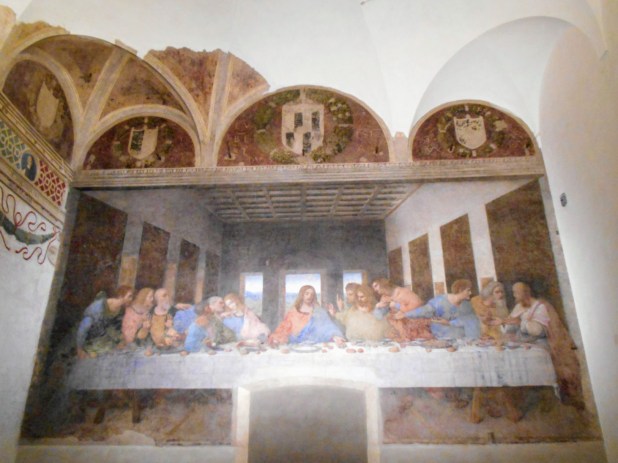
The Last Supper portrays the reaction of each apostle at the moment that Jesus begins to open his mouth to say that one of them will betray him. It is a scene before Judas is ever determined as the traitor. The apostles nearest Jesus have a stronger relationship with Jesus, and they knowingly wait in anticipation. The apostles farthest from Jesus are in discussion because they are uncertain about what is happening. Judas is appears withdrawn and startled by the revelation of his plan.

Only John and Judas have different tones of skin compared to the other bodies. John is white symbolizing his good soul, and Judas is dark skinned with a dark soul. Peter is between John and Judas as a representation of church. John is facing Judas, which symbolizes that people face their darker souls in the church. The message suggests that even though people are not perfect, sin happens at the moment of choice. Judas had the chance to not betray until the exact moment Jesus uncovered his plans.

DSCN0158.JPG

The table of the Last Supper is actually larger than the surrounding, painted room. This illusion pops the table into a clear view while cramming the apostles on the sides into the intense moment. In addition, the entire painting is huge with the dimensions of 15 by 29 feet. On Jesus’s cheek, a small hole can be seen where Leonardo De Vinci used a nail as the vanishing point of the picture. He used a rope to draw the room with perfect geometry.

Visiting The Last Supper requires reservation months in advance, for only a 15-minute viewing allowance. The feeling of anticipation, followed by utter amazement exemplifies the story of The Last Supper.


Milan


I love Milan. The city is the future and the past. It is a fast-paced metropolis of creativity, and the people are fueled with bubbly ambition and energy. Milan is the business capital of Italy, and Milanese lifestyle has evolved to support working hard and playing harder. At every corner, cafes and vending machines dispense endless shots of espresso, each for a single euro. (America needs more espresso vending machines.) Every evening from eight till midnight, people of all ages flock to the bars for aperitivo, a Milanese culture of free buffets with the purchase of drinks. In the mornings, the city begins the hasty business day around nine. Although they smoke and drink excessively, they also maintain a proper, assembled ambiance. Looking good is compulsory. For travelers, Milan is welcoming and relaxing, while expressing a sense of home. The city has many hidden secrets with only select tourist destinations. Thus, Milan feels authentic and free from lingering crowds. The center of Milan houses the Castel Sforza, the Duomo and the Galleria Vottorio Emanuele II, so many tourists congregate here. Luckily, the main streets in this area are majestically wide, and the tourists are comfortably spread out.


dscn0506

Wide piazza seen from the Duomo


img_00621

Espresso vending machine


Uniquely, the center of Milan was reconstructed after the city was conquered by Napoleon. Napoleon influenced the architecture to reflect Paris. Even today, Milan looks more similar to old downtown Paris than the rest of Italy.  Just outside the Castel Sforza, there is a twin of Paris’s Arch of Triumph. It’s called the Arch of Peace. The two arches are on both sides of a road that connects Paris and Milan. Even today, Milan wants to be more like Paris. Currently, Milan’s economy is strong, while the economy of the rest of Italy is crumbling. In recent news, Milan wants to gain a specific government for the city in order to speed up politics in favor of thriving entrepreneur businesses. Many people believe that the Italian government is slow and harming the economy.  Similarly, Paris also has their own independent government power.


dsc_0244

Arch of Peace


The Old

Milan has a rich dynamic of ancient history and thriving entrepreneurial nuances. The old part of Milan is an immense downtown center. Massive marble buildings stand firmly within the ancient walls of the old city. Here, the luxury brand shops for the high-class business citizens fill the streets. Churches dating back as far as the 3rd century are small treasures hidden within the windings streets. Every church is still used religiously. For example, one church, shown below, is called the Santa Maria Presso San Satiro. This church was built in the 15th century. When it didn’t have enough space to expand, an illusion was painted to make the church feel bigger. Furthermore, the Civic Archaeological Museum displays the Roman artifacts, on which the modern city is built. Near the fantastic Hostel Ostello Bello, the streets have open spots that offer sneak peeks at the Roman ruins beneath.

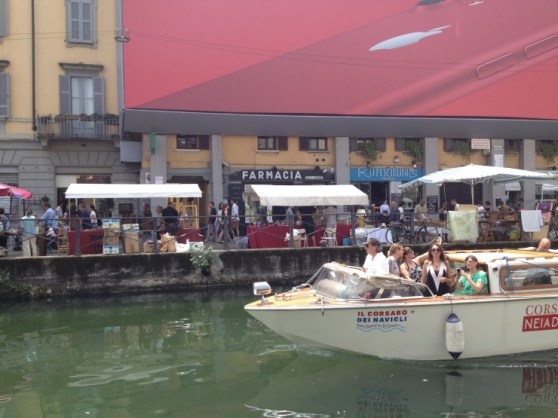
The ancient ways are alluring to the people in Milan. On the last Sunday of each month, the Navigli district, the ancient canals that flow through Milan, hosts a massive antique market. Continuous tents weave along the canals, displaying Roman artifacts, watches, African trinkets, Renaissance art, statues, silverware, clothing, jewelry, and furniture. The market is a real treat, as it is a glimpse into the culture of Milan.

img_0133

Antique Market

img_0132

Navigli District

Leonardo Da Vinci is a historical favorite of Milan. In fact, Da Vinci lived in Milan for over 20 years of his life. He worked for the Duke of Milan to paint the impressive Last Supper, and he lived with the Duke in the Castle Sforza. Within the Castle, Leonardo lined his room with wood and painted beautiful tree canopies across the ceilings and walls. This room is preserved under the name Sala Delle Asse, and available to the public within the colossal fortress. The Castle Sforza also sports another famous painting by Da Vince, the Madonna Lia. While painting the Madonna Lia, Leonardo was experimenting with using light sources and sloping shadows, mixed with physical movements, to reveal the soul and new perspectives of space. It is one of the best paintings to depict his artistic philosophies.

Leonardo Da Vinci was not only an artist. Recently the Museo Nazionale Scienza e Tecnologia analyzed Leonardo’s invention journals. Experts used his ideas to create models and presented the masterpieces in an exhibit. One model was an improved printing press. Another was a mechanical loom. He also experimented with war boats and flying machines.

The New

Milan has a strong sense of entrepreneurship and growth. The push towards the future, developed during the Renaissance era, has continued throughout the centuries. Northern Italians are prideful of the Risorgimento, an Italian unification movement of the 1850s and early 60s. This was a time when Italy finally eradicated their feudal system and fought for a new Italy under one King, Vittorio Emanuel II. The heroes of this time are honored as the statues across Milan, and their names are presented on popular streets and buildings. The passionate determination for the future persists because of the remembrance of these heroes.
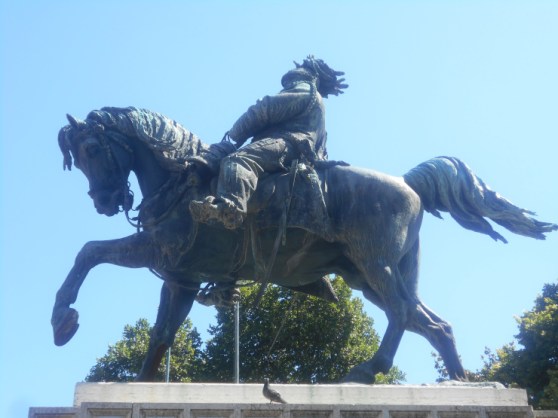
 

dscn0324

Vittorio Emanuele II


Then in the early 20th century, artistic and social movements influenced the period of Futurism in Milan. The change emphasized speed, technology, industry, and fascism. The modern paintings from this time are displayed in the Museo del Novecento. The paintings hint towards Picasso style but with more fluidity and movement rather than cubism. In 1913, Umberto Boccioni sculpted the Unique Forms of Continuity in Space. This famous statue is featured on the 20 cent euro coin. The speed of this figure is still reflected, today, in the people of Milan as they walk determinedly across the city.

In addition, many buildings still remain from the fascist politics of the early 20th century. The Milano Centrale train station and the Milan Stock Exchange are in fascist style buildings. The architecture is elegant and full of replicas of Roman statues and designs.  Recently, an artist placed as sculpture in front of the Milan Stock Exchange that presents a strong message. It shows a hand with all the fingers cut off but the middle one, an old fascist symbol. It is presented as a remembrance of the fascism that used to reign in Milan. However it also a modern message. This statue suggests an attitude towards the crumbling banks of Italy.

Today, Milan is the forefront of fashion and business in Italy. The constant, daily evolution of fashion in Milan has shaped a culture of nuance in every part of the city. Situated outside the Milano Centrale train station, there is a massive sculpture of the Apple logo with a bandage across the bitten piece. It symbolizes that nature and technology must find a way to coexist. This theme is scattered across the city. Everyone in the city uses the metro and walks. However, small electric cars (far cooler than Tesla) scurry through the streets. The modern part of Milan, Porta Nuovo, contains some of the most impressive architecture in the world. This area is lively and creative. The towering Unicredit Tower marks the hub of modern business in Milan. Amongst wavy architecture, fountains and modern sculptures, the impressive forerunners of millennial entrepreneurial businesses are presented such as Tesla, Moleskin, and Swatch. Peeking out from behind the Unicredit Tower is a unique skyscraper called the Bosco Verticale, or the Vertical Forest. This is a new residential building that uses an elaborate watering system to create an appealing green living area filled with trees and plants. The entire area of Porta Nuovo is under construction. The large land proposes hope for a green, livable modern business center of Milan. The new opportunities and potential are enticing.

The Opera

scala-420-x-2383

The Teatro Alla Scala offers a lavish and stunning experience into the thriving tradition of opera. I bought pricey tickets to be in a plush compartment near the stage. It was one of the best seats in the opera house. I sat in awe at my surroundings. The compartment fits four people and was decorated with intricate gold embroidery that surrounded velvety cushions. The view into the audience was stunning. The compartments rose up five stories high. The wealthy regulars popped their heads over the balconies to chat with their friends. Antique gold lights radiated the expanse with a warm glow. The entire room was massive! I spent longer staring at the marvels of the room than I did admiring the Duomo. The Teatro Alla Scala is a must see destination. Unfortunately, camera use is strictly forbidden so I didn’t take my own pictures.

1-teatro-alla-scala-2img_06831

I attended the performance of La Bohème, one of the most famous operas in the world. It was emotional and intense. I sat above the orchestra, and the music complimented the story with hints of excitement followed by mourning. The opera opened with a humorous scene of starving artists freezing in a simple apartment. Dramatically, the artists burned their operas and writings to keep warm. I found the set to be amazing! It was extremely detailed from scuffs on the walls to textured windows. It was so realistic that I felt like I was peering into a portal, and witnessing France in the 1840s.


la-boheme-ph-brescia-e-amisano-630063badg-1

Scene from La Bohème from Teatro Alla Scala website


The next scene was intense. The curtains drew back to reveal a stage that was two stories high and filled with hundreds of actors. The bottom story was a busy riverside festival near a restaurant, while wealthier citizens gossiped on the upper story. Horses and donkeys pulling carriages and carts of goods traversed across the stage. The music was uplifting, as the two main couples each fell in love during the festivals.

Then the following scenes got dark and depressing. The relationships between the two couples struggled. In the climactic end, the woman, Mimì, confesses her final love to Rodolfo as she dies from a short life plagued with poverty. In her dying moments, Mimí asks Rodolfo if he thinks she is still beautiful. Rodolfo romantically explains, “Beautiful as the dawn.”  Then tragically, Mimí replies, “You’ve mistaken the image: you should have said, beautiful as the sunset.”


dsc_0180

The entrance to Teatro Alla Scala


The Fashion

The average fashion in Milan is not as wild as Vogue Magazine portrays. However, the people of Milan are confident and prideful. Thus, the people of Milan dress smartly. There is a strong culture of eating small, healthy, fresh meals and hastily walking long distances, while exorbitantly drinking and smoking. This culture has uniquely paid off in an interesting way. The people of Milan are beautiful, sexy, charismatic and grungy. In fact, they walk a fine line. Due to healthy eating and exercise, the people are thin, with strong attributes of either femininity or masculinity. The women’s hairstyles are typically long, straight and black. During the summer, the younger women wear high waist short shorts with exposing blouses and elaborate laced sandals with super thick soles to make them appear taller and thinner. Also, rompers are very popular. The older women wear longer, colorful sundresses, or tight sheath dresses. I did notice that the fashion shops are influencing elaborate woman shoes. For example, heals are covered in fluffy fur. I didn’t notice anyone wearing these shoes. However, I did see a couple woman with shoes that had huge red bows on top. The bows were so enormous that the woman had to be careful to not trip.

The men have a stricter dress code. It is imperative to wear pants, preferably slacks, to enter many restaurants, churches, or special events. Shorts are not accepted. Even collared shirts are suggested. The men wear elaborated leather shoes, slacks, and half buttoned up dress shirts, exemplifying the machismo culture of Italians. Businessmen are dressed in full suits. The older men have longer, curly hair that is pushed back. The young men sport a more modern look of undercuts, with the sides trimmed short and the top long. The top can be slicked back or let loose, wildly.

Men and women both typically have many tattoos and greasy looking hair. Furthermore, sunglasses, bracelets, and large flashy watches are popular for everyone. Every type of sunglasses is worn such as round, wayfarer, butterfly or even octagon. The signs of tobacco and alcohol leave hardened faces and wrinkles. The women cover the wrinkles with flawless, but heavy makeup, while the men rock the look as it supports their masculine toughness. This is a unique contrast from how elegantly they dress and walk.

The Food

The food is surprisingly cheap. Unless of course, you are eating from a balcony in the Galleria Vittorio Emanuele II. This is contributed by the prevalent aperitivo tradition and the lack of mass tourism. A traveler could eat well with only spending 20 euros a day. Aperitivio is typically 8 euros which includes a drink and a buffet for dinner between 8 pm and midnight. Breakfast seems to be a small muffin with a couple shots of espresso before work. Italians typically eat smaller meals when they are hungry.  Panini, gelato, and pizza cafes are everywhere. Each store takes fresh fruit for the new gelato each day. The pizza joints make their own tomato sauce by using a slow process with the best Italian tomatoes. This makes the pizza excellent.  Shopping at market stores is the cheapest option. Groceries are significantly cheaper in Milan than in Montana. Notably, olive oil is insanely cheap. As I am from Montana, Milan food lights up my taste buds. The fresh produce in Milan is mouth-watering. Even the cucumbers are juicy!

The cafes are my favorite. If you want to sit down, coffee is more expensive. Usually, Italians stand at the counter to drink their coffee and talk. It’s easy to meet people. Unlike Montana, liquor licenses in Italy are easy to attain.  This makes a wide available variety of types of coffee. A cafe shakerato is an iced coffee made like a cocktail with a shot of liqueur. A cafe correcto is an espresso with a shot of brandy. Many times a day, I always order a cafe macchiato. Each time, it is prepared excellently. In America, I would be running the risk of getting a horrible latte caramel macchiato. Uniquely, McCafes are popular here. In fact, I ordered a really good cafe macchiato from a McCafe.

img_0255

Interestingly, the food in Milan used to be fairly unhealthy. Then, the Expo 2015 shocked Milan. The quality food from around the world at the festival altered how people in Milan thought out about food. Now, the healthy and exotic cuisine is fashional in Milan. The food scene in Milan is diverse and popular.

Follow closely as I dive deeper into Milan and the nearby cities of Italy.


Jumping into the Unknown

3 months, 90 days, 2160 hours, I got the wonderful opportunity to spend in the land of the Kiwis. The beautiful country southeast of Australia should not be overshadowed. New Zealand, the land of rugby, Lord of the Rings, beautiful beaches, bungy jumping, left-side-of-the-road driving, strong coffee, Maori Culture, etc., was my home for the summer.

The Kiwis (local people) welcome new travelers with open arms and open hearts. I interned for a non-profit organization, Recreate New Zealand, working with people with intellectual disabilities. Everyone I worked with, both participants and staff members, were the nicest people I have ever met. I become close friends with other staff members and interns. I even got to play on a soccer team for two games with a staff member (something I never thought I’d get the opportunity to do).  One staff member’s family was kind enough to host a traditional “kiwi feast”.

My Global Theme and Challenge for my time abroad focused on engaging children in physical activity to give them a healthy start to life. While the population I worked with in New Zealand would not be considered children, but rather young adults, they are just as important of a population to be teaching healthy habits. Health and nutrition were not the main focuses of most of the programs (a few programs were focused on health habits), but all the programs did incorporate it one way or another. On weekend getaways, we would plan healthy meals. We would always try to get out for some physical activity during the day as well. Everyone enjoyed walking along the beach or in the bush (forest). I have learned that health encompasses more than just physical activity, but social interaction as well. Recreate NZ focuses on creating the environment where participants can receive and participate in a fun, social environment. Many of the participants have met their best friends through Recreate NZ.

New Zealand is a well-developed country like The United States and thus extremely similar. I easily made friends with my co-workers at Recreate NZ and always went to them with questions if something about the culture confused me. Interacting with the participants really strengthened my role as a leader. Everything I did was being watched and possibly copied by the participants. I was a role model they looked up to.

As a going away present and a thank you, Recreate NZ took me and another American Intern to the Auckland Harbour Bridge. They pushed us off the bridge!! Just kidding, we jumped and were connected to harnesses. Bungee Jumping is a great representation of my experience going abroad. I was nervous all up until the final step off the edge. But, looking over over the edge, feeling all the safety equipment, and knowing everything was going to be okay, I made the jump. I’d never been abroad, let alone on the other side of the hemisphere. The whole experience was a leap of faith and brought me out of my comfort zone, but I knew everything was going to be okay. And it was more than okay. It was amazing. Just like the bungee, I would love to do it again.

I had a wonderful experience abroad and I would give anything to go back to New Zealand to work with Recreate NZ again or to just see all the wonderful friends I made. I loved learning first-hand about New Zealand and being immersed within the culture. I am forever grateful for the Franke Global Leadership Initiative for giving me the opportunity to have the most amazing experience of my life.

Surviving Yanapaccha

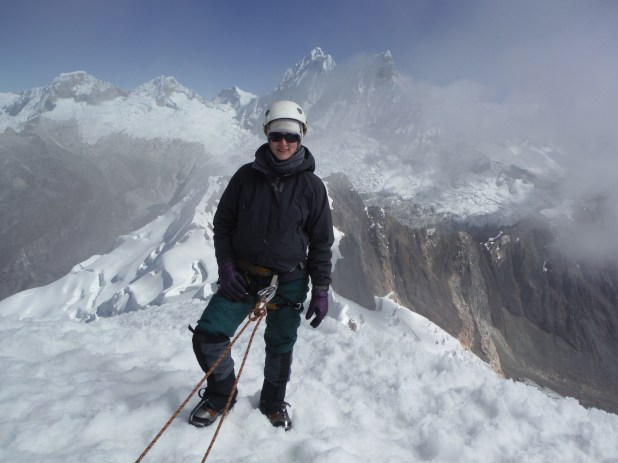
I went to Peru to experience other mountains. I need mountains, having left Seattle to live in Missoula. I wanted to meet someone else’s mountains, so I trekked over a couple in the Andes and Cordillera Blanca. My guides shared their culture and reverence for nature in a mixture of English, Spanish, and Quechua. But walking was familiar. Arriving at the end of my trip, I realized, terrified, I am going to climb a mountain.

When we begin, the sky is dark. Dark enough to see the swath of pinpricks composing the Milky Way – without my contacts in! The ground is dark too, save for the round white beams emanating from our headlamps. Yana, Quechua for “black,” I learn. For twenty minutes we clamber over rocks in our moonboots, following the trail marked only by occasional rock cairns and the dirt of rocks crushed by those who’ve passed before. Today, I lead.

Reaching the glacier, we clamp on our cramp-ons and unhitch our pickaxes. Our guide scrambles up the ice face to set an anchor. “On belay!”

Hours of slow steps across thick, frozen snow follow. The altitude gives some of us stomachaches, others headaches, and makes our breathing heavy.

A bright light shines over the edge of a nearby mountain. Sunrise? But it is only 3 am. The moon reveals itself fully, outlining the enormity of the mountain.

My feet barely pass each other with each step. One of my partners does not feel well either though, so my pace suffices. We keep our heads down, sights set on following the pre-existing footprints that keep us on trail. By halfway, sunrise imbues the snow with a soft glow.

Here we rest. I cannot stomach food so I down a juice box. I try to keep my eyes open. My friend does not feel well at all. The summit may be a lofty goal for us. Our guide points to some hills, two-thirds of the way.

“If you cannot go any more, just say so and we can turn around,” He says.
“Let’s go there and then chat,” we decide.

We never had that chat.

Slope after slope rises in front of us. The severity of the steepness overwhelms me – how can I climb this? “Zero!” I call, as my heart climbs into my throat and my eyes well with tears. If I can just compose myself… I close my eyes for a moment. I am afraid. Yes. But, I have made it all the way here. “Clear!”

By the last ice wall, immense, we are too close to give up. Despite dwindling strength, we pull ourselves up twenty meters. We each collapse at the top of the wall, only to be roused to our feet. We are not there yet. With the guide tugging on the rope, I struggle to crawl up the last bit. I gave up hours ago on reaching the summit. I only agreed with myself to take the next step, the next hill, the next traverse. Now I’m here.

“You made it!” a friend at the top exclaims. “I didn’t think we would,” I mutter. I wanted to let the mountain beat me, but my team’s encouragement refused. They gave me the courage to lead, to bite down my fear, to remember the skills at my disposal to evade all the danger and thoughts the mountain threw at me. Laying on my pack, I cry at my exhaustion, my upset stomach, my aching limbs. I cry because I did not have faith in myself and yet I still succeeded. Pagcha, or paccha, Quechua for “waterfall,” I remember, making my own. I feel intense respect for Pacha Mama, Mother Earth, and what she can do for or to us.

The peak is beautiful.

Meandering through Morocco

My name is Julia Maxon, and over the summer I had the unique opportunity to intern abroad for a women’s empowerment organization in Rabat, Morocco.

When I first arrived in Rabat, I remember peeking through the faded curtains in my hotel room watching as the city moved fast below me. Blue petit taxis zoomed by trying to pick up their next rider, restless people were trying to squeeze onto the crumbling sidewalks just to shuffle past one another, and older men lined the crowded buildings below trying to take it all in just like me. It seemed as though this city stopped for no one, and I felt afraid to throw myself into the mix. As I peered out and looked at my surroundings, it all just felt overwhelmingly unreal. How could I be in Montana one day and Morocco the next? How could I be 5,250 miles from home? 5,250 miles from the ones I loved?

19748503_10209468208772072_4866088758518383550_n

(Pictured: My first view of Morocco)

As weeks passed, I grew accustomed to the medina where I resided, which is the oldest portion of the city before the French colonized the region. The initial maze that was laid out before me felt increasingly more manageable each day. My loving host family was one of the main attributes that made me feel the most welcome throughout my entire experience. My host mom, Saana, especially always made sure I had enough food to fill my belly until I couldn’t eat anymore, and had a pot of mint tea always ready.

While in Morocco, I was also incredibly lucky to be able to experience Ramadan. Prior to my arrival, I had never fully experienced Ramadan or the traditions and culture associated with it. It was captivating to see how Ramadan took form in a predominantly Islamic nation. It was beautiful to see families like my host family preparing iftor, or the evening meal that breaks the daily fast, each night for people in the medina who didn’t have as much. It was moving to hear the evening prayer call echo throughout the streets of the medina, and to see so many people come together in an act of peace.

19756911_10209468203811948_1179240224108977840_n

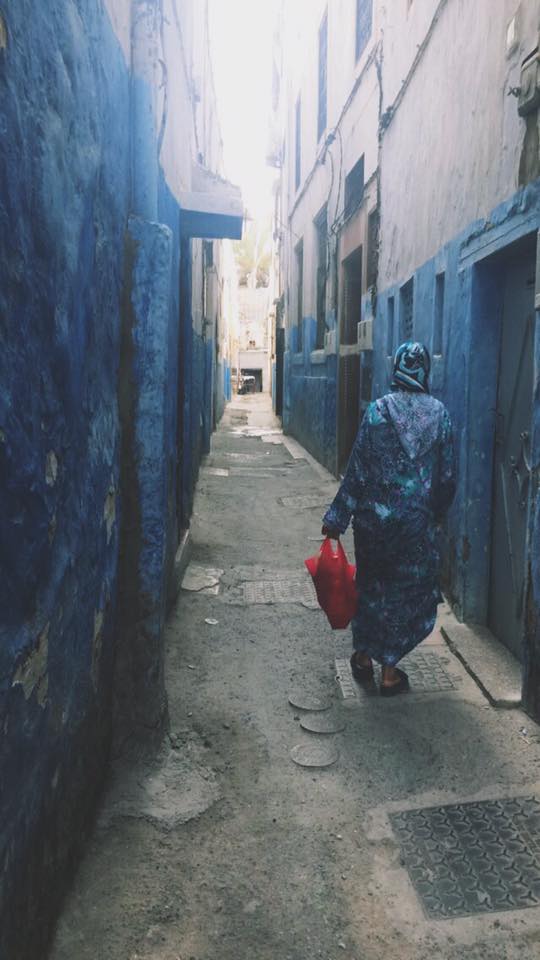
(Pictured: My host mom, Saana, leading the way home through the medina)

Morocco is a beautiful country filled with so much life and so much love, but like many other nations, it has its faults as well. As a GLI student, I was interested in looking at social inequality and human rights, or more specifically how the individual, community, organizations, and public policy come together to contribute to the inequalities women face in Morocco. The organization I interned with was a nonprofit specifically interested in the socio-economical development and empowerment of women in the Saharan region of Morocco. During my internship, I facilitated the NGO’s social media and social marketing department on various projects aimed at promoting and furthering the efforts of multiple couscous cooperatives throughout the Saharan region to improve its members’ quality of life.

By being able to have this experience, I was able to learn more about women’s rights in the Middle East, and create a proposed intervention plan based off of the needs that women in rural Morocco vocalized. I wouldn’t trade this experience for the world, as it helped give me a broader perspective on women’s rights and human rights in a global context.

A few days before I was to depart from Morocco, I returned to that little hotel on the corner where I watched the world move before me. However, this time, I sat below with my back against the cement wall, studying the street move idly by.

This experience gave me a sense of renewed confidence that I could take on whatever life throws at me. Whether that be venturing out into a world where I may not necessarily know anyone nor speak the common language, or hopping onto multiple trains traveling solo to destinations unknown. By escaping my comfort zone and throwing myself in, I was able to experience endless possibilities and pursue unexpected adventures that I will never forget. ~

19059051_1775744995785947_877865961425579413_n

(Pictured: Me ready for my next adventure!)


A Year in Spain

During my third year at the University of Montana, I studied abroad in Málaga, Spain, a smaller city on the southern coast in a province called Andalucía. My experience was filled with ups and downs, challenges, and growth as well as unadulterated fun. My global theme and challenge is Culture and Politics. Living in Spain and traveling throughout Europe, I was lucky enough to meet friends from Spain, Portugal, France, the Netherlands, Germany, England, Ireland, Poland, Italy, Greece, Turkey, Austria, Hungary, Belgium, Denmark, Sweden, Morocco, China, South Korea, Argentina, Mexico, Colombia, and even other Americans. By interacting with cultures from across the globe, many of them completely different from that of the United States, I was exposed to cultural differences that opened my mind and challenged my perspective on life. I also noted similarities between myself and everyone with whom I interacted, and felt connected globally to other human beings, without regards to nationality or upbringing. Learning Spanish was also an incredibly humbling and eye opening experience. I immersed myself in the Spanish language and was able to gain so much understanding about the culture through speaking and listening to the language itself. This highlighted, again, both differences and similarities between Spanish and American culture. I also learned to be humble and listen more than I speak – at first because I couldn’t say much but by the end because I found value in listening to others before seeking for my own voice to be heard. I was exposed to countless different cultures and I was able to find a connection with nearly everyone I met, whether it be over something superficial or a deep, lifelong connection. As a leader, I believe it is important to listen to others and find common ground, while having an open mind and an understanding heart. Through living in a completely unfamiliar world I was able to hone in on these skills and develop them each day through different social interactions with new people. My experience abroad was never completely perfect – my computer, passport, and many other things were stolen, I struggled to find close connections at first, I was homesick and frustrated with Spanish culture at points, but the struggle is what makes the incredible moments stand out, and the experience so life-changing. My thirst to travel and experience new cultures, eat different foods, and meet new people has only grown stronger over the course of the last year, and I can’t wait to see how my cultural connections grow and change and to foster new ones as I use the skills I learned in Spain to explore every corner of the world and capitalize on new opportunities to see where life takes me.

Nasdaq Summer Internship

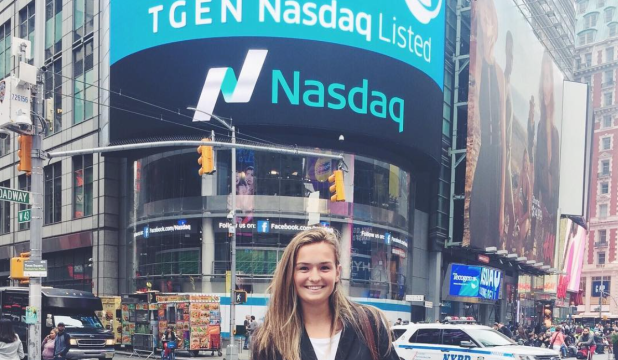
This summer I interned with the Nasdaq Futures Exchange in Chicago, Illinois. My theme is Technology and Society and my Global Challenge is: how can organizations harness technology and data.

The past few years the growth of technology in our world has been apparent and fast moving. Almost everything can be connected with technology.  To remain competitive in the marketplace, and keep up with competitors, organizations must figure out a way to harness the power of technology. Interning at Nasdaq this summer helped me learn a lot more about my global challenge because Nasdaq is a company that has already begun to harness the power of technology. Nasdaq has created technology that powers the world’s market operators, clearinghouses and regulators, the building blocks of the global financial marketplace. In all of my experiences this summer, I learned about the diverse factors that come into play when harnessing technology.

For my specific job, using technology to automate daily reports was tremendously beneficial for running an efficient exchange. I took on this project and went above and beyond what was asked of me to create a keyboard shortcut to cut down on time and to automate my daily report. By far my most memorable experience was being successful with this automation project and being able to leave a lasting impression with Nasdaq. I took this experience to learn as much as I could about the futures industry and all that I could about using technology as a tool so I could play a beneficial role in our product development team.

Working in a corporate office is a much different environment than any I have experienced before. This experience made me more independent and confident as a person, as I was thrown into challenging situations and made to problem solve and think on my feet. I feel as though my leadership skills have grown because of this experience, because I had to be accountable for my own work and manage my responsibilities while working cohesively in my team. I am pleased I was able to learn about the corporate environment while gathering useful information to take back to my GLI team in the fall!

Having this experience not only prepared me for a job after college but it also gave me great insight on a global company’s daily operations and how they use and continue to unite technology and data. I am so grateful for this experience as I was offered a full time position post-graduation! I am appreciative to everyone that made my summer internship possible and for those I met throughout my involvement with Nasdaq. My GLI out of classroom experience truly was life changing and has launched my future career!

Lost in Japan

IMG_1757.jpg

  I had a lot of expectations and plans for my time in Japan, but I never imagined  that I’d find myself in a tiny house in an abandoned village in Fukushima, singing karaoke with an elderly man that I had just met. He didn’t speak English. I didn’t speak Japanese. But when we finished singing “Hey Jude” by the Beatles, he gave me a huge smile and a thumbs-up and said “Good”. I said “sugoi”, which I think means “great!” or “amazing!”. It was one of the few Japanese words I could remember.

  I had been planning and dreaming about this trip for almost a year. I had a meticulous schedule and budget for every day that I would be there. I studied flashcards of Japanese survival phrases. I even made a map of all the places I would go. The trip was part of an international journalism class that I had with 15 other journalism students and two professors. Our plan was to write and report stories about people that were affected by the 2011 earthquake, tsunami, and nuclear meltdown. Each of us were assigned a story to focus on. Mine would be about how fishermen, the ocean, and Fukushima’s fishing economy were affected. I spent most of my time reporting in a fishing village in Fukushima and had the chance to interview several fishermen about their experience.

  It was was one of the most educational experiences of my life. I learned more in one month than I could have learned in a semester-long lecture class. I learned the most, though, when things went wrong and I had to veer off of the original plan. My maps and flashcards frequently failed me. Whenever I got lost in Japan, without the group or a translator, something magic would always happen. I would find myself laughing with strangers as we tried to use wild hand gestures and facial expressions to communicate with each other. I once got lost and ended up being physically pulled into a temple by a woman who wanted to show me how to perform a Buddhist prayer. Another time, I was dragged into a group of drunken Japanese college students who wanted to light fireworks with me to celebrate the beginning of summer.

  That night was one of the strangest and most memorable nights of my life. At the last minute I volunteered to write a story about a man who leads “darkness tours” of a small village in rural Fukushima that was abandoned after the nuclear disaster. I went to the village with two other students. Before we even talked to the man, I had the story all mapped out in my head. It would be about this village, frozen in time after people fled after nuclear disaster and about how this man found a way to profit on that by offering scary tours.

  When we got there, though, the experience was much different. For the tour, he just took us to his friends’ houses. Over the years since the disaster, he became close with the few remaining people in the village. When I asked him why he was taking us to see his friends as part of a “darkness tour”, he confessed that he just loves his village. He hoped that by offering tours, he could convince outsiders that Fukushima was not a nuclear wasteland. He wanted us to see that it was actually a beautiful forest and some friendly people still lived there. I didn’t have a plan for this kind of story.

  He drove us to a tiny house on top of a hill, where his friend greeted us at the door. He explained to us that his friend’s name was Hiroshi and he was a great singer. Hiroshi had a karaoke stage and microphone set up in his living room. He sang us a beautiful song in Japanese and and then asked us (via a Google Translate)  if we wanted to sing with him. We shrugged and agreed.

  While we were in the middle of singing the chorus in this man’s tiny living room, I asked myself “What am I doing here? This wasn’t part of the plan. How am I going to explain this to my professor? How am I going to write a story about this?”. I started to laugh and sing even louder because the situation was so bizarre. I forced myself to accept that the story I had planned to write wasn’t going to work out. After the song was over, we made a traditional Japanese dinner with the men we met in the village. We asked each other questions all night via Google translate. We laughed and ate a lot. It was wonderful. I learned last night that it is okay to let yourself stray from your plans and expectations.

A Semester in Ireland

kurtThis spring I studied abroad in Cork, Ireland. I lived in the city and attended UCC Cork. My experience was, in a world, incredible. Having been born and raised in Montana, I was completely unprepared for living in an urban city halfway across the world. Still, studying abroad was the one thing that I absolutely wanted to do in college, and I am extremely grateful that it was possible. As part of the GLI program, I have a unique theme and challenge that I wanted to research. My goal was to examine how international policy programs can effectively fuel environmental protection efforts.

Cork is fortunate enough to be one of the multicultural towns in Ireland. I was able to meet and become friends with several French, Italian, Spanish, and (of course) Irish students over the course of the semester. I was also been fortunate enough to travel across Europe at various points throughout the semester, which has helped me discover just how diverse and complex the world is. I’ve had conversations with my Portuguese roommate about the refugee crisis, witnessed a march against Brexit in London, and was part of a rally for science outside the Pantheon in Italy. More than anything, during my time abroad I’ve been made aware of how little I really know about the world. I’m forced to wonder how to best spur international cooperation on the issue of climate change. The problem doesn’t have an easy answer. However, I don’t believe it is impossible to solve the problem. There are a variety of small steps many countries have taken to work towards lessening carbon emissions. One of the major bus companies in Germany, for example, gives customers the option to pay a small amount more to purchase a carbon-offset for their bus trip. The extra money will go towards funding programs in Germany or developing countries that promote more sustainable business practices.

I also took the time to do some independent research and observations on climate change and environmental efforts in Europe, as was a part of my goal when originally coming here. Ireland has several areas where policies and regulations produce excellent energy results. Recycling is more prominent in Ireland than America, for example. Regarding my challenge, I’ve realized how difficult it is to communicate the causes and effects of climate change. Raised in suburban Montana, I took it for granted that people were at least aware that greenhouse gas emissions are a long-term problem. Since travelling, I’ve realized that this is not always the case. We should take greater efforts to not only combat the problem, but also to improve general awareness of the issue. In the U.S. especially, recent discussions over current political actions and environmental leadership have convinced me that there is a need for action. We will need political support in order to make any meaningful progress in slowing human-caused climate change. The European Union has enacted programs such as the Carbon Emissions Trading Scheme in an effort to reduce overall emissions without damaging the European economy. Norway, as well, has contributed substantially to REDD, a program designed to reduce emissions from deforestation. I believe that we in the US can emulate these political actions. However, in the current political economy, it will take substantial pressure from grassroots organizations and corporations to progress towards meaningful change. I feel that as a result of having studied abroad and talking to so many different people I am more ready to take action in local and national efforts. We have many challenges to tackle, but taking action begins with efforts as simple as having conversations about the topic.

I feel that my time spent abroad helped to widen my view of the world. I remain amazed at the many achievements so many people I met abroad have met. I spoke to one man who was hitchhiking across Europe so that he could teach in Iran. I saw pictures of a mural one refugee painted after years spent seeking a new home in Scotland. And I hope that I can achieve a fraction of what these incredible individuals have done.
Thanks for reading.
Kurt Swimley

Living in Italy: Life on the Farm

Day 1:
I arrived here at the farm about midday and I was soon greeted by the entire family. The Acetia Malagoli Daniele, named after the father Daniele Malagoli, is a small family run business managed by their eldest daughter Sofia. The family of four and their grandmother live in a beautiful yellow house in the countryside along with a herd of donkeys, several sheep, an army of chickens, a cow named Rosa and a few peacocks. They greeted me with open arms and showed me to my room for the next two weeks.

I met with the other volunteers at the farm, Sabine and Floris from the Netherlands and Anna from Australia, they promised to show me the farm tomorrow along with how to feed the animals and some other daily work. Tonight, however, Daniele had asked us to pick cherries at a nearby farm so that Barbara, his wife, could make some jam and cherry liquor. So off we went, the five of us packed into the back of an old car equally entertained and terrified as Danielle drove about 80 mph down country roads while singing opera in his deep baritone voice. We did survive and returned home with about 75 pounds of cherries. (This is not an exaggeration, we later had to pit all of them and it took several hours over the course of two days.)

Though I have only been here a day I can already see how much the Italians value their food, not just the recipes but also the ingredients. We all eat dinner together, with the ten of us seated around a table piled high in pasta and fresh vegetables. We talked about the differences in cherry names and what you use each kind for, today we picked large sweet cherries that are best for eating raw or cooking down into jam.

Day 2-5 The art of faccina and more cherries:
The past few days have been a whirlwind, I learned how to feed and water all the animals on the farm, how to pit a couple thousand cherries (by hand) and the ‘art’ of faccina. Now what is faccina you might wonder? Several days before I arrived the other workers helped to trim the vineyard, after feeding the leaves to the goats the remaining sticks were loaded onto a bigger pile of sticks and that where our new job starts. In the mornings before the temperatures climb into the 90’s we break the sticks down into usable sizes and then bundle them. In all seriousness faccina, or creating bundles of sticks, is an important part of making balsamic vinegar. The sticks help create the fire that the grape juice is cooked over eventually turning it into a thick sugary liquid that is then aged into vinegar. The work is quite monotonous but it has been good to spend time getting to know the other workers, talking about international politics and why we all decided to work here.

Flo (Floris) and Sabine, are taking a few months off work to travel. They have spent the last few months in Southeast Asia and decided to spend their last month away from work volunteering and learning some new skills on the farm. Anna, a graphic designer, just finished her work in Germany for Adidas and wanted to take a break from normal city life while she looked for new work. They are a really great group of people all with different strengths and experiences working and traveling abroad.

Today was also the final day of pitting the cherries and I am really happy it’s over. Tomorrow Barbara, Danielle’s wife, will start making the jam and other sweets. Now we will start preparing for a large tour of cyclists coming on Saturday. The Acetia offers a tours to a variety of different groups. Sofia manages all of the public relations for the family, and has really turned her family’s passion for vinegar into a business. The family used to make balsamic vinegar as a hobby and give what they made away to friends and family. (This sounds a little crazy when you realize that the family has at any given moment about 700 barrels of balsamic vinegar.). Sofia decided to turn the family hobby into a business and has since expanded their product to several different countries. Barbara however does the majority of the work. She is the one in charge of making the vinegar, bottling the vinegar and maintaining a high quality product. She is incredible.

Day 6
The cyclists came today, what we expected to be around 200 people ended up being closer to 50 because of the heat. The next few weeks are going to be hot as a huge heat wave moves through Southern Europe. It was a little disappointing not having a big turn out but it was never the less a good event. In the morning we helped set up tables, prepared food and cleaned the yard. It was also the first day I got to go into the acetia.

The acetia is actually located right above my apartment (thankfully my apartment doesn’t smell like vinegar). Walking into it you get hit with this overwhelming smell of vinegar, it’s not bad but it definitely grabs your attention. Inside all the walls and floor space is filled with vinegar barrels, some of them almost 200 years old. The sizes range from wine barrel to bread loaf. In the process of aging the vinegar you move the vinegar from largest to smallest barrel, the smallest barrels are at least 25 years old and contain the most expensive vinegar. While in the acetia Sofia gave the cyclists a tour and I aided in passing out samples. She talked about the aging and production processes and the importance of following the traditional method of balsamic vinegar production. In Italy balsamic vinegar that follows a strict traditional production method is labeled with D.O.P., meaning it is only made with cooked grape juice grown in a specific region in Italy and aged in wood barrels without any artificial additives. Vinegars with the D.O.P label are considered to be some of the best in the world.

Day 7-12
The last few days have been hot, really, really hot. We moved an old bathtub into the yard and have been using it as a swimming pool. Whenever it’s too hot to work we fill it with the hose and sit in it for a few hours. Beyond that things are going well (with the exception of the peacocks who decide to sit outside my window and scream for all hours of the night. If we get to choose what animals get eaten next I’m choosing peacock). In the mornings we feed the animals and over the last few days have done quite a few odd jobs. Moving hay bales, moving chickens, finding new chickens and putting them in the incubator, stoning about 50 lbs of peaches, and splitting giant logs are a few of the most memorable. Today Anna found several newly hatched and abandoned ducklings (we think a fox got onto the farm the other night because several of the birds abandoned their nests, these eggs hatched from the heat. It’s really hot here). Anna has since adopted the ducklings, they have imprinted on her and now accompany her in our daily chores.

We have moved into the vineyard and have started to prune more of the grape vines. It’s fun work and very rewarding when you finish a row. I am feeling very thankful to have been given the opportunity to travel and to find myself in the company of so many talented and kind people, not to mention this beautiful landscape. I am really enjoying staying with the Malagoli family, all of them are very kind and personable people. Barbara has been teaching us about traditional Italian cuisine and showed me how to roll tortelloni, Danielle has been helping us to finish some of the wood cutting. We actually managed to break an industrial wood cutter that Danielle designed because the wood was so hard. Taisia their youngest daughter has been hanging out with us a little between studying for her final exams next week. It feels like I am part of the family.

One very memorable thing that happened the other day was that I met an Oscar winner, Roger Ross Williams. About three days ago Flo was whisked off by Sofia to accompany her on some ‘errands,’ so he got to go and tour cheese and meat factories with the Oscar winner for best documentary. All of us working at the farm were invited to go and see a screening of his movie Life, Animated, in Bologna. So the four of us hopped into Flo and Sabine’s car, drove to Bologna and then met Roger at the movie theater with his friend and guide Lucas Tabareli, a local pasta maker and entrepreneur. I highly recommend Life, Animated, it was a beautiful and touching story that I won’t go into detail about here, but you should watch it. Afterward Roger took us out to the film festivals after party as his ‘official entourage.’

Day 13
Today was weird. A good weird but I’m still working out the details in my mind. So the morning was as usual, fed the animals drank some espresso, nothing too crazy. But then Sofia mentioned that there was a street party in a nearby town and all of us were invited to go. We decided that it would be fun and agreed. Then Danielle asked us if we wanted to go to his friends BBQ and we agreed to that too. So come about 7 at night we arrive at Danielle’s friend’s house which was in a beautiful and kind of secluded, forestry area. Things are good, everyone is socializing, eating and then they lighted a large bonfire. Apparently we agreed to go to a pagan summer solstice celebration and before I knew what was going on I was covered in sage smoke and jumping over a fire and rolling dice to help me decide what I would accomplish in the next year.

Then we went to the street party at about midnight. It was a completely different world from the solstice festival. Loud music, people dancing, strobe lights and some really crazy outfits. We hung out for a few hours and then made out way back to the house. Upon arriving home we were scared by a peacock hanging out in a tree above us like a ghost from a horror movie. Like I said, it was a strange day.

Day 14
Today is my last day here and I am sorry to go, it has been such a great experience getting to learn about agriculture in such a small and intimate setting. I feel like I have learned a lot about Italian culture, food and various international perspectives on farming, politics and what it means to be connected to one’s cultural roots. On my last day here Anna and I headed out into the vineyard with her ducklings to trim some of the plants and then had a great lunch with the family. I have a new appreciation for traditional food products and quality food. I have always loved cooking but being in Italy has taught me about the history behind their food and why it is important to keep alive these century old traditions. Food is the glue that holds Italian families together, everyone is involved in either cooking, eating, cleaning, shopping or making something that contributes to the meal.

I am incredibly thankful for the Malagoli family for this experience. Now I leave for Spain to do a month long course in Spanish in Almeria, Spain. Thanks again to everyone I met in their past month, you all taught me so much!