
Sláinte! My name is Sophia Mahoney, and I am a junior majoring in Earth, Water and Climate Sciences, with a minor in Wilderness Studies. For my Beyond the Classroom Experience, I spent part of my sophomore year studying at the University of College Cork (UCC), in southern Ireland. My global theme is Resources and Sustainability, which I was able to study in a past ecological context. Rather than look at resources and sustainability from a current perspective, I took classes focused on paleoecology, palynology and paleoclimatology. Here I studied the ecology and past abundance of vegetative species across Ireland, past climatic events and how they impacted resources without human influence, and how those resources were then managed as human settlers arrived. We looked at vegetative composition dating back to the last glacial maximum, the distribution of trees in comparison to shrubs and grasses, and how that composition shifted as human settlements spread. By studying how these shifts occurred in the past, we gained insight into how resource management could progress and be managed in the present.
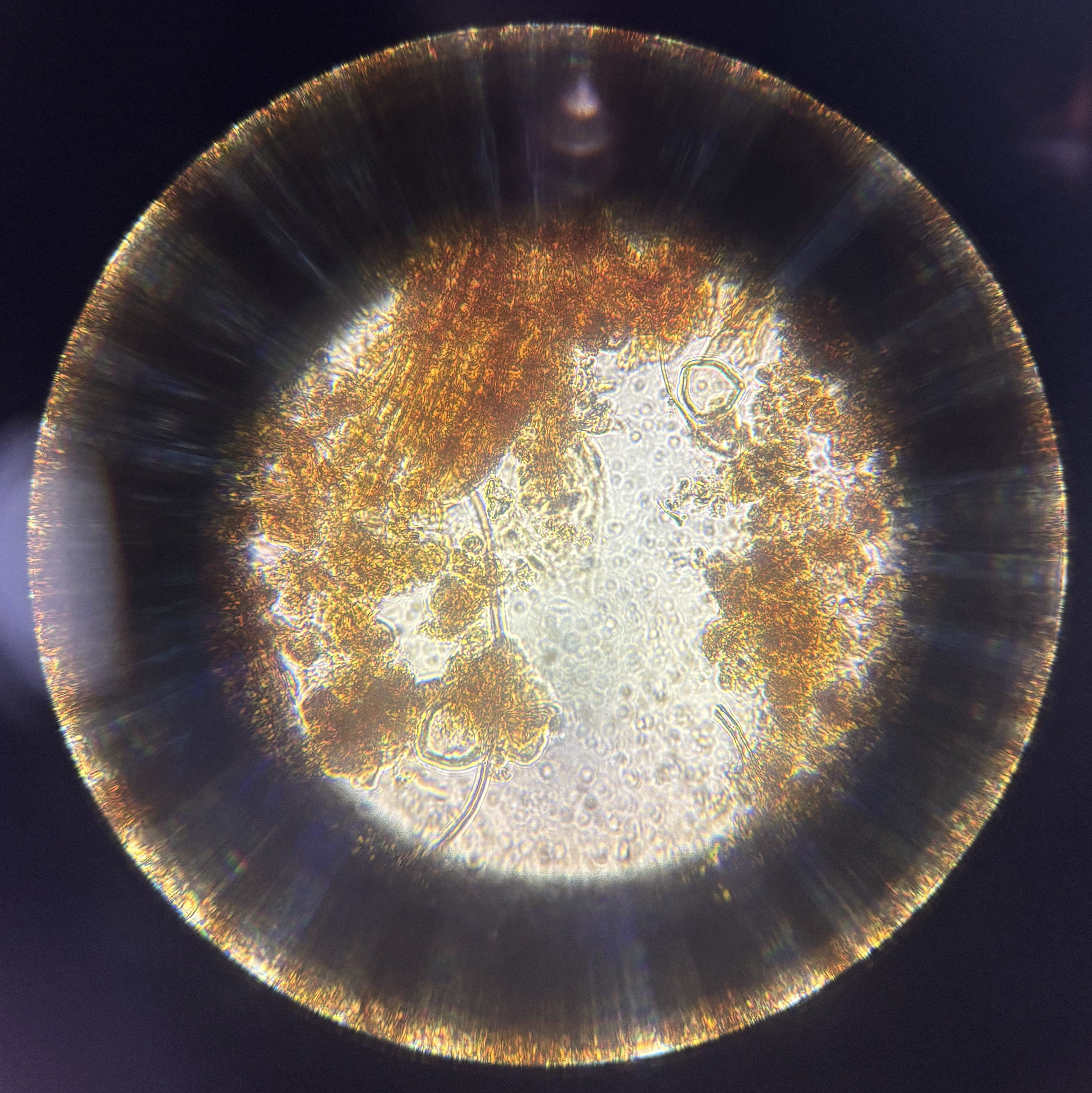
A live sample from Irish peat, when doing pollen count analysis for historic native vegetation composition in the area. Two betula (birch) grains are visible.
In addition to the courses I took at UCC, I spent a lot of my time traveling and hiking, to see less traveled parts of the country. One of the most interesting things for me was learning what was considered to be native, or “wild”, from an environmental standpoint. I had completed my Wilderness Studies minor the semester before, which focused on wildland management in the States. In the case of Ireland, the strawberry tree is considered both an introduced species and a native one due to how long it has existed on the island. It is believed to have been brought over about 4,000 years ago from the Iberian Peninsula. Likewise, hazel is considered a wild native plant, but is nowadays more commonly found almost exclusively in hedgerows, as a large amount of it was harvested by early settlers. Ireland is called the Emerald Isle, a name earned from its extensive coverage of grass fields. Though pre-settlement Ireland was around 80% covered by native trees and woodland, now less than 1% of the island is wooded, most of which is a non-native species that have been planted for timber production.

Over 70% of the country of Ireland is now farmland; you can see cleared farmland bordered on the upper left by homogeneous conifer plantations.
I spent half of my spring break backpacking through the Scottish Highlands in Cairngorm National Park, considered to be one of the last wild places in the British Isles. Everywhere I turned, I saw that the park had been stripped and hunted of most of its natural resources, from the trees that were removed during the world wars, to the native deer populations hunted for sport by local communities and nobility alike. In both cases, it allowed me to take a step back and look at how historic resource removal became so commonplace that now that these places lack most of their resources, it is considered normal, wild, and beautiful. What does this mean for other places natural resource extraction? Is the reasoning that something else will replace it, like in the case of Irish woodlands to farm land, an acceptable answer? These are some questions that I wish to explore further.
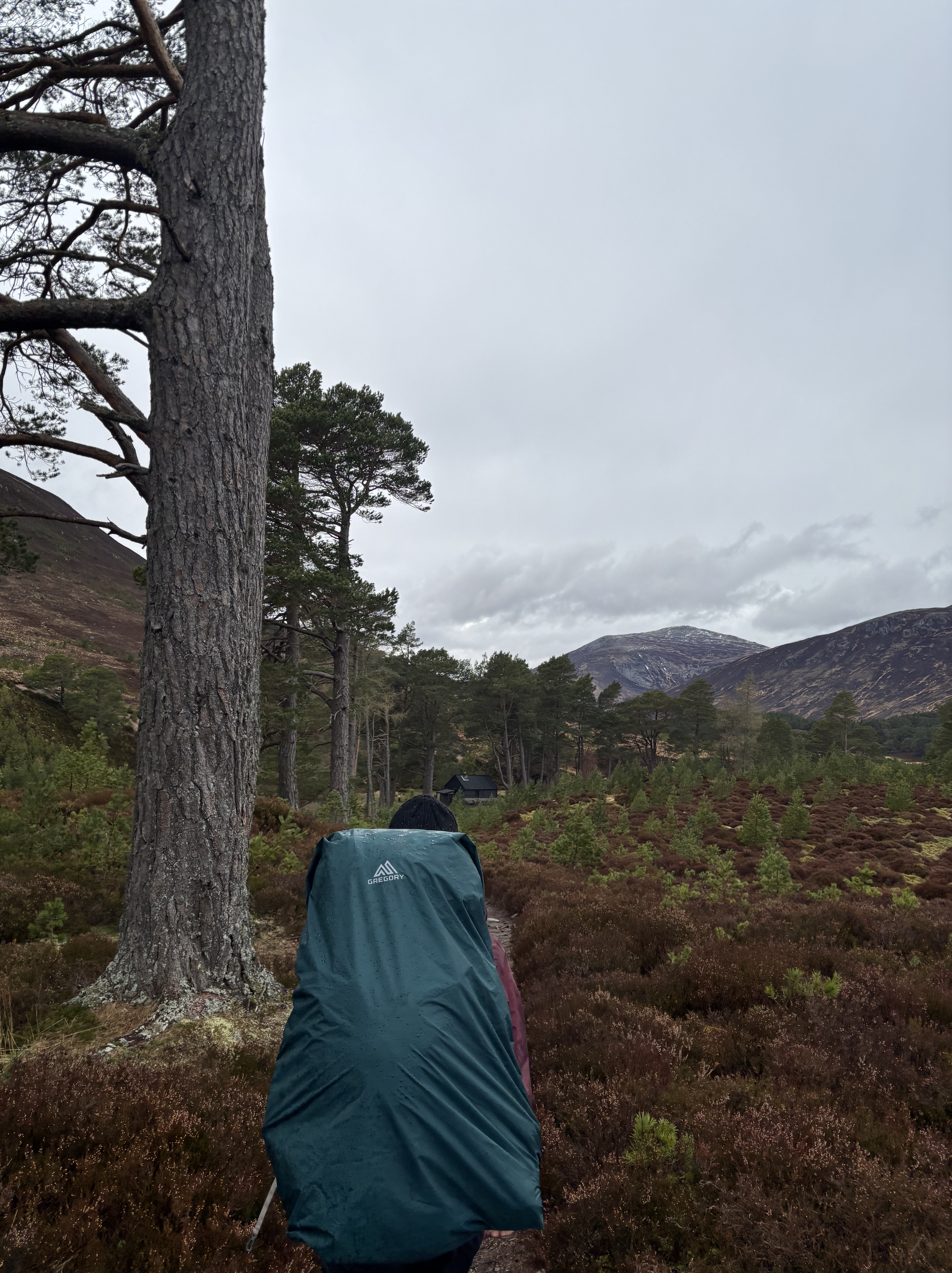
Hiking through a few remaining trees along the valley floor, with many smaller saplings starting to become established, you can see the bare hills in the background. Historically this would have all been forested by the tall trees on our left.

Looking down on the valley where a few lone trees can be spotted along the valley floor that have started to regenerate following the mass logging of the world wars and over consumption of natural resources. Historically, woodlands would have spanned up the majority of the hillside before the conditions would have become too hostile.
These questions and my learnings are building blocks of the whole of my education that I will carry with me forever. As I think back on the time I spent in Ireland, I think back on everything I experienced, all the people I met, and all the things I learned, and how I will carry every moment of it forward with me.
 Beyond the Classroom