
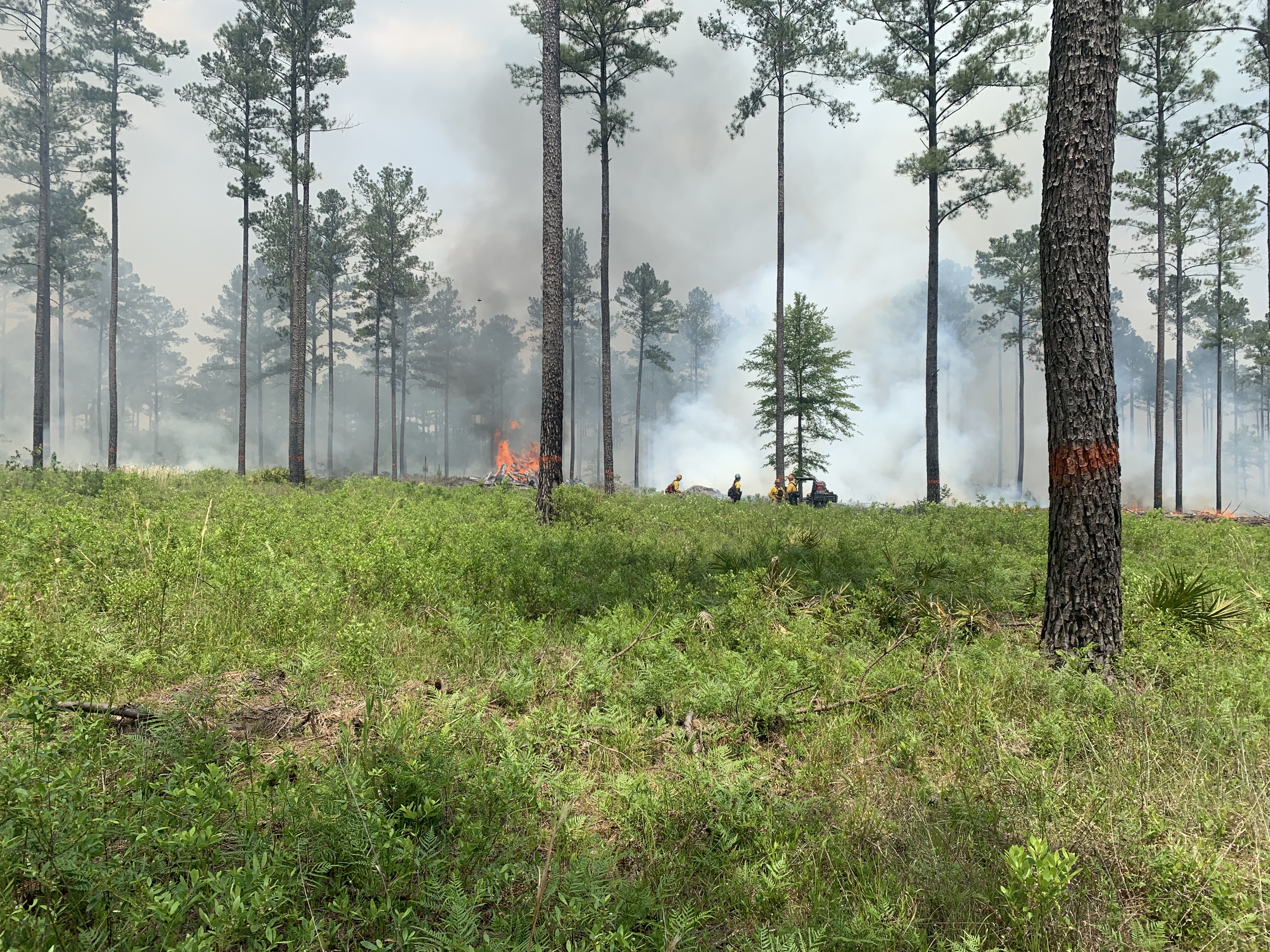
Imagine the birds are chirping, sounding like musical notes, cascading all around you. Above you, the trees are a vivacious green and insects hum from their trunks. Up ahead rises a column of smoke and a wave of flames bites at its heel. There is a trail of fire leading up to where you’re standing. You started the fire. And you watch as it burns through the blackberry bushes, palmetto, oaks, and pines.
Hi! My name is Jaiden Stansberry and this was my Beyond the Classroom experience. I traveled to Baxley, Georgia with the University of Montana’s Prescribed Fire Practicum. The class was led by three UM professors and one Montana Forester, in addition to six University of Montana students from varying backgrounds. We traveled to the Moody Forest owned by The Nature Conservancy (TNC). The purpose of the prescribed burning was to regenerate longleaf pine (Pinus palustris) stands, which need fire to develop. This tree was once the predominant species of the south, creating many essential habitats, but has since deteriorated due to reduction of fire to eliminate its competition. This experience offered a unique and hands-on opportunity to aid in the restoration of these species through prescribed fire. In addition, I was also able to build my own knowledge and leadership in wildland fire, a career that I have worked for the last two years.
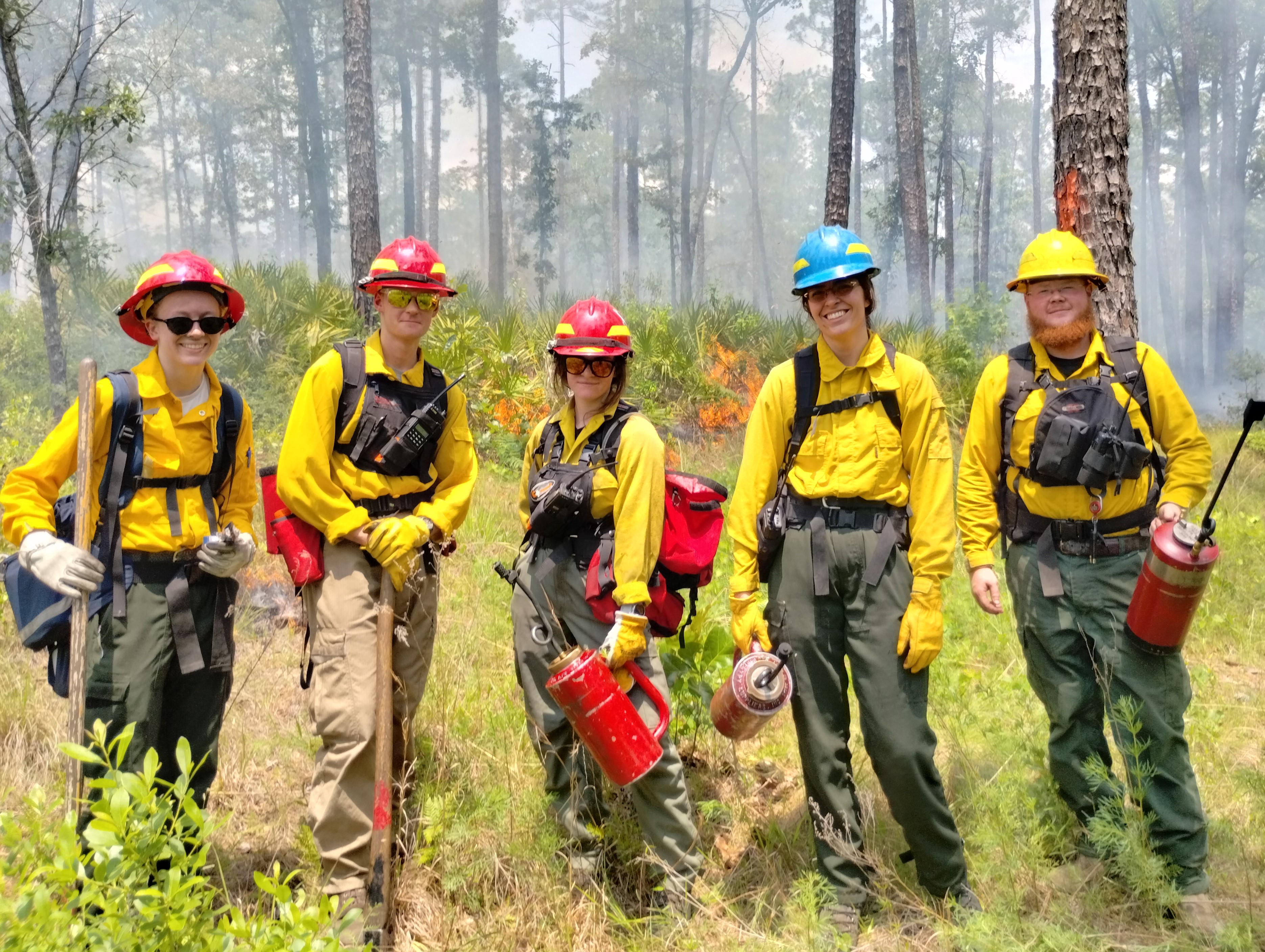
The class and I hit the ground running when we arrived in Georgia, waking up early the first day to burn 100 acres in 90 degree weather and suffocating humidity. Upon arriving to breifing, it was very apparent that this forest ecosystem was unlike any that I had burned in. The grass and shrubbery seemed green and unburnable and the relative humidity (RH) was in the 70’s (for comparison, the RH is commonly in the 20’s in Yosemite). A rattlesnake slithered its way from the unit and settled beneath the handtools laid on the road, welcoming the traveler’s from Montana. Once we were briefed, we began firing operations and to my surprise the greenery caught flame like it had been soaked in kerosene. This was just the start of many prescribed burns we would complete in Georgia.
Most days, the division of firing was operated by students, which allowed me to explore leadership roles in fire. Being relatively new to the fire world, I tend to listen to others with more experience and inquire to learn more, but in this environment, I was able to test my knowledge when telling others with less experience what to do. I felt that I got to use the techniques of leadership I learned in GLI last year when teaching others. I enjoyed sharing the world of fire to those that had yet to experience and share my knowledge.
The trip was not only compiled with amazing fire experience, but also the opportunity to explore the ecosystems of Georgia. There were a few days that the thunderstorms or wind direction prohibited us from burning. But these days were of no loss to our learning. One day we spent exploring the Moody Forest’s ecosystem of cypress forests and nests of Red-cockaded Woodpeckers. This species is directly affected by the decline of longleaf pine forests in the south as their resinous wood is preferred to build nests within. We also found the endangered species of Gopher Tortoise and explored the Okefenokee Swamp, one of the few Wilderness areas in the south, near the Florida-Georgia line. Other days, we assisted in preparing future burn units for TNC, which led to additional chainsaw and line-cutting experience.

Burning in the south was informative from a wildfire perspective compared to burning in the west. Wildlfire is given a very negative connotation in the west, because it is often associated with destruction of property and forests. Prescribed fire is also difficult to initiate, because there are many hoops that need to be navigated, like burn plans, smoke permits, and personnel to operate the burn. And many communities tend to be fearful of fire as they may have lost homes or property in severe wildfires. However, in the south, prescribed burning was openly accepted by communities. Oftentimes, if we arrived in an area to burn, the neighboring houses would ask us to burn their property or join us in burning. This perspective was wildly different than what I was acclimated to seeing. The support seemed to aid in the implementation of prescribed burning and allowed burning to happen more often than I have seen anywhere in the west. The lack of prescribed burning is an issue on a global scale, because as wildfires spread severely all over the world there is more of a need for fuel mitigation, like prescribed burns, to reduce severity. My Beyond the Classroom experience gave me a new perspective of how difficult prescribed burning can be to implement without the support of the community. This helped me to connect my theme of Resources and Sustainability to my Beyond the Classroom experience and see this issue on a local and global scale.

This experience has been one of my favorite opportunities at the University of Montana. The connections I made with my professors, peers, and coworkers are unforgettable. I developed myself in a career that I pursue and participated as a leader, strengthening that skillset.
 Beyond the Classroom